
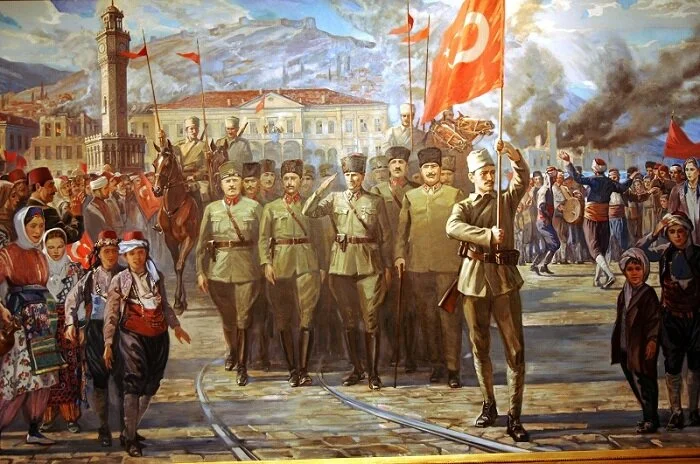
The Turks celebrate September 9 as the day of the liberation of Smyrna and the victory of the Turkish War of Independence. On this very day in 1922, the Turkish troops entered the city and two days later Mustafa Kemal with his staff.
The American writer Edward Bierstadt collected testimonies of his compatriots who lived through the events of Smyrna and described the situation in the city and its surroundings in detail. “The first to enter was dressed in black, wore black fez with a red crescent and a star. They were on horseback with long yatagans. With one hand raised, they shouted at the residents not to be afraid. However, as they were aware of the Turks’ reputation, the people of Smyrna were terrified. Turkish troops were parading in the city this morning and they started looting, raping and murdering on Saturday afternoon at 15:00, it is impossible to describe in words.”
In the city of Smyrna, the massacres started in the Armenian quarter of Saint Stefanos. The Turkish soldiers blocked all the quarter’s transport routes of the district with the rest of the city. The US Consul in Smyrna, George Horton, wrote: “The streets leading into the Armenian quarter were guarded by Turkish soldier sentinels. No one was permitted to enter while the massacre was going on. The most shocking moments of the tragedy occurred in the Cathedral of Saint Stefanos, where more than 4,000 people had taken refuge. The Turks asked the detainees to come out and surrender, and the Armenians, who knew the atrocities to be committed, refused to do so. They then came under fire and grenades, and the Turks invaded the church slaughtered and executed them. Those who survived were taken, per 100 people, to Konak Square where they were cold-bloodedly killed by the Turkish firing squads.”
Unlike the Metropolitan Chrysostomos, the Armenian Bishop Ghevont Tourian sought asylum in a Catholic ecclesiastical institution and secretly fled to the United States of America, where he was assassinated by Armenian compatriots on charges of treason.
Following suffocating pressure, Kemal Atatürk allowed to Greek and other ships to enter the port of Smyrna. The evacuation began on September 11 and lasted a week. On September 13, 19 ships entered Smyrna to save the world. A total of 300.000 refugees crossed into Greece.
The fires started from the Armenian quarter and quickly spread throughout Smyrna. American teachers and sailors talk about Turkish soldiers who poured into the narrow alleys of Smyrna holding cans of oil and kerosene, bathing houses, churches and catholic temples.
Out of the 46 Orthodox churches, only three survived. The arsons destroyed 3/5 of the area of Smyrna, leaving the Turkish quarter intact. The official position of Turkish historiography presents the fires as the work of the Armenians and Greeks themselves so that the Turks would not find their homes available to live in them.
The US consul, George Horton, had said that Kemal Atatürk could occupy Smyrna peacefully, without allowing and forcing his troops to extremities. Without raping, looting, murdering and fire. Just with a formal handover ceremony. In this way he would have won the trust of the people of Smyrna and the city would have maintained its dynamism and pluralism.
Horton was a man who had lived most of his life in the East. He loved Smyrna and felt it as his homeland. When he left, seeing the fire leveling his beloved city, he exclaimed, “I am ashamed to belong to the human race.”
Source: pontos-news.gr, Orthodoxtimes.com


