The ancient naval war between the Greeks and Persians stands as a testament to the clash of civilizations, shaping the course of history and leaving an indelible mark on the annals of warfare. This pivotal conflict, chronicled in historical texts and immortalized in legend, encapsulates the struggle for supremacy and independence in the ancient world. Delving into the depths of this maritime confrontation unveils a saga of valor, strategy, and geopolitical intrigue that reverberates through the ages.
I. Origins of the Conflict: 1.1. Historical Context:
Set against the backdrop of the Greco-Persian Wars, the naval conflict emerged as a pivotal theater of engagement.
The expansionist ambitions of the Persian Empire clashed with the resolute spirit of Greek city-states, igniting a struggle for dominion over the Aegean Sea.
1.2. Catalysts of Conflict:
The Ionian Revolt: A rebellion by Greek city-states in the Persian Empire incited Persian retaliation, triggering hostilities.
Athenian Support: Athens emerged as a staunch advocate for Greek autonomy, rallying allies to confront Persian encroachment.
II. Battle of Salamis: A Turning Point in History: 2.1. Strategic Significance:
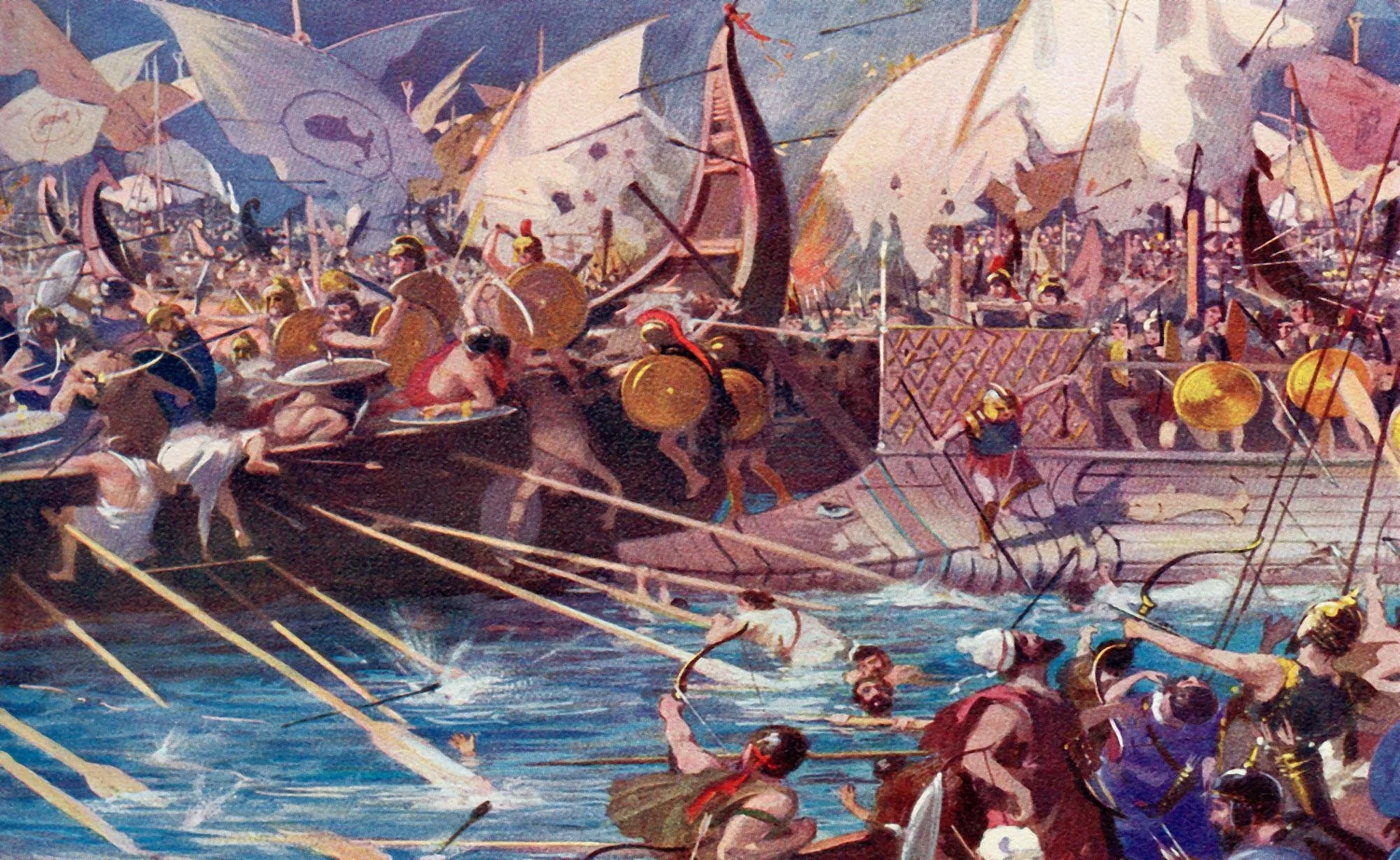
The narrow straits of Salamis provided a tactical advantage to the Greek fleet, nullifying the numerical superiority of the Persian navy.
Greek triremes, swift and maneuverable vessels, exploited the confined waters to devastating effect against the cumbersome Persian ships.
2.2. Leadership and Strategy:
Themistocles, the Athenian statesman and strategist, orchestrated a masterful plan to lure the Persian fleet into the treacherous waters of Salamis.
Utilizing deception and guile, Themistocles exploited internal divisions within the Persian command, sowing discord and confusion.
III. Naval Tactics and Technological Innovations: 3.1. Trireme Warfare:
Triremes, agile warships propelled by rowers, formed the backbone of Greek naval supremacy.
Coordinated maneuvers, such as the 'Diekplous' and 'Periplous,' enabled Greek vessels to outmaneuver and encircle larger Persian ships.
3.2. Fire Ships:
Greek ingenuity manifested in the deployment of fire ships, laden with combustible materials, to wreak havoc amidst the Persian armada.
These incendiary vessels, unleashed amidst the chaos of battle, inflicted catastrophic damage and sowed panic among Persian ranks.
IV. Legacy and Impact: 4.1. Preservation of Greek Independence:
The resounding victory at Salamis safeguarded Greek autonomy and thwarted Persian hegemony in the Aegean.
Emboldened by their triumph, Greek city-states forged a collective identity and pursued democratic ideals, shaping the course of Western civilization.
4.2. Cultural and Historical Reverberations:
The naval war between the Greeks and Persians reverberated across the annals of history, immortalized in literature, art, and oral tradition.
Herodotus, the "Father of History," chronicled the conflict in his seminal work, ensuring its enduring legacy for posterity.
The ancient naval war between the Greeks and Persians epitomizes the timeless struggle for freedom, valor, and the pursuit of sovereignty. Against the backdrop of turbulent seas and shifting alliances, the Battle of Salamis emerged as a defining moment in the annals of warfare, shaping the course of history and inspiring generations to come. As we reflect on this epic clash of civilizations, we are reminded of the enduring power of human resilience, ingenuity, and the indomitable spirit that transcends the ages.
Sources:
https://www.britannica.com/event/Greco-Persian-Wars/The-Ionian-Revolt-499-493-bce
https://en.wikipedia.org/wiki/Greco-Persian_Wars