The Far East of Hellas: The Greco-Bactrian and Indo-Greek Kingdoms
While many think of the Greek world ending at the Mediterranean, some of the most powerful and culturally fascinating Greek states existed thousands of miles away in Central Asia and Northern India. Born from the remnants of Alexander the Great’s empire, these kingdoms represented the ultimate frontier of Greek civilization, lasting for centuries in isolation from the Aegean.
1. Bactria: The Empire of a Thousand Cities
Bactria (modern-day northern Afghanistan and Tajikistan) was known in antiquity as a fabulously wealthy land. Around 250 BCE, the local Greek governor, Diodotus I, broke away from the Seleucid Empire to form the Greco-Bactrian Kingdom.
Military Might: At its peak, the Greco-Bactrian Kingdom was arguably the most powerful Greek state in existence, possessing a massive cavalry and a sophisticated military infrastructure that held off nomadic tribes from the north for generations.
Ai-Khanoum: This is one of the most significant archaeological finds of the 20th century. A fully-fledged Greek city on the banks of the Oxus River, it featured a gymnasium, a theater seating 5,000 people, and Doric columns—all situated on the border of the nomadic steppe.
Greek Art in the East: Bactrian coins are considered the finest of the Hellenistic world. They featured realistic, high-relief portraits of kings that surpassed even those made in Athens or Alexandria.
2. The Indo-Greek Kingdom: Crossing the Hindu Kush
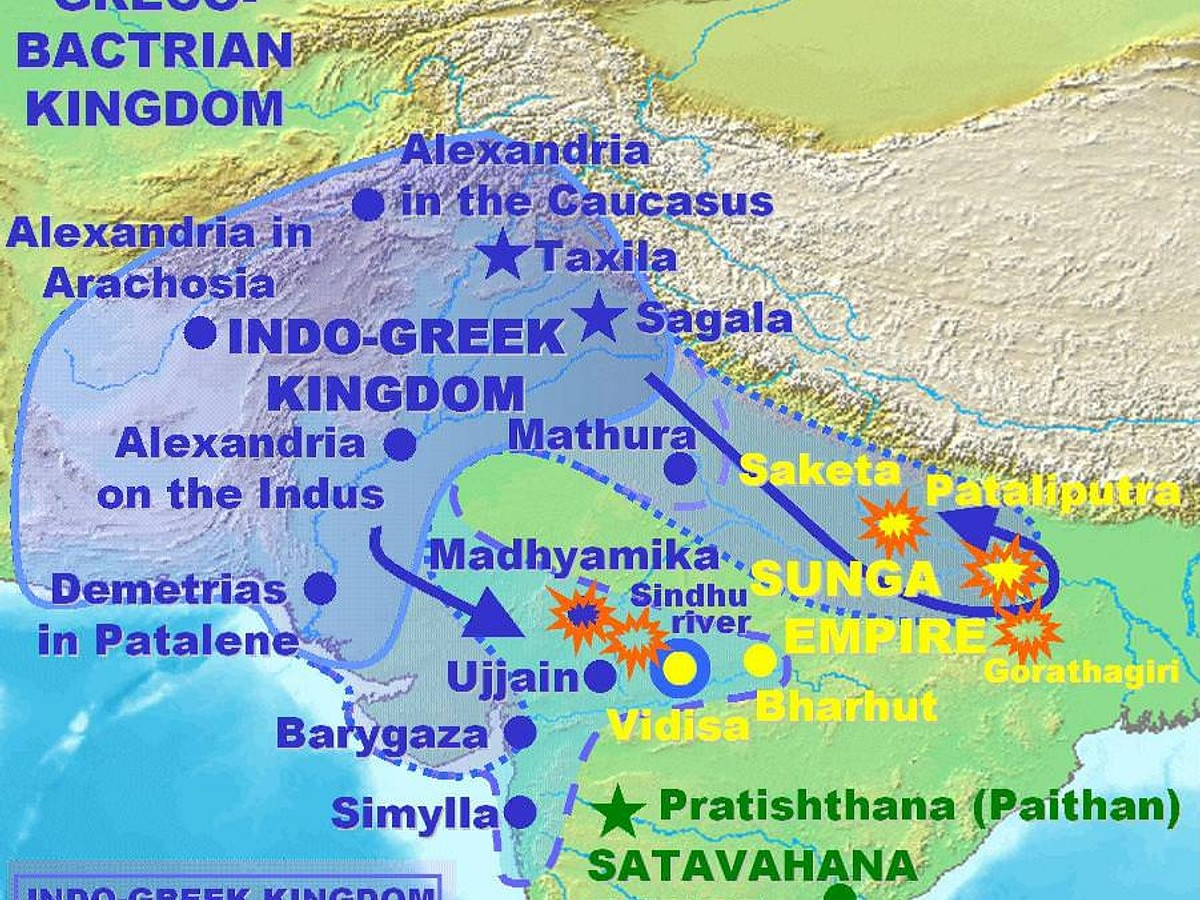
As the Greco-Bactrian power shifted, kings like Demetrius I launched an invasion into northern India around 180 BCE. This led to the creation of the Indo-Greek Kingdom, a fascinating "hybrid" state that stretched across modern Pakistan and northwest India.
King Menander I (Milinda): The most famous of the Indo-Greek kings, Menander ruled a vast territory and became a legendary figure in Buddhist tradition. He is the protagonist of the Milinda Panha ("The Questions of King Milinda"), a Buddhist text where he engages in a philosophical dialogue with the sage Nagasena.
A New Synthesis: These kings were the first to put both Greek and Kharosthi (an ancient Indian script) on their coins, signaling their rule over a diverse, multicultural population.
3. Greco-Buddhism: The Fusion of East and West
The most enduring legacy of these kingdoms was the birth of Greco-Buddhism. This was not just a religious shift, but an artistic revolution.
The Face of the Buddha: Before the Greeks arrived, Buddhist art was "aniconic" (the Buddha was never shown in human form). Greek influence introduced anthropomorphism. The first statues of the Buddha were modeled after the Greek god Apollo, featuring wavy hair, athletic builds, and heavy, toga-like robes.
Vajrapani and Heracles: In many early Buddhist reliefs, the Buddha is accompanied by a protector named Vajrapani. Curiously, Vajrapani is often depicted exactly like the Greek hero Heracles, complete with a lion skin and a club.
4. The Isolation and Fall of the Far East Greeks
The Greco-Bactrians were eventually cut off from the rest of the Mediterranean world by the rise of the Parthian Empire in Iran. This "Hellenistic island" in Central Asia was forced to survive on its own.
The Nomadic Tsunami: Around 145 BCE, Ai-Khanoum was sacked by nomadic tribes (the Yuezhi and Scythians). The Greco-Bactrian Kingdom collapsed shortly thereafter, though the Indo-Greeks held out in India for another century.
The Final King: The last Indo-Greek king, Strato II, disappeared around 10 CE. With his fall, the last independent Greek political entity of the ancient world vanished—not in the Mediterranean, but in the Punjab.
5. The Legacy of the "Lost" Kingdoms
Though these kingdoms fell, their impact on Asia was permanent.
The Kushan Empire: The nomads who conquered the Greeks (the Kushans) ended up adopting Greek culture, language, and the Greek alphabet to run their own empire.
The Silk Road: The Greek presence in Bactria helped establish the early infrastructure of the Silk Road, linking the markets of China to the Mediterranean world for the first time.
The Greco-Bactrian and Indo-Greek worlds prove that Greek culture was incredibly adaptive. It didn't just survive in the shadow of the Himalayas; it flourished, creating a unique civilization that bridged the gap between the philosophy of Socrates and the teachings of the Buddha.