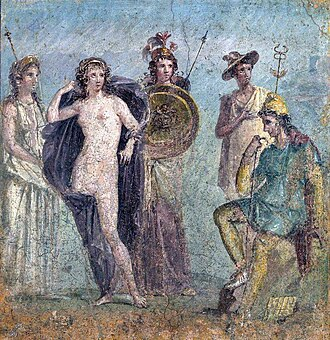
The Judgment of Paris is one of the most famous stories connected to the Trojan War.
At its center is a divine beauty contest involving Hera, Athena, and Aphrodite, whose rivalry ultimately leads to the decision that Paris should award a golden apple to Aphrodite.
The consequences of this seemingly simple judgment become catastrophic.
The Golden Apple
The story begins with a wedding involving Peleus and Thetis, the parents of Achilles.
The goddess of discord, Eris, was not invited.
Angered by her exclusion, she threw a golden apple among the guests.
The apple was inscribed for the “fairest.”
Three Goddesses
Three goddesses claimed the prize:
Hera;
Athena;
Aphrodite.
Each believed she deserved the title.
Zeus Refuses to Judge
Zeus did not want to decide which goddess was most beautiful.
Instead, the task was assigned to Paris, a prince of Troy.
Paris
Paris was the son of King Priam and Queen Hecuba.
He was raised away from the royal court because of a prophecy concerning his birth.
Eventually, he returned to Troy.
Hera's Offer
Hera offered Paris political power.
She promised to make him a great ruler.
Athena's Offer
Athena offered military glory and wisdom.
She promised victory and greatness in warfare.
Aphrodite's Offer
Aphrodite offered Paris the most beautiful woman in the world.
Paris chose Aphrodite.
Helen
The woman promised to Paris was Helen, wife of Menelaus, king of Sparta.
Helen was already married.
Her departure with Paris became one of the immediate causes of the Trojan War.
The Beginning of the War
Menelaus demanded Helen's return.
His brother Agamemnon assembled the Greek forces.
Greek kings and warriors gathered for an expedition against Troy.
Among them were:
Achilles;
Odysseus;
Ajax;
Diomedes;
and many other heroes.
The Myth's Deeper Meaning
The story is often interpreted as a myth about desire and its consequences.
Paris chooses immediate personal reward over:
political power;
wisdom;
and responsibility.
Beauty and Power
Each goddess offers a different form of power.
Hera represents political authority.
Athena represents wisdom and military skill.
Aphrodite represents desire and beauty.
Paris' decision demonstrates the power of personal desire over strategic thinking.
The Apple as Symbol
The golden apple becomes a symbol of rivalry.
Its seemingly harmless origin produces enormous consequences.
This reflects a recurring theme in Greek mythology:
small acts can trigger events of enormous significance.
Fate
The Trojan War was not caused by Paris alone.
Greek mythology presents the war as part of a larger network of:
prophecy;
divine rivalry;
human decisions;
and fate.
Conclusion
The Judgment of Paris is ultimately a story about choice and consequence.
Paris is asked to judge beauty but is really forced to choose among competing forms of power.
His decision to accept Aphrodite's promise leads to Helen's involvement and eventually to the Trojan War.
The golden apple therefore becomes one of mythology's most famous symbols of how rivalry, desire, and poor judgment can reshape history.