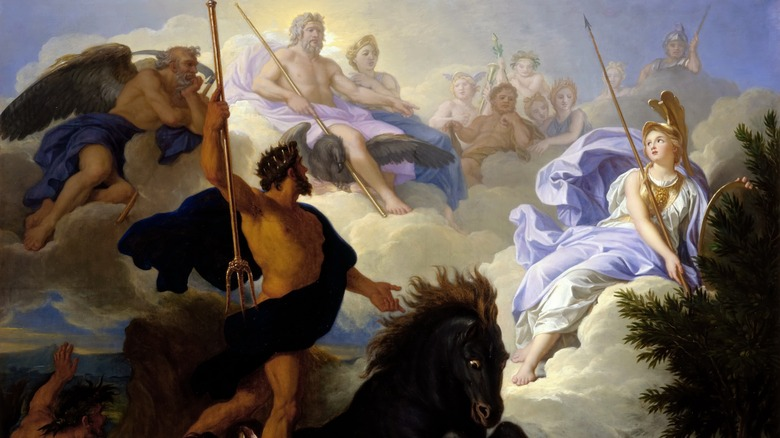
The Myth of the Autochthons of Athens is deeply connected with the ancient Athenian idea that their people were not simply immigrants or descendants of foreign founders but were, in a symbolic sense, born from the land itself.
The Greek word autochthon means “sprung from the earth.”
This concept became extremely important to Athenian identity, politics, mythology, and artistic representation.
What Does Autochthonous Mean?
An autochthonous people were imagined as originating from the land where they lived.
For the Athenians, this concept created a powerful connection between:
people → land → ancestors → city.
Rather than seeing Athens merely as a place where generations of migrants had settled, mythology presented the Athenians as indigenous to Attica.
Erichthonius
The most important figure associated with this tradition is Erichthonius.
He was closely connected with Athena and the early kings of Athens.
According to one famous tradition, Hephaestus attempted to approach Athena.
The semen that fell to the earth was wiped away by Athena and fell upon Gaia, the Earth.
From this event, Erichthonius emerged.
The Earth-Born Child
Because Erichthonius emerged from the earth, he became a powerful symbol of autochthony.
Athena then became associated with his protection.
In some traditions, he was hidden in a sacred chest guarded by a serpent.
Cecrops
Another major figure was Cecrops, the legendary first king of Athens.
He was sometimes described as having a human upper body and serpent-like lower body.
The serpent imagery connected him with the earth.
Athena and Poseidon
Athens' identity was also shaped by the famous contest between Athena and Poseidon.
Both wanted to become patrons of the city.
Poseidon struck the ground with his trident and produced a source of water.
Athena produced the olive tree.
The Athenians chose Athena's gift.
The Olive Tree
The olive tree became a central symbol of Athens.
It represented:
agriculture;
peace;
prosperity;
endurance;
and the city's relationship with Athena.
Political Importance
The idea of autochthony had political significance.
It supported the idea that Athenian citizens shared an ancient relationship with their homeland.
This concept could strengthen:
civic unity;
military identity;
political legitimacy;
and attachment to Attica.
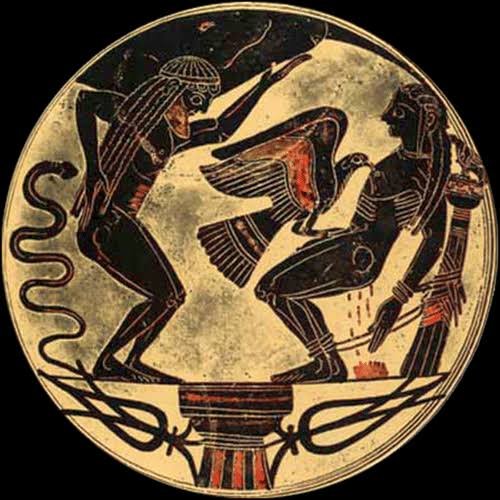
The Myth in Athenian Art
Autochthony appears in Athenian visual culture.
Erichthonius and the early kings of Athens could be represented alongside Athena.
The imagery emphasized that Athens was not simply a political community.
It was a sacred ancestral community.
The Snake Symbol
Serpents frequently appear in Athenian mythology.
The serpent was strongly connected with:
the earth;
fertility;
ancestors;
and chthonic powers.
It therefore suited the concept of people emerging from the soil itself.
Conclusion
The Myth of the Autochthons of Athens is more than a collection of strange origin stories.
It expresses one of the strongest ideas in ancient Athenian identity: the belief that Athenians belonged to their land through an almost biological and sacred relationship.
By presenting legendary ancestors as earth-born, mythology transformed Athens from a geographical location into an ancestral homeland.