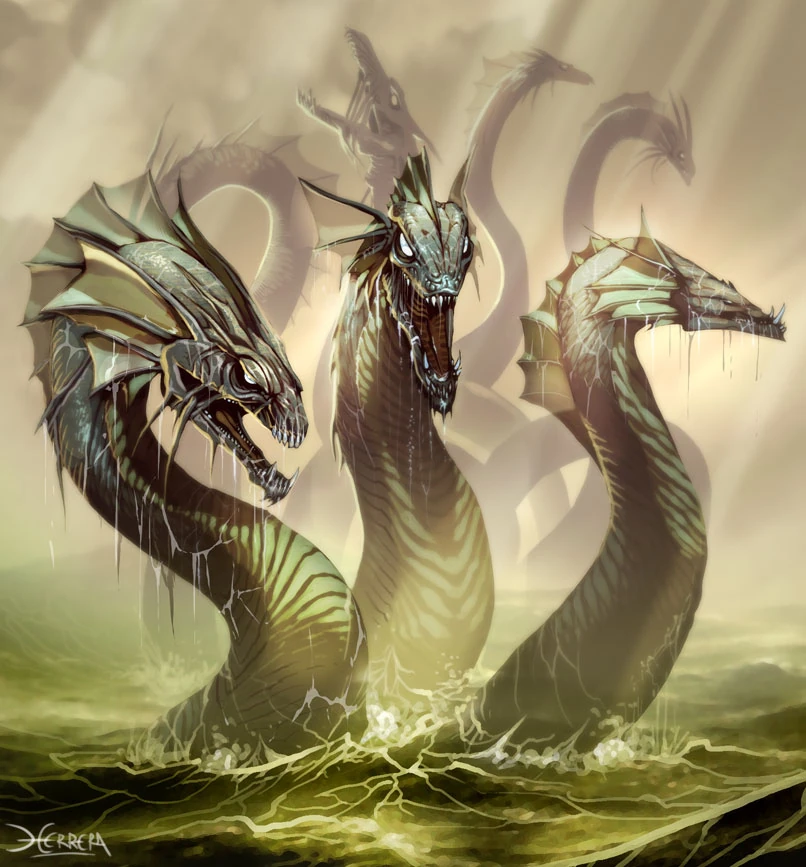
The Lernaean Hydra is one of the most famous monsters of Greek mythology and one of the most formidable opponents faced by Heracles during his Twelve Labors. Described as a gigantic water serpent with multiple heads, the Hydra lived near the marshes of Lerna in the northeastern Peloponnese. Its destruction became the second of Heracles’ labors and demonstrated a recurring theme in Greek mythology: physical strength alone is not always enough to overcome a supernatural threat.
The story is preserved in several ancient sources, although details vary between traditions. In its best-known form, the Hydra possessed numerous serpentine heads, and whenever one was cut off, additional heads could grow in its place. One of its heads was considered immortal, making the creature particularly difficult to destroy.
The monster was said to be descended from Typhon and Echidna, two primordial monstrous beings associated with some of the most dangerous creatures of Greek mythology.
The Hydra's Home at Lerna
Lerna was an ancient region associated with springs, wetlands, and underground waters.
The area had religious significance even before the classical period. It was also associated with myths concerning the Underworld and the goddess Demeter.
The Hydra's presence in this watery environment was therefore symbolically appropriate.
Water in Greek mythology could represent:
fertility;
purification;
danger;
transformation;
and access to the supernatural world.
The Hydra's marshy home placed it at the boundary between civilization and wilderness.
Heracles Receives His Second Labor
Heracles was required to perform a series of extraordinary tasks as punishment and as part of his quest for purification and redemption.
After completing his first labor, the killing of the Nemean Lion, he was ordered to destroy the Hydra.
Unlike the lion, however, the Hydra could not simply be defeated through brute force.
The Battle Begins
Heracles traveled to Lerna accompanied by his nephew and companion Iolaus.
The hero attempted to draw the monster out of its hiding place.
When the Hydra emerged, Heracles attacked.
He struck one of its heads and cut it off.
But instead of ending the battle, something extraordinary happened.
Two heads emerged from the wound.
The monster became more dangerous every time Heracles attacked it.
The Problem of Regeneration
The regenerative ability of the Hydra is one of the central elements of the myth.
The creature's ability to produce new heads transformed a simple combat encounter into a problem requiring strategy.
Heracles eventually realized that cutting the heads alone would never work.
He needed another method.
Iolaus and the Burning Brand
Iolaus played a crucial role.
After Heracles removed a head, Iolaus cauterized the wound using fire.
By burning the exposed neck before another head could grow, they prevented regeneration.
This allowed the pair to gradually eliminate the Hydra's mortal heads.
The episode is significant because it demonstrates the importance of cooperation and intelligence.
Heracles possessed extraordinary physical strength, but Iolaus' assistance was essential.
The Immortal Head
The Hydra had one immortal head.
After destroying the other heads, Heracles confronted this final supernatural head.
According to the traditional story, he cut it away and buried it beneath a massive rock.
The immortal nature of the head meant that simply killing it was impossible.
Instead, it had to be permanently restrained.
The Poison of the Hydra
The story does not end with the monster's death.
Heracles recognized that the Hydra's body contained a powerful poison.
He dipped his arrows into its venom.
These poisoned arrows later became some of the most dangerous weapons in Greek mythology.
The decision would have enormous consequences.
The Death of Heracles
The Hydra's poison eventually contributed to Heracles' own tragic death.
The poisoned arrows became associated with wounds that could not be cured.
In this way, the monster Heracles defeated indirectly contributed to the hero's eventual destruction.
The story creates an important mythological irony: a weapon gained through victory eventually becomes an instrument of tragedy.
Why the Hydra Was So Dangerous
The Hydra represents more than a giant snake.
Its regenerative heads make it an embodiment of problems that multiply when attacked incorrectly.
The myth can therefore be interpreted as a story about:
persistence;
strategy;
escalation;
and the consequences of victory.
The Hydra as a Symbol of Chaos
Greek mythology frequently contrasts civilization with dangerous wilderness.
The Hydra belongs to the monstrous world beyond ordinary human society.
Heracles' task was therefore not merely to kill an animal.
He was restoring order to a dangerous landscape.
The Role of Fire
Fire becomes the decisive tool in defeating the creature.
The use of fire is significant because fire represents human technological power.
Rather than depending solely on physical strength, Heracles and Iolaus use knowledge of how wounds behave to overcome regeneration.
The Hydra in Ancient Art
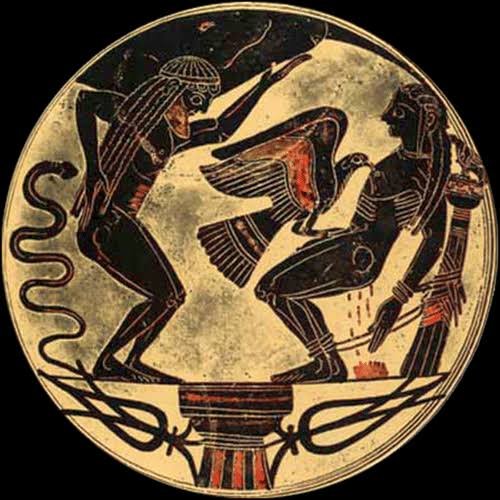
The Hydra appears in ancient Greek pottery, sculpture, and other artistic traditions.
Artists frequently portrayed Heracles confronting the many-headed creature.
These scenes emphasized:
heroism;
courage;
supernatural danger;
and the triumph of order over chaos.
The Hydra in Later Culture
The Hydra became one of the most recognizable monsters from Greek mythology.
Its name has entered modern language as a metaphor for a problem that produces new problems when one part is eliminated.
Modern literature, fantasy, film, games, and popular culture have repeatedly adapted the creature.
Conclusion
The Story of the Lernaean Hydra is more than an account of Heracles defeating a monster.
It is a story about a seemingly impossible problem that becomes more dangerous when approached incorrectly.
Heracles provides strength, while Iolaus provides essential strategy.
The monster's regeneration makes it an enduring symbol of problems that multiply rather than disappear.
Most importantly, the Hydra's poison connects the hero's triumph with his eventual tragedy, demonstrating one of Greek mythology's recurring ideas: victory can carry consequences that are not immediately visible.