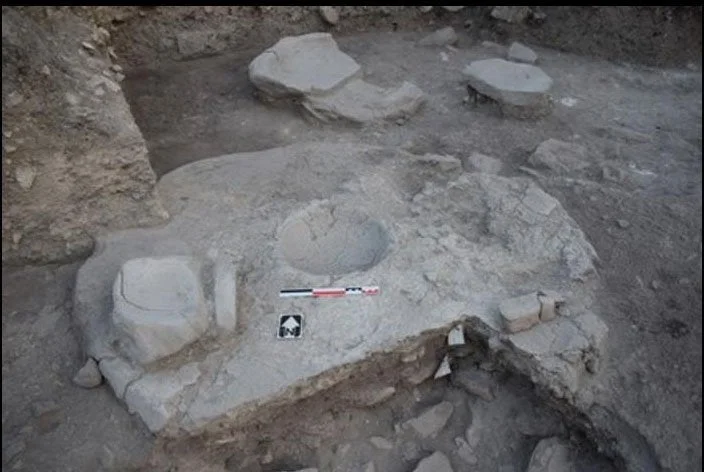
Archaeologists exploring a multi-period site at Prastio–Mesorotsos in Paphos have uncovered a well-preserved plaster hearth and a well-built plaster floor of an Early- or Middle-Chalcolithic (2500-2300 BC) house, the antiquities department said Friday.
“This season the entirety of the final phase of a mud-plaster hearth was revealed, with a quern left in situ on top, and an adjacent large stone basin sitting on the terminal deposits of the building,” the department said.
Excavations at the site in the Dhiarizos valley, were conducted between July 10 and August 10, under the direction of Dr Andrew McCarthy, fellow of the School of History, Classics and Archaeology at the University of Edinburgh and lecturer at the College of Southern Nevada.
The site is situated around a rocky outcrop that acts as one of the most important topographical features in the valley.
“It seems to have been at a crossroads between the lowlands and the uplands and between the west of Cyprus and the rest of the island. Its location and the proximity of abundant natural resources led to the site’s extraordinary longevity, showing evidence for occupation from the Pre-pottery Neolithic until the modern day.”
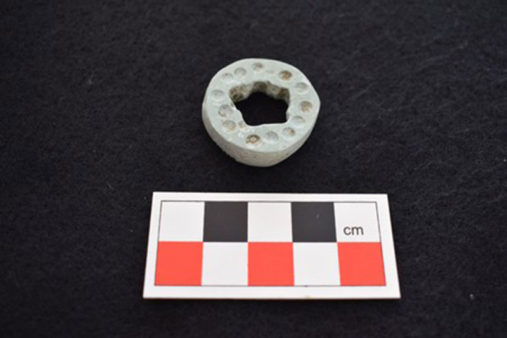
A unique picrolite stone disc pendant is evidence of a new material culture which accompanied the Middle Cypriot period reconfiguration. Photo Credit: Ministry of Interior, Cyprus.
In the eleventh excavation season at the site, four areas of the site were investigated exposing prehistoric remains from the Neolithic, Chalcolithic and the Early and Middle Bronze Ages (2,400-1,00 BC).
The entire space was covered by collapsed roof material, which indicates that the interior deposits of this building are mostly undisturbed after the collapse of the structure.
Although the location of the walls for this building are not entirely clear, it is probably not a circular structure, rather an elliptical or sub-rectangular building, perhaps indicating its date in the Early rather than Middle-Chalcolithic period, the department said.
Activities this season also included a focus on the earliest phases of the Bronze Age, including the so-called ‘Philia’ transition from the Chalcolithic into the Early Cypriot Bronze Age.
Philia transition or Philia culture marked the transition from the Chalcolithic to the Bronze Age in mid-third millennium Cyprus. The name comes from a location in Morphou.
It is associated with an initial intrusion into Cyprus of autonomous groups from Anatolia, which later developed a distinct, identifiable Philia cultural system.
Inhabitants continued to live in circular structures for several architectural phases and did not seem to alter their lifestyles greatly between the Late Chalcolithic and the Early Cypriot periods.
In 2019, the team uncovered the remains of a round domestic structure with a pit hearth, likely dating to this transitional period.
Although the Early Cypriot inhabitants were rather slow to change their lifestyles and were probably reluctant to do so, change did occur eventually, and the settlement, its architecture and probably the inhabitants’ lifestyles were significantly reconfigured in the Middle Cypriot period (MC).
The MC reconfiguration is accompanied by a massive series of terraces, a new style of rectilinear architecture and new elements of material culture, including a unique picrolite stone disc pendant with incised decoration and a perforated rosette pattern in the centre.
This reconfiguration represents a new trajectory for the village which moves toward increasing social stratification and architectural sophistication, culminating eventually in the abandonment of the site toward the end of the MC period.
In 2019, a massive, monumental river terrace was revealed to have been constructed as part of the major terracing construction at the site in the MC period, possibly part of a perimeter wall around the village.
Source: https://cyprus-mail.com/2019/08/23/new-finds-at-paphos-site-inhabited-for-thousands-of-years/