Introduction
Discovered in 1901 in a shipwreck off the Greek island of Antikythera, the Antikythera Mechanism remains one of the most enigmatic artifacts of the ancient world. Dating back to around 100 BCE, this complex bronze device is often described as the world’s first analog computer. It was used to predict astronomical positions, eclipses, and possibly even the timing of the Olympic Games. Its advanced engineering challenges our understanding of ancient Greek technological capabilities.
Discovery and Structure
The mechanism was found by sponge divers near Antikythera and initially overlooked as a corroded piece of metal.
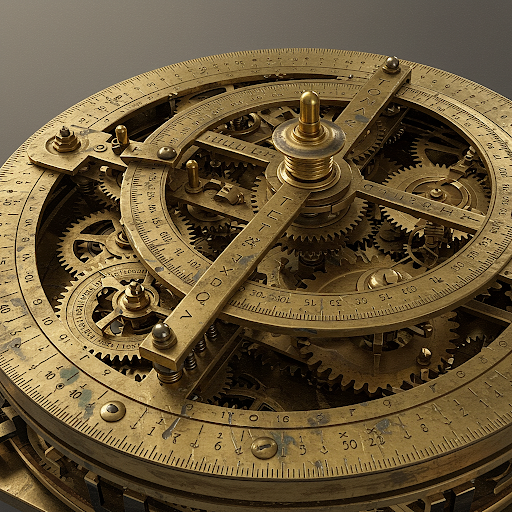
Composed of at least 30 interlocking gears, dials, and inscriptions, it was housed in a wooden frame about the size of a shoebox.
Radiographic imaging and modern reconstructions reveal its function as a highly sophisticated astronomical calculator.
Astronomical Functions
Solar and Lunar Cycles: The mechanism tracked the movements of the Sun and Moon relative to the zodiac.
Eclipse Prediction: It used a gear system to forecast lunar and solar eclipses with remarkable accuracy.
Planetary Motion: Evidence suggests it may have also modeled the positions of the five known planets of antiquity.
Olympic Games Cycle: Some inscriptions indicate it helped track the four-year cycle of the Olympic Games.
Technological Significance
The precision of its gears and differential mechanisms demonstrates an advanced knowledge of mathematics and mechanical engineering.
The level of craftsmanship suggests it was built by highly skilled artisans, possibly connected to the school of Archimedes.
No other device of comparable complexity is known from antiquity until the development of medieval clockwork in the 14th century.
Legacy and Impact
The Antikythera Mechanism challenges assumptions about technological progress in the ancient world.
It provides insight into Greek advancements in astronomy, mathematics, and engineering.
Its study has influenced modern fields like horology and mechanical computing.
Conclusion
The Antikythera Mechanism stands as a testament to the ingenuity of the ancient Greeks. Its intricate design and astronomical precision highlight a level of scientific understanding far ahead of its time. While mysteries remain, ongoing research continues to unlock the secrets of this remarkable ancient device, reinforcing its status as one of history’s greatest technological wonders.