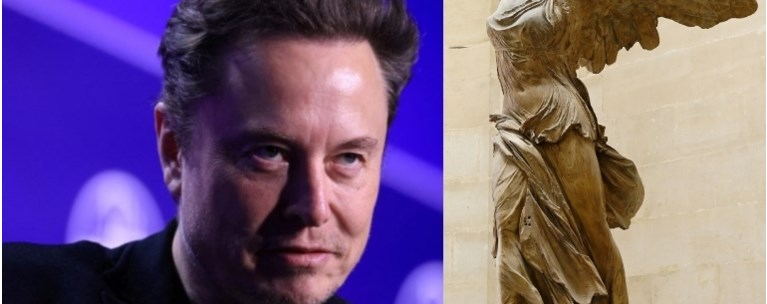
A user on X, the social media platform owned by the eccentric billionaire, shared a thread featuring some of the most exquisite ancient sculptures. At the very top of the list was the Winged Victory of Samothrace, and Elon Musk couldn’t resist reposting it with a single caption: "beauty."
Many of his followers agreed, commenting on the striking beauty of ancient Greek art and lamenting that such awe-inspiring masterpieces are no longer created today.
Beauty https://t.co/KOezhB2ge5
— Elon Musk (@elonmusk) March 15, 2025
Hello, World!
The Story Behind the Legendary Sculpture
The Winged Victory of Samothrace has been displayed at the Louvre Museum since 1884. It is one of three winged Nike statues found at the Sanctuary of Samothrace. The other two are housed separately—one, a Roman replica discovered by Austrian archaeologists, is in the Kunsthistorisches Museum in Vienna, while the second, unearthed in 1949 by American archaeologists Karl and Phyllis Williams-Lehmann, remains in the Archaeological Museum of Samothrace.
In 1950, the Lehmanns made another remarkable discovery—fragments of the statue’s right hand. A few months later, they identified its missing fingers in the Austrian museum, where they had been cataloged incorrectly and were not recognized as part of the famous sculpture. Through restoration efforts, the right palm was reconstructed, revealing that the goddess was not holding a trumpet, as previously believed. This reconstructed hand is now displayed separately at the Louvre, near the statue.
Standing 3.28 meters (10.75 feet) tall with its wings and 5.58 meters (18.3 feet) including its marble ship base, the sculpture was created to honor the goddess Nike and commemorate a naval victory. It was dedicated at the Sanctuary of Samothrace, a place renowned in antiquity for its religious significance. Experts estimate its creation between 220 and 190 BCE, with most agreeing on circa 190 BCE.
At the time, the donor who commissioned the work for the temple likely intended it to be a grand composition of the goddess and a ship. The figure of Nike was sculpted separately from white Parian marble, and some scholars believe she may have been holding a laurel wreath for the victorious fleet commander. Alternatively, she may have been raising her hand in triumph or in a gesture of greeting.
The ship beneath her was carved from greyish marble from Rhodes (specifically from Lindos and Lartos), suggesting a strong connection to Rhodian naval victories. Experts believe the sculpture was designed to be viewed from a three-quarter left angle, as this side is more intricately detailed—an artistic choice common in Hellenistic times for statues intended to be seen from a specific vantage point.
A Mystery of Ancient Naval Triumph
For years, scholars speculated that the statue was dedicated by Demetrius the Besieger (337–283 BCE) to commemorate his naval victory over Ptolemy off the coast of Cyprus around 290 BCE. However, modern research suggests it was more likely commissioned by the Rhodians in 191 BCE after they, in alliance with Pergamon, defeated Antiochus III of Syria in a decisive naval battle near Side.
The right wing of the statue was found in fragments and was largely reconstructed as a mirrored copy of the left wing by Louvre restoration experts. It is believed that the statue was toppled and shattered due to a powerful earthquake in the 6th century CE.
Today, the Winged Victory of Samothrace remains one of the most celebrated masterpieces of Hellenistic art, standing as a timeless symbol of triumph, grace, and artistic brilliance.