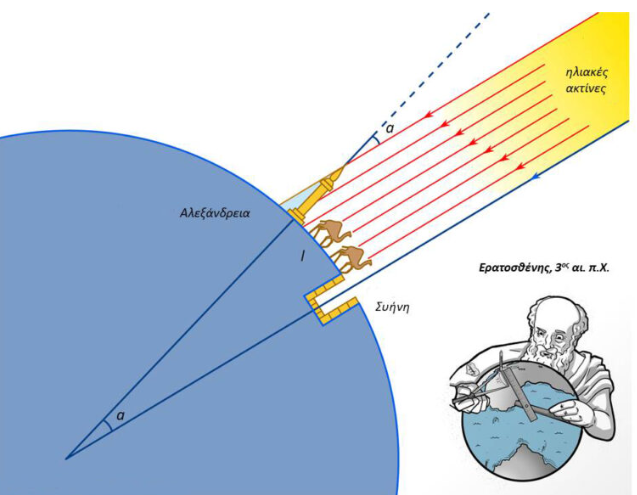
The ordeal of a group of Greek students in Alexandria, Egypt, came to a fortunate end after they were briefly lost while participating in an ambitious educational project. Their goal? To recreate Eratosthenes' famous experiment, measuring the Earth's circumference just as it was done in the 3rd century BCE.
As part of their five-day school trip, the students were divided into two groups. One group was tasked with measuring the angle of the sun's rays in Alexandria. The second group took on a more physically demanding challenge: measuring the distance between Alexandria and Syene (modern-day Aswan) by walking—just as ancient "step-counters" did, using their strides to estimate distances.
However, during their journey, the 12 students in the second group lost their way. Not only did they veer off course, but they also lost contact with the first group for an extended period. Concern quickly grew, and the Greek embassy in Cairo intervened, prompting Egyptian authorities to launch a search. Eventually, the students were found several kilometers outside Alexandria, near the suburbs of Kafr El-Dawar—exhausted, but thankfully unharmed.
Educational Controversy
The incident has sparked debate within the Ministry of Education, particularly regarding how schools conduct Eratosthenes’ experiment each March. Some teachers reject the use of Google Earth as a legitimate method for distance measurement, insisting that students must physically walk the distances, following the ancient method to the letter. This has led to strenuous, and at times, risky excursions.
In response, the Ministry of Education has announced plans to issue a directive advising schools to avoid excessive physical demands while still preserving the experiment’s immense educational value—offering students a hands-on experience far more engaging than a standard classroom lecture.