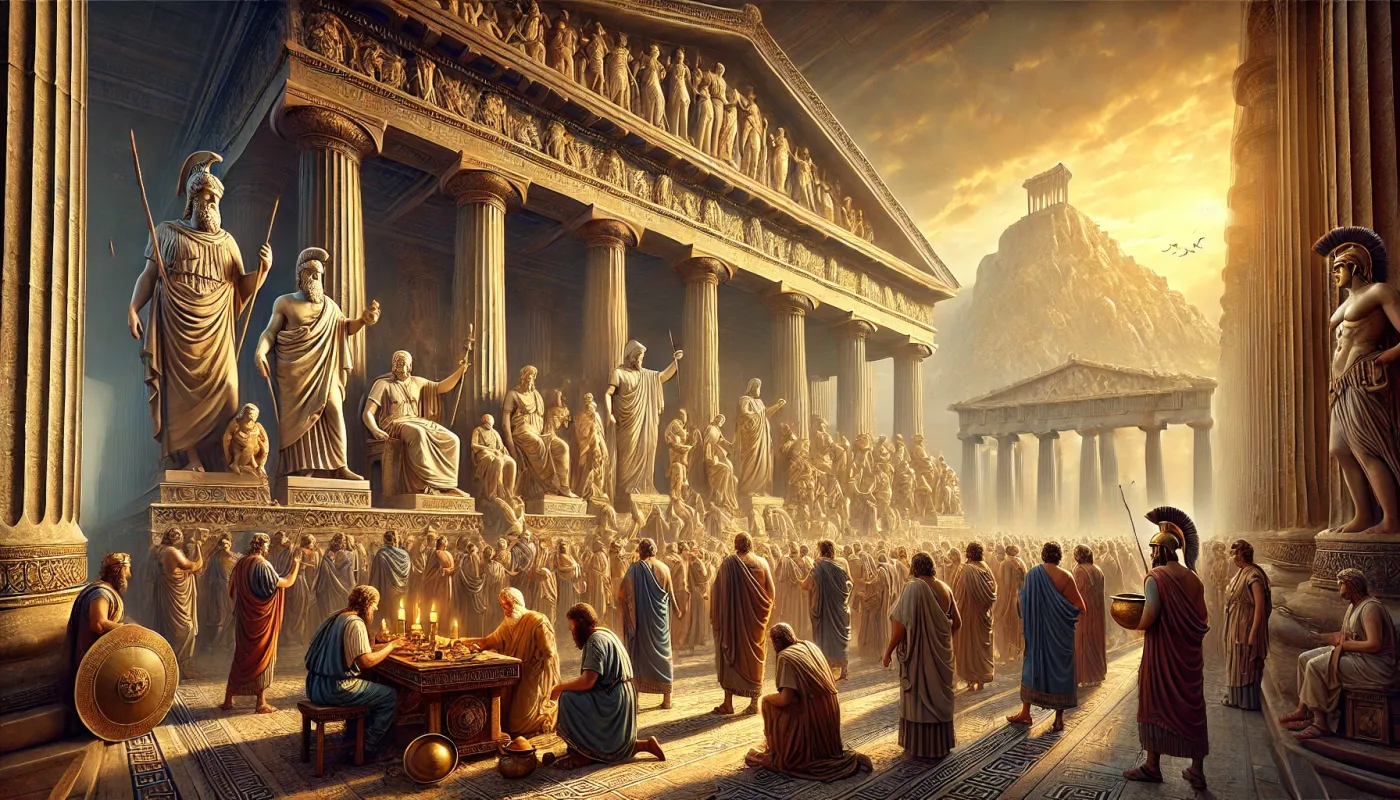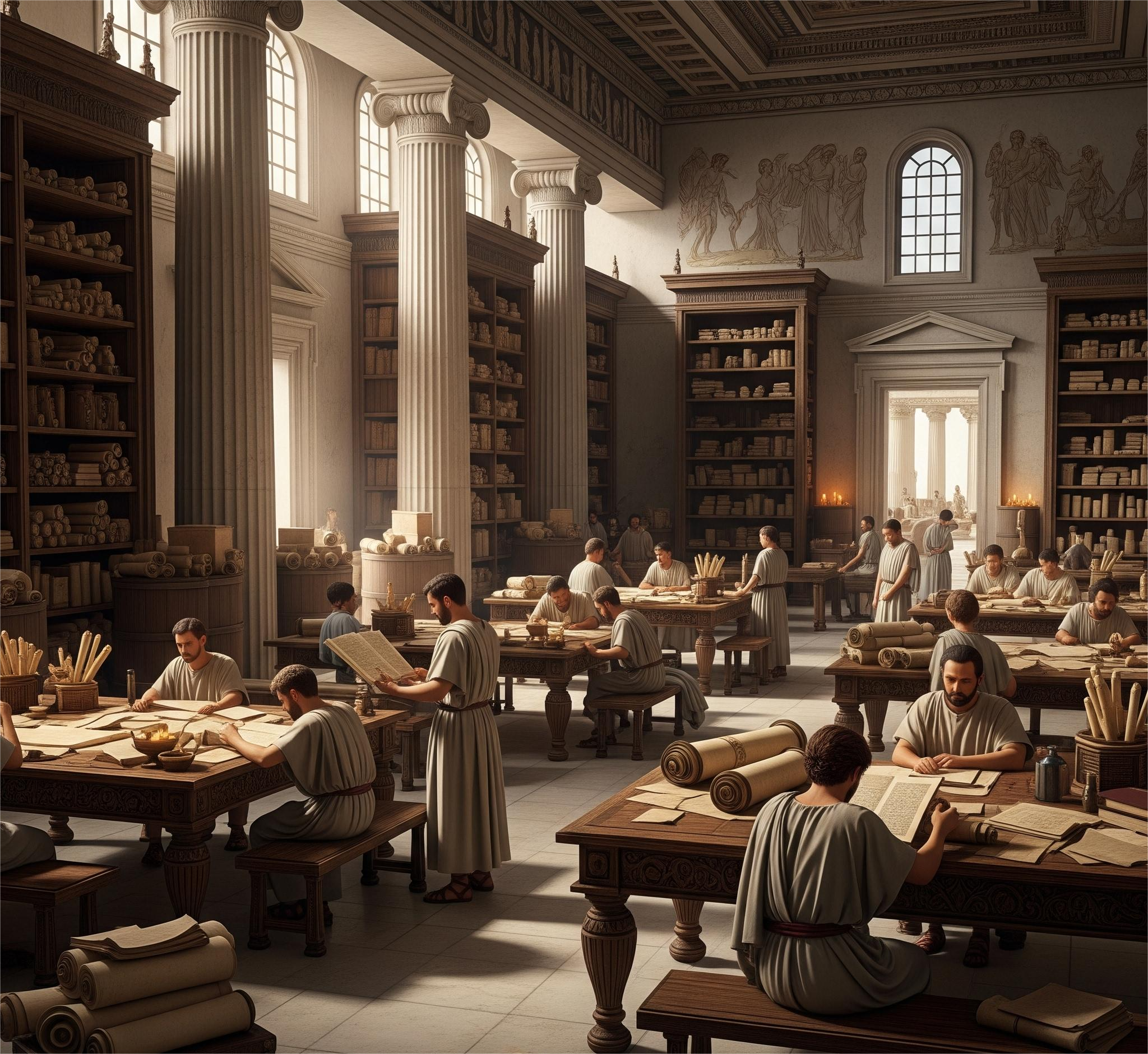
In the ancient Greek world, libraries were more than buildings filled with scrolls—they were symbols of intellectual power, tools of empire, and temples of learning. Among them, the Library of Alexandria and the Library of Pergamon stood out as two of the most iconic centers of knowledge, preserving and producing texts that would shape philosophy, science, medicine, and literature for centuries.
The Rise of Greek Libraries
As literacy expanded and intellectual life flourished in the Hellenistic period (after the death of Alexander the Great in 323 BCE), the need for organized collections of texts became clear. Greek rulers and scholars sought not only to collect books but to create comprehensive archives of all known human knowledge.
These libraries became competitive projects of cultural prestige—akin to modern universities or research institutions—where philosophers, poets, scientists, and historians worked side by side.
The Library of Alexandria: Legend and Legacy
Location: Alexandria, Egypt
Founded: 3rd century BCE, under the reign of Ptolemy I Soter (or Ptolemy II Philadelphus)
Mission: To collect every book in the world
Key Facts:
Part of the Mouseion, a larger research complex akin to a university.
Estimated to house 400,000 to 700,000 scrolls at its peak.
Collected texts through aggressive acquisition, including copying scrolls from ships docked at Alexandria’s port.
Included works in Greek, Egyptian, Persian, Indian, and Mesopotamian languages.
Contributions:
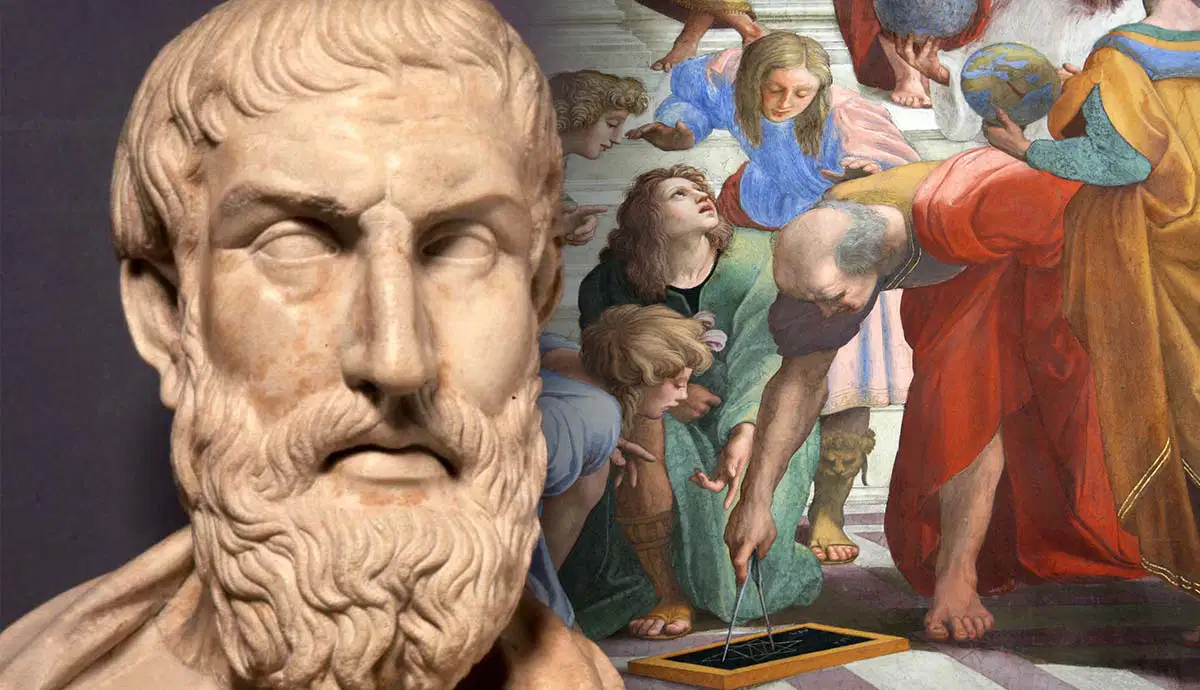
Supported scholars like Euclid (mathematics), Eratosthenes (geography), Herophilos (medicine), and Callimachus (literature).
Callimachus compiled the Pinakes, the world’s first library catalog, classifying scrolls by subject and author.
Fostered advances in astronomy, medicine, and textual criticism.
Its Fate:
The Library suffered multiple incidents of destruction, including:
Possible burning during Julius Caesar’s siege of Alexandria (48 BCE).
Further loss during later Roman and Christian rule.
Its final destruction remains debated, but its symbolic weight remains unmatched in intellectual history.
The Library of Pergamon: Rival of Alexandria
Location: Pergamon (modern-day Bergama, Turkey)
Founded: 2nd century BCE, under the Attalid dynasty
Key Facts:
Housed over 200,000 scrolls.
Famous for its architectural elegance and multi-tiered storage system.
Developed in direct competition with Alexandria, especially when Egypt tried to halt Pergamon’s growth by cutting off its papyrus supply.
The Invention of Parchment:
In response to the papyrus embargo, Pergamon pioneered the extensive use of parchment (charta pergamena)—a writing material made from animal skins, which was more durable and eventually replaced papyrus in much of Europe.
Scholarly Contributions:
Attracted scholars of literature, medicine, and history.
Hosted one of the most refined textual editing traditions, ensuring accurate versions of Homer and classical plays.
The Gift to Cleopatra:
According to legend (though debated), Mark Antony gifted the scrolls of Pergamon to Cleopatra to help restore Alexandria’s library—a story that reflects the legendary status both libraries held.
Other Notable Greek Libraries
Aristotle’s Private Collection: Arguably the first major personal library; later became the foundation of many philosophical schools.
The Athenian Library (Library of Hadrian): Built later under Roman rule (2nd century CE), it carried on the tradition of public book access and scholarly activity.
The Library of Rhodes: A center of Stoic philosophy and rhetorical training.
What Was in These Libraries?
Greek libraries stored scrolls (volumes) made of papyrus or parchment, usually stacked horizontally in niches or wooden boxes. Subjects included:
Epic and lyrical poetry (Homer, Sappho)
Tragedies and comedies (Aeschylus, Euripides, Aristophanes)
Philosophy (Plato, Aristotle, the Stoics)
Medicine (Hippocrates, Galen)
Mathematics and geometry (Pythagoras, Euclid)
Astronomy and geography
Histories (Herodotus, Thucydides)
Many works we consider “classics” today survived only because they were copied and archived in these ancient libraries.
Legacy and Influence
Though the great Greek libraries were eventually lost or destroyed, their influence echoes in:
The design of modern research libraries and archives
The concept of knowledge curation and classification
The dream of universal knowledge pursued by later institutions like the Library of Baghdad, the Renaissance academies, and even the modern Internet