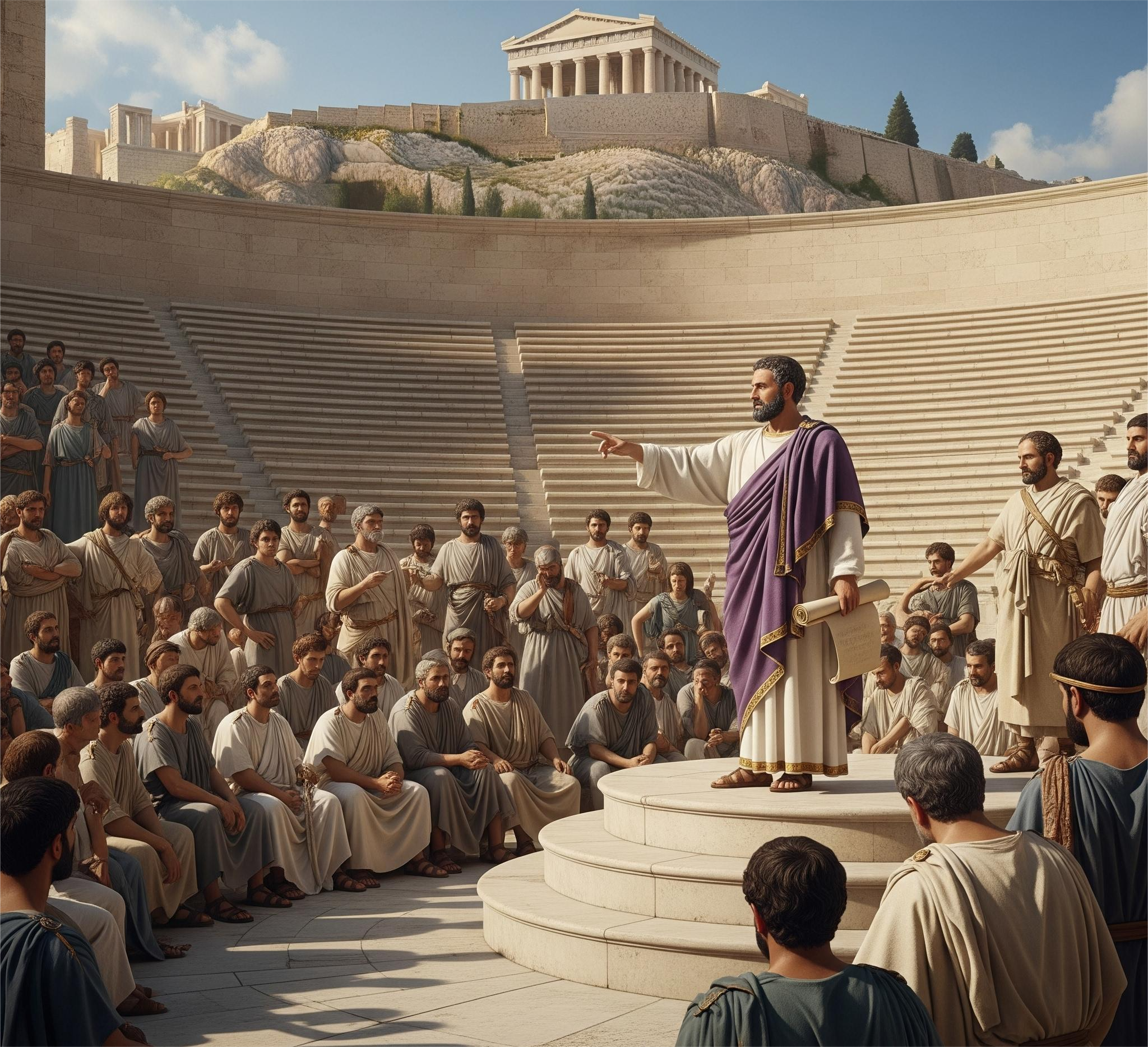
In the late 6th century BCE, Athens stood at a political crossroads. Dominated by aristocratic families and recovering from the rule of the tyrant Peisistratus and his sons, the city was rife with internal conflict. Into this chaos stepped Cleisthenes, a nobleman of the Alcmaeonid clan, whose radical political reforms around 508/507 BCE laid the groundwork for what would become Athenian democracy—a system that profoundly influenced political thought for millennia to come.
The Political Landscape Before Cleisthenes
Prior to Cleisthenes, Athenian society was sharply divided along lines of family, wealth, and tribal loyalties. The aristocracy controlled political offices, and citizenship was limited. The previous reforms of Solon had alleviated some class tension by establishing rights for the poor, but power remained concentrated.
When Isagoras, a rival aristocrat, tried to centralize power and expel Cleisthenes and his allies with Spartan backing, the people of Athens revolted. Cleisthenes returned, and with popular support, introduced reforms that would dismantle aristocratic power structures.
Cleisthenes’ Key Reforms
1. Reorganization of the Tribes
Cleisthenes replaced the traditional four Ionian tribes, which were based on familial and regional ties, with ten new tribes (phylai).
Each tribe was composed of demes (local townships) from three different regions: city, coast, and inland—a system called trittyes.
This broke up traditional power bases and forced cooperation between diverse communities.
2. Creation of the Council of 500 (Boule)
The Boule replaced Solon’s Council of 400.
50 citizens from each of the 10 tribes, chosen by lot, served on the council annually.
The Boule prepared legislation for the Assembly and supervised daily government affairs.
This increased citizen participation and ensured broader representation.
3. Strengthening the Ecclesia (Assembly)
Cleisthenes empowered the Ecclesia, the citizens' assembly, as the primary legislative body.
All male citizens could speak and vote on laws, war, and foreign policy.
This was a significant shift toward direct democracy.
4. Introduction of Ostracism (Possibly)
Although it may have been instituted a bit later, ostracism is often attributed to Cleisthenes’ system.
Citizens could vote to exile a political figure for ten years to prevent tyranny.
It served as a safeguard against authoritarianism.
Philosophy Behind the Reforms
Cleisthenes' reforms were not just administrative—they were ideological. They reflected the idea that power should reside with the people (demos) rather than a select few. By dismantling aristocratic networks and promoting equality among citizens, he transformed the political structure of Athens from oligarchy to isonomia—“equality under the law.”
The Birth of Democracy
Though limited by modern standards (only adult male citizens could participate), Cleisthenes' reforms were revolutionary for their time:
Political power was distributed more evenly.
Public office was based on lot rather than wealth or lineage.
Government became more transparent and accountable.
These principles laid the institutional foundation for the Golden Age of Athens, during which philosophers like Socrates, Plato, and Aristotle flourished under this new system.
Legacy
Cleisthenes is often referred to as the "Father of Athenian Democracy." His reforms didn’t create a perfect democracy, but they introduced the core mechanisms that allowed the people of Athens to rule themselves—an unprecedented concept in the ancient world.
“The strength of a democracy lies in the participation of its citizens.”
Cleisthenes' bold vision ensured that Athenian politics would no longer be the privilege of the few—but the right and responsibility of the many.