Winter folklore, the fear of the wilderness, and the cultural boundaries of supernatural storytelling.
The Winter Landscape of Thrace
Thrace occupies a historically important region of southeastern Europe, extending across areas of modern Greece, Bulgaria, and Turkey. Its landscapes include plains, forests, mountains, and river valleys, while its history reflects centuries of movement, settlement, cultural exchange, and political change.
Winter can transform familiar landscapes into environments that feel unfamiliar. Snow and fog reduce visibility, frozen ground changes travel conditions, and cold weather places additional demands on households and livestock. In earlier rural communities, these conditions could affect food supplies, transportation, work, and the ability to reach neighboring settlements.
Stories about supernatural beings often emerge from environments where human survival depends on understanding natural dangers. Winter legends may describe hostile spirits, mysterious voices, dangerous travelers, or creatures that threaten people who venture too far from safety. Such stories can express anxieties about isolation, hunger, and the uncertainty of life during difficult seasons.
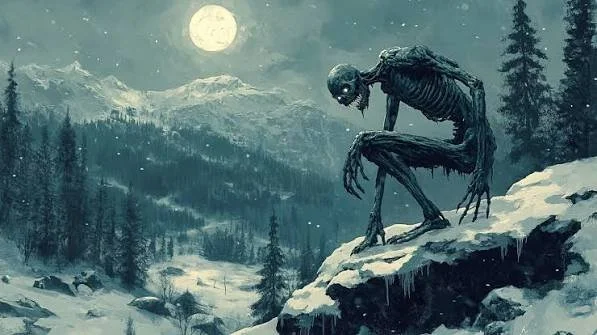
The title's reference to the wendigo introduces a creature associated with particular Indigenous traditions of North America, especially Algonquian-speaking peoples. The wendigo should not be presented as an established figure in Thracian folklore without evidence. A more responsible investigation would compare the cultural roles of winter monsters and hunger-related spirits across different traditions while recognizing their distinct origins.
The Wendigo and Its Cultural Context
The wendigo belongs to Indigenous North American cultural traditions, with accounts varying between communities and historical periods. In some traditions, it is associated with extreme hunger, destructive consumption, dangerous transformation, or the violation of social and moral boundaries. Its significance cannot be reduced to the image of a generic monster found in modern horror entertainment.
The creature has been represented differently in oral traditions, written accounts, popular literature, and contemporary media. Modern depictions often exaggerate or alter earlier characteristics, sometimes removing the cultural context in which the figure originally carried meaning.
This makes careful historical treatment essential. Researchers studying the wendigo should consult appropriate Indigenous scholarship and community-informed sources rather than relying solely on modern fictional portrayals. The figure should not be transferred to another cultural region simply because the environment appears similar.
Thracian winter tales offer a separate field of investigation. Regional folklore may include stories about spirits, supernatural beings, dangerous landscapes, and the consequences of violating customary rules. These traditions should be identified through their own languages, names, sources, and historical settings.
Comparative folklore can still ask why different societies develop stories about hunger, winter isolation, and threats from beyond the settlement. The comparison becomes meaningful when it investigates differences as carefully as similarities.
Hunger, Isolation, and the Winter Story
Food scarcity has historically influenced the way communities experienced winter. In rural societies, households needed to preserve supplies, protect animals, and manage resources until conditions improved. A difficult winter could create anxiety about hunger, sickness, and the possibility that assistance might not arrive in time.
Folklore can express these fears through supernatural figures that embody excess, deprivation, or the collapse of ordinary social behavior. Stories about beings that consume too much, attack travelers, or lure people away from safety can reinforce shared expectations about caution and cooperation.
Such interpretations require evidence from the particular tradition being studied. A winter story might function as a warning, a religious narrative, an entertaining tale, or an explanation for an unusual event. Its meaning cannot be determined solely by identifying a common theme such as hunger.
Researchers investigating Thracian folklore could examine regional collections, historical ethnographies, and oral accounts recorded in Greek, Bulgarian, and Turkish. The area's linguistic and cultural diversity makes it especially important to identify the community and context associated with each narrative.
The stories could then be compared with environmental history. Historical records concerning agriculture, livestock, settlement patterns, and severe weather may help explain the conditions under which particular motifs became meaningful.
The Sound of Winter and the Fear of the Unknown
Winter landscapes can alter the way sound is perceived. Wind moving through trees, branches cracking under pressure, animals calling at night, and snow or ice shifting under changing temperatures can produce unfamiliar noises. In remote locations, echoes and limited visibility may make it difficult to identify their sources.
These conditions can influence storytelling, although a particular legend should not be attributed to a sound without evidence. Some narratives may arise from direct experiences, while others develop through literary transmission or inherited cultural motifs.
Acoustic research can examine how sound travels through forests and mountainous terrain. Environmental historians can reconstruct past landscapes, while folklorists can investigate whether local stories associate particular noises with spirits or dangerous beings.
The connection between sound and fear is not unique to winter. Darkness, isolation, and uncertainty can influence how people interpret experiences in many environments. Folklore gives those experiences recognizable forms through stories that can be shared and remembered.
Comparing Traditions Without Erasing Their Differences
Comparative mythology is most useful when it avoids treating every supernatural creature as a variation of the same universal monster. Two figures may share characteristics while having very different histories, meanings, and relationships to the communities that tell their stories.
The wendigo and Thracian supernatural figures should therefore be studied in their own cultural contexts. Researchers can compare how narratives address hunger, social obligations, isolation, and the dangers of leaving familiar places, but they should not imply that the traditions are historically connected without evidence.
A study of Thracian winter folklore could also examine how stories changed with migration, religious conversion, urbanization, and modern media. A creature described in a nineteenth-century collection may be represented differently in a contemporary retelling, and the difference may reveal more about cultural change than about the original narrative.
The most compelling article would investigate the documented winter stories of Thrace and place them within the region's environmental and social history. The wendigo can provide a carefully qualified point of comparison, but it should not replace the distinct voices and traditions of the communities whose folklore is actually being studied.