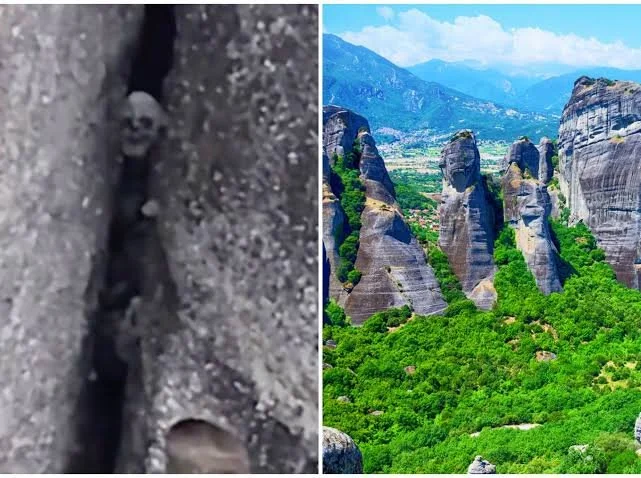
Stone guardians, sacred architecture, and the extraordinary monasteries rising above the Thessalian plain.
Monasteries Suspended Above the Landscape
In central Greece, the towering rock formations of Meteora rise dramatically above the surrounding plain. Their steep faces and isolated summits create a landscape that appears almost separated from the ordinary world. For centuries, these rock pillars have provided a setting for monastic communities whose buildings occupy locations that demand careful planning, specialized construction, and an intimate understanding of the terrain.
Meteora is particularly known for its Eastern Orthodox monasteries, some of which were established on high rock formations where access was historically difficult. The buildings and their surrounding cliffs reflect a combination of religious devotion, practical adaptation, and the desire for relative isolation. Their architecture also creates opportunities for investigating how people transformed extraordinary natural locations into places of worship.
The title's reference to secret gargoyle guardians suggests that stone figures may watch over the cliffs and protect the monasteries from unseen threats. However, gargoyles in the familiar architectural sense are especially associated with medieval European buildings, where projecting stone figures often served as water spouts. Specific claims about hidden gargoyles at Meteora require architectural documentation rather than assumption.
The historical investigation is more compelling when it asks how religious architecture uses sculpture, decoration, defensive features, and dramatic placement to communicate sacred authority.
The Difference Between Gargoyles and Decorative Stone Figures
A gargoyle is traditionally a projecting architectural feature that channels rainwater away from a building. Many European examples are carved in the shapes of animals, monsters, or human figures. Their appearance can be frightening or humorous, and they are often associated in popular imagination with the protection of sacred spaces.
Not every monstrous stone sculpture is a gargoyle. Some figures are purely decorative, while others have symbolic or architectural functions unrelated to drainage. Modern descriptions sometimes use the word loosely for any unusual stone creature attached to a building.
This distinction matters when examining Meteora. An architectural survey would need to identify the actual features present on the monasteries, document their construction and purpose, and determine whether they resemble gargoyles in a technical sense. Without that evidence, it would be misleading to claim that the monasteries possess a hidden system of gargoyle guardians.
The broader subject of protective imagery is still worth exploring. Religious buildings in different parts of the world have used sculpture, icons, inscriptions, and architectural symbolism to express ideas about holiness, spiritual struggle, and the relationship between sacred and ordinary space.
Why the Rocks Inspired Religious Retreat
The physical setting of Meteora contributed to its development as a monastic landscape. The towering formations created places that were difficult to reach and offered opportunities for solitude, contemplation, and communal religious life. At the same time, the environment presented serious practical challenges involving construction, transportation, water, food, and communication.
Monastic communities had to adapt to the terrain. Buildings needed stable foundations, access routes had to be maintained, and materials required careful movement across steep and uneven surfaces. The construction of monasteries in such locations demonstrates the importance of local knowledge and collective labor.
The landscape also shaped the experience of visitors. Approaching a monastery from below can emphasize its apparent isolation, while changing light and weather alter the visual character of the cliffs. These effects can encourage a sense of awe and make the buildings appear closely connected with the surrounding rock.
Such experiences help explain why Meteora has become a powerful cultural and religious landmark. They do not establish that supernatural guardians were installed on the cliffs, but they provide context for understanding why later storytelling might imagine the rocks as inhabited or protected by extraordinary beings.
Guardians in Religious Art and Architecture
Protective figures appear in many architectural traditions. Their meanings vary according to religion, period, location, and artistic convention. Some are associated with the defeat of evil, while others represent authority, vigilance, or the boundary between sacred and ordinary space.
In Christian architecture, protective meaning may be expressed through images of saints, angels, biblical figures, crosses, and other religious symbols. Their presence can communicate theological ideas as well as identify the building's religious community.
Monasteries also contain objects and spaces whose functions are devotional rather than defensive. Icons, frescoes, relics, inscriptions, and liturgical furnishings help structure religious practice. Their interpretation requires attention to the theological and historical context in which they were created.
An investigation of Meteora's architectural imagery could examine which figures actually appear in the monasteries, how they were made, and what religious meanings have been attributed to them. Art historians could compare the imagery with other Orthodox sites, while architectural researchers could document the relationship between decoration and building function.
If a particular stone figure has acquired a local legend, that tradition could be investigated through historical records and oral accounts. The legend should be distinguished from the documented purpose of the sculpture itself.
Modern Documentation of the Cliff Monasteries
Digital surveying methods offer new opportunities to record Meteora's architectural heritage. Photogrammetry can create three-dimensional models from photographs, while laser scanning can document building surfaces and structural details. These models may help researchers monitor erosion, examine construction techniques, and preserve information about vulnerable features.
Geological research can also clarify how the rock formations developed and how natural processes affect the cliffs. Weathering, water movement, fractures, and changes in temperature all influence the stability of rock surfaces. Such information is important for conservation and visitor safety.
These scientific approaches complement historical and artistic research. A digital model can establish the location and shape of a stone feature, but interpreting its original meaning requires architectural, historical, and cultural evidence.
The image of secret gargoyle guardians can therefore serve as an engaging opening for an article about Meteora's extraordinary architecture and the broader history of protective imagery. The strongest story investigates the real stonework, the monastic landscape, and the meanings attached to sacred buildings without inventing undocumented sculptures or hidden supernatural defenses.