
Introduction
The Pontic Greeks possess one of the richest musical traditions of the eastern Mediterranean.
Among the most recognizable instruments associated with Pontic culture is the Pontic lyra, a bowed string instrument central to traditional music and dance.
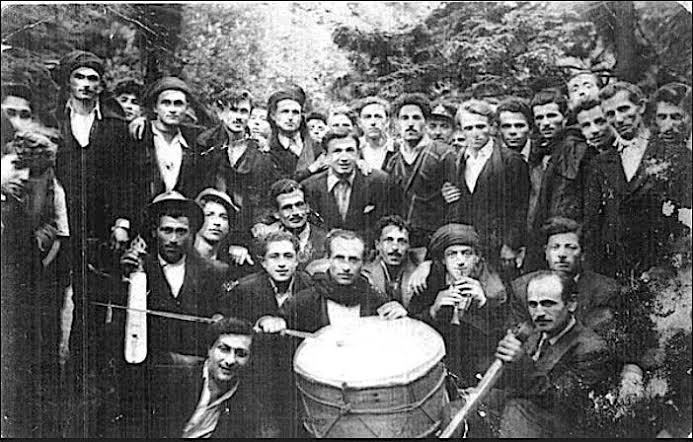
The title Rare Pontic Lyra Players' Odyssey to Athens Slums evokes the migration of Pontic Greek musicians from the Black Sea region into the neighborhoods of Athens after the upheavals of the early twentieth century.
Unlike several of the other titles in this collection, this theme has a strong historical foundation: the arrival of large numbers of Asia Minor and Pontic refugees transformed urban Greece.
Pontic Greek Communities
Pontic Greeks lived for centuries around the southern and eastern Black Sea.
Their communities developed distinctive dialects, religious traditions, foodways, dances, and music.
The Pontic lyra became an important instrument in communal celebrations and cultural expression.
The Catastrophes of the Early Twentieth Century
The First World War and subsequent conflicts devastated many Greek communities in the Ottoman Empire.
Pontic Greeks experienced persecution, displacement, massacres, deportation, and migration.
Large numbers eventually reached Greece.
Refugees in Athens
Athens and its surrounding areas received enormous numbers of refugees.
New settlements developed rapidly.
Some refugee neighborhoods were poor and overcrowded.
Infrastructure often struggled to keep pace with population growth.
Yet these neighborhoods also became centers of cultural creativity.
Music as Memory
For refugees, music provided a way to preserve identity.
Songs could recall:
lost villages,
family members,
mountains,
religious traditions,
journeys,
love,
war,
and exile.
The Pontic lyra therefore functioned as more than a musical instrument.
It became a vehicle for memory.
The Urban Transformation
Athens changed dramatically after the arrival of refugees.
New communities introduced food, crafts, dialects, religious practices, and musical traditions.
The city became more culturally diverse.
Refugee musicians performed at weddings, community events, taverns, festivals, and private gatherings.
Poverty and Cultural Production
The word "slums" can obscure the complexity of refugee neighborhoods.
Many were economically disadvantaged, but they were not culturally empty.
People created associations, churches, businesses, schools, sports clubs, and cultural organizations.
Music was one of the tools through which community networks developed.
The Pontic Lyra
The instrument itself has a distinctive shape and playing technique.
Its sound became closely associated with Pontic dances and songs.
Musicians passed techniques from older generations to younger players.
As communities moved into urban environments, the musical tradition adapted.
Preservation Today
Pontic music remains an important part of Greek cultural heritage.
Associations and cultural organizations teach traditional dances and instruments.
Recordings and digital archives also help preserve performances.
Modern musicians sometimes combine traditional Pontic styles with contemporary genres.
Conclusion
The Rare Pontic Lyra Players' Odyssey to Athens Slums captures an important dimension of refugee history.
The journey from the Black Sea to Athens was not simply geographic.
It involved the rebuilding of identity after catastrophe.
Musicians carried instruments, melodies, memories, and cultural knowledge into neighborhoods where displaced families attempted to create new lives.
The Pontic lyra consequently became a symbol of cultural survival: an instrument that transformed exile into continuity.







