
Introduction
The Urartian civilization flourished in the ancient Armenian Highlands, particularly around Lake Van, during the Iron Age.
Its kingdom developed sophisticated fortifications, irrigation systems, monumental architecture, metalworking traditions, and long-distance connections.
The title Rare Urartian Merchant Trails to Lake Prespa Shores proposes a connection between Urartian commercial networks and the Lake Prespa region of the Balkans.
No established archaeological evidence currently demonstrates a direct Urartian merchant road reaching Lake Prespa.
The topic is therefore best approached as a study of long-distance exchange possibilities rather than a confirmed Urartian trade route.
The Kingdom of Urartu
Urartu emerged as a major regional power during the first millennium BCE.
Its territory centered around the Lake Van basin.
Urartian rulers constructed massive stone fortresses and irrigation works.
Their inscriptions provide valuable information about political expansion and military campaigns.
Metalworking and Trade
Urartu was particularly associated with metal production.
Bronze objects, weapons, vessels, horse equipment, and decorative objects circulated through regional exchange networks.
The civilization interacted with Assyria and other neighboring states.
Trade and warfare could both transfer objects and technologies across political boundaries.
The Balkans and the Black Sea
The ancient Black Sea connected Anatolia with southeastern Europe.
Maritime networks linked coastal populations.
Objects could travel through multiple intermediary communities rather than moving directly from one civilization to another.
This distinction is important.
Finding an object with eastern stylistic characteristics in the Balkans would not automatically prove that Urartian merchants personally carried it there.
Lake Prespa
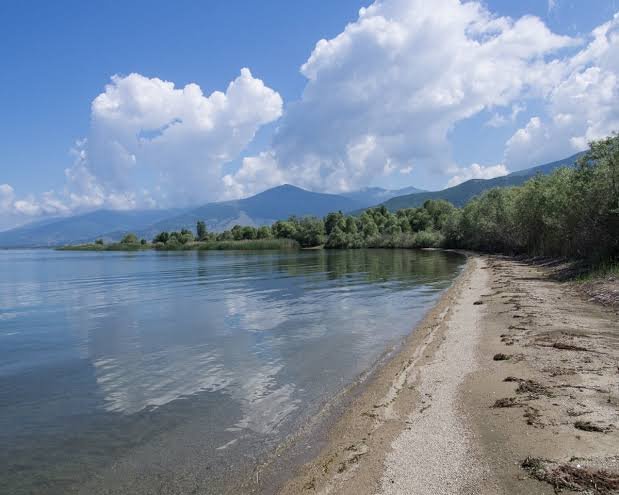
Lake Prespa lies in a mountainous region where modern Greece, North Macedonia, and Albania meet.
The area has long served as a crossroads between Balkan interior regions.
Its geography could support movement through mountain valleys and lake basins.
The Problem of Direct Evidence
Archaeologists look for evidence such as:
inscriptions,
distinctive ceramics,
metallurgical signatures,
imported objects,
settlement patterns,
coins,
road infrastructure,
or securely dated artifacts.
Without such evidence, claims of a direct merchant trail remain speculative.
Cultural Transmission
Long-distance exchange often operated through chains.
A metal object could pass through several markets.
A decorative motif could be copied by local artisans.
A technology could spread from one community to another.
Consequently, cultural influence does not require direct contact between the original producer and final user.
Iron Age Mobility
The Iron Age was a period of substantial movement.
Armies traveled.
Merchants traveled.
Craft specialists traveled.
Migrants traveled.
Marriage alliances created additional connections.
These processes created networks far more complicated than modern national boundaries suggest.
Future Research
Archaeometallurgy could potentially contribute to the question.
Chemical and isotopic analysis can sometimes help identify the geological origin of metals.
However, provenance studies are rarely simple.
A metal may be mined in one location, refined elsewhere, transformed by another workshop, and eventually traded across several regions.
Conclusion
The Rare Urartian Merchant Trails to Lake Prespa Shores remain a hypothesis rather than a documented archaeological route.
The existence of extensive Urartian exchange networks is well established.
The existence of long-distance connections between Anatolia, the Black Sea, and the Balkans is also historically plausible.
What remains uncertain is whether Urartian goods or merchants specifically reached Lake Prespa.
The question illustrates an important principle of archaeology: distant cultural similarities can reveal networks, but proving a direct connection requires physical evidence.







