
Introduction
The Pomak communities of the Rhodope Mountains represent one of the most complex cultural histories of the Balkans.
The term "Pomak" has been used in different ways and remains socially and politically sensitive in some contexts.
Pomak communities are generally associated with Slavic-speaking Muslim populations concentrated particularly in the Rhodope region of Bulgaria and Greece.
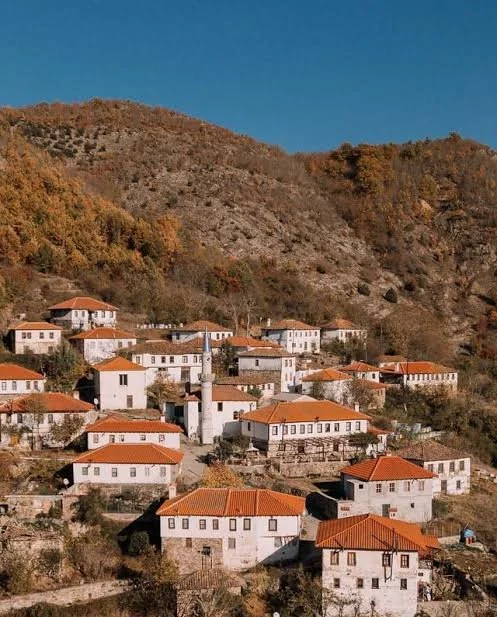
The title The Unseen Pomak Villages Along the Rhodope Frontier evokes settlements that may appear remote or overlooked because of their mountainous geography.
Rather than suggesting that these villages literally disappeared from maps, the subject is better understood as an exploration of mountain communities whose histories have often received less attention than those of major Balkan cities.
The Rhodope Mountains
The Rhodopes extend across Bulgaria and Greece.
The mountain environment contains forests, deep valleys, high plateaus, and isolated settlements.
Transportation has historically been difficult.
Communities therefore developed strong local economies and social networks.
Pomak Identity
Pomak identity is complex.
Different scholars, states, and communities have used the term differently.
Language is one important component.
Many Pomak communities historically spoke local varieties of South Slavic languages.
Religion is another major component, with Islam playing an important role in community identity.
However, identity cannot be reduced to language or religion alone.
Family history, locality, cultural traditions, and political circumstances also matter.
Ottoman History
The Ottoman period was particularly important for the development of Muslim communities in the Rhodopes.
Conversion to Islam occurred over long periods and under diverse circumstances.
It would be misleading to explain all conversion simply through a single process.
Economic, political, social, and personal factors could interact.
The region's religious landscape subsequently became part of the Ottoman Balkan world.
Mountain Villages
Traditional mountain settlements often adapted closely to their environment.
Homes could be built from locally available stone and timber.
Agriculture was shaped by altitude.
Livestock raising complemented farming.
Forests provided fuel and building materials.
Villages could therefore become relatively self-sufficient.
The Meaning of "Unseen"
Remote mountain villages can become invisible in national narratives.
Historical writing frequently concentrates on capitals, major battles, rulers, and administrative centers.
Small settlements leave fewer written records.
Their histories may survive instead through:
family traditions,
cemeteries,
mosques,
houses,
agricultural terraces,
place names,
songs,
oral histories,
and local dialects.
Borderland Identity
The Greek-Bulgarian border has not always existed in its modern form.
Political boundaries changed dramatically during the nineteenth and twentieth centuries.
Communities that once interacted through regional mountain networks could find themselves divided by international borders.
This transformed patterns of trade, migration, marriage, and pastoral movement.
Population Movement
Twentieth-century political changes had major effects on Muslim populations in the Balkans.
Migration, state policies, border controls, economic changes, and population exchanges reshaped many communities.
Some villages declined.
Others changed linguistically or economically.
The resulting landscape is therefore very different from the one that existed several generations ago.
Preserving Village Heritage
Traditional architecture is especially vulnerable.
Abandoned houses deteriorate quickly.
Wooden structures collapse.
Agricultural terraces become overgrown.
Oral traditions disappear when younger generations move to cities.
Documentation is therefore essential.
Researchers can combine architectural surveys with oral history and historical documents to reconstruct village life.
Conclusion
The Unseen Pomak Villages Along the Rhodope Frontier represent an important part of Balkan social history.
The villages are not simply mysterious hidden places.
They are communities shaped by mountains, religion, language, agriculture, Ottoman history, modern borders, migration, and changing economic conditions.
Their relative absence from mainstream historical narratives demonstrates why migration and diaspora studies are so important.
History does not happen only in capitals.
It also happens in mountain villages, family homes, shepherd trails, workshops, fields, and communities whose stories survive through memory long after official records become silent.







