
Introduction
The history of Circassian displacement belongs to one of the largest and most consequential forced migrations in the nineteenth-century Caucasus. The Circassians, an Indigenous group of the northwestern Caucasus, experienced catastrophic upheaval during the final decades of the Russian conquest of the region. Large numbers were expelled or forced to migrate, with many eventually settling in the Ottoman Empire.
The title Hidden Circassian Exile Camps in Thessaly Plains suggests a little-known chapter of this broader diaspora: the possibility of Circassian refugees being temporarily accommodated in or passing through Thessaly.
The subject requires particular care because Ottoman refugee settlement was extensive and frequently temporary, while surviving documentation is uneven. It would therefore be inappropriate to claim that a specific undiscovered "Circassian camp" existed at a particular Thessalian location without documentary or archaeological evidence.
Nevertheless, the wider history of Caucasian refugees in Ottoman territories provides an important framework for understanding how displacement reshaped nineteenth-century Greece and the eastern Mediterranean.
The Circassian Catastrophe
During the nineteenth century, the Russian Empire expanded into the Caucasus.
The resulting wars were particularly devastating for Circassian communities.
Following the defeat of major Circassian resistance in the 1860s, enormous numbers of people were displaced.
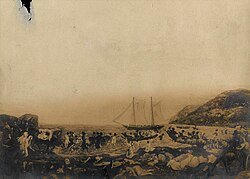
Many were transported across the Black Sea into Ottoman territories.
The migration was accompanied by disease, hunger, overcrowding, and extremely high mortality.
For survivors, exile meant rebuilding communities far from their ancestral homeland.
The Ottoman Refugee System
The Ottoman Empire became the principal destination for many Caucasian refugees.
Authorities attempted to distribute refugee populations across different provinces.
Settlement was influenced by agricultural needs, security concerns, available land, transportation, and existing population patterns.
Refugees were sometimes settled in villages specifically established for them.
Others were temporarily housed in camps or moved repeatedly before permanent settlement.
Thessaly as a Borderland
Thessaly occupied a distinctive position during the nineteenth century.
Much of the region remained under Ottoman rule until the annexation of Thessaly by the Kingdom of Greece in 1881.
This political transition is important when discussing refugee communities.
A group located in Thessaly before 1881 would have lived within the Ottoman administrative system.
After annexation, the same landscape became part of the Greek state.
Political change could therefore alter the legal status and administrative treatment of communities.
Why Camps Could Disappear
Temporary refugee camps are among the most difficult historical settlements to identify.
Unlike permanent villages, camps might consist of tents, wooden shelters, or improvised structures.
After residents moved elsewhere, physical traces could disappear rapidly.
Archaeological evidence might be limited to broken ceramics, foundations, pits, metal objects, or altered soil.
Historical records may provide stronger evidence than archaeology.
Ottoman administrative documents, refugee registers, land records, correspondence, and local histories can help establish whether a particular community was present.
Circassian Communities in the Ottoman World
Circassian refugees eventually established communities across the Ottoman Empire.
They became involved in agriculture, military service, administration, livestock raising, and local commerce.
Their identities also evolved through interaction with other Muslim and Christian populations.
Circassian communities were not culturally isolated.
They participated in the wider economic and political life of the regions where they settled.
The Problem of the "Hidden Camp"
A mysterious abandoned site should not automatically be labeled a Circassian refugee camp.
Historical identification requires evidence connecting the location to Circassian migrants.
Useful evidence might include:
Ottoman settlement documents,
refugee registers,
contemporary maps,
personal accounts,
cemetery inscriptions,
oral histories,
architectural remains,
or identifiable material culture.
Without such evidence, the claim remains speculative.
Memory and Diaspora
Diaspora communities often preserve memories of migration long after the original settlement disappears.
Family histories may record the names of villages, journeys, hardships, or relocation.
Such memories can be extremely valuable, although they should be compared with documentary evidence.
The absence of a written record does not automatically invalidate oral history.
Instead, historians treat oral testimony as one part of a larger evidentiary framework.
Conclusion
The Hidden Circassian Exile Camps in Thessaly Plains should be approached as a historical investigation into the movement and settlement of Caucasian refugees rather than as a confirmed archaeological discovery.
The Circassian displacement itself is firmly documented.
The broader Ottoman refugee system is also well established.
What remains uncertain is whether particular temporary camps existed in specific parts of Thessaly and what physical traces they may have left.
The story nevertheless illustrates a larger transformation of the nineteenth-century eastern Mediterranean: communities displaced from one imperial frontier could become part of entirely new societies hundreds or thousands of kilometers away.







