
Introduction
The Crimean Goths represent one of the most intriguing examples of cultural continuity and transformation in the medieval Black Sea region.
Gothic-speaking communities survived in Crimea long after the collapse of the western Roman Empire.
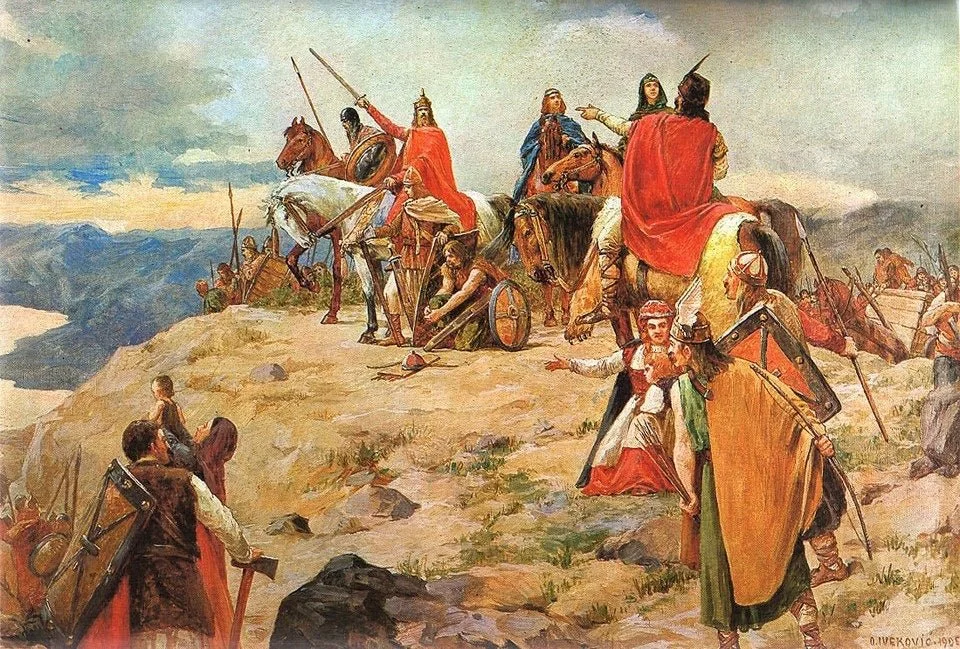
The title The Unwritten Flight of Crimean Goths to Corfu imagines a migration from Crimea to the Ionian island of Corfu.
There is no firm historical evidence establishing a mass migration of Crimean Goths to Corfu.
Nevertheless, the possibility of individual movement across Byzantine maritime networks provides an interesting framework for exploring mobility in the medieval Mediterranean.
The Goths in Crimea
Gothic groups settled in Crimea during late antiquity.
Over centuries, they interacted with Greek-speaking populations, the Byzantine Empire, steppe peoples, and other communities.
Their culture therefore changed substantially.
They were not simply an isolated surviving fragment of the ancient Goths.
Byzantine Crimea
Crimea was strategically important to Byzantium.
Its ports connected the Black Sea with Constantinople and other coastal regions.
Military garrisons, merchants, sailors, clergy, and diplomats moved through the region.
This created opportunities for cultural exchange.
The Gothic Language
A Crimean Gothic language survived for a long period.
Unfortunately, evidence for it is limited.
A small number of words and references have been preserved.
This makes every fragment particularly valuable to historical linguists.
Corfu and Byzantine Networks
Corfu occupied a strategic position in the Ionian Sea.
It served as a maritime gateway between the Adriatic, Greece, and the broader Mediterranean.
Byzantine ships and military forces used the island as part of wider regional networks.
A person from Crimea could theoretically have traveled through Byzantine maritime systems to the Ionian world.
Individual Mobility Versus Mass Migration
This distinction is crucial.
Medieval empires moved people for many reasons.
Soldiers could be reassigned.
Prisoners could be relocated.
Merchants could settle abroad.
Clergy could travel.
Families could migrate.
But without documentation, it is impossible to transform such possibilities into claims of a large Gothic migration.
Why the Story Persists
Lost-migration stories are attractive because they offer explanations for cultural similarities.
However, historical research requires evidence.
Place names, inscriptions, burials, linguistic traces, and documentary references would be necessary to demonstrate a Crimean Gothic presence in Corfu.
The Mediterranean as a Connected World
The Byzantine world was highly interconnected.
The Black Sea and Mediterranean were linked through Constantinople.
People could travel enormous distances within imperial networks.
Therefore, the movement of individuals from Crimea toward the Ionian Islands is not geographically impossible.
It is simply undocumented at the scale implied by the title.
Conclusion
The Unwritten Flight of Crimean Goths to Corfu is best treated as a thought-provoking migration hypothesis rather than an established historical event.
Crimean Goths genuinely existed.
Byzantine maritime networks genuinely connected Crimea with the Mediterranean.
What remains unproven is a specific Gothic migration to Corfu.
The story nevertheless highlights a broader truth: medieval identities were not confined to one landscape. People could move across imperial systems, and their journeys could disappear almost completely from the surviving historical record.







