Introduction
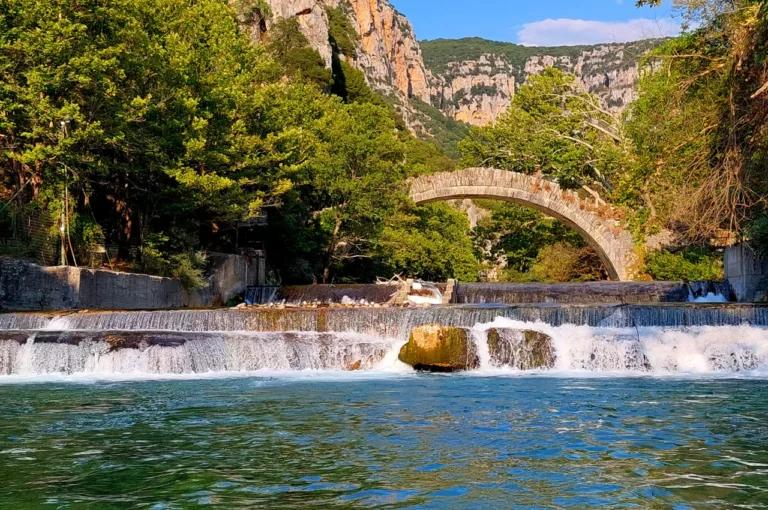
The Voidomatis River, located in the Epirus region of northwestern Greece, is known for its clear waters, limestone landscapes, and association with the Vikos Gorge and the wider Zagori region. Its geological setting provides an interesting environment for studying carbonate dissolution, groundwater movement, and mineral deposition.
Travertine cascades are formations created when calcium carbonate precipitates from water, often producing terraces, small dams, ledges, and irregular mineral surfaces. The possibility of travertine formation along particular sections of the Voidomatis River presents a useful geological research topic.
The presence of specific travertine cascades at particular locations along the river would require geological mapping and mineralogical confirmation.
Geological Setting
The broader Zagori landscape is characterized by carbonate rocks, including limestone, which are susceptible to chemical weathering.
Rainwater absorbs carbon dioxide from the atmosphere and soil, forming a weak carbonic acid solution. This water can dissolve calcium carbonate in limestone as it moves through fractures, caves, and underground drainage systems.
When groundwater emerges into the open, environmental changes may cause calcium carbonate to precipitate.
The process is particularly important in karst landscapes, where groundwater circulation creates caves, springs, sinkholes, and other geological features.
Travertine Formation
Travertine is a form of terrestrial carbonate deposit commonly associated with springs, streams, and groundwater systems.
The precipitation of calcium carbonate may occur when:
Water loses carbon dioxide.
Temperature changes influence carbonate chemistry.
Turbulence increases gas exchange.
Photosynthetic organisms remove dissolved carbon dioxide.
Water chemistry changes during mixing.
The resulting deposits can form around rocks, submerged vegetation, stream edges, and other surfaces.
Over time, repeated deposition may produce stepped surfaces and small cascades.
Cascade Development
Travertine cascades develop when carbonate deposition gradually modifies the shape of a stream channel.
Small mineral ridges may create shallow pools upstream. Water passing over these ridges may deposit additional carbonate, gradually strengthening or enlarging the structures.
This process can create a series of terraces, barriers, and irregular channels.
However, carbonate deposition is not necessarily continuous. Floods may erode deposits, transport sediment, and reshape the channel.
Geological and Ecological Significance
Travertine deposits can preserve evidence of environmental conditions.
Their layers may contain:
Mineralogical changes.
Organic remains.
Microbial structures.
Sediment inclusions.
Chemical variations.
Evidence of past water conditions.
These features may help reconstruct changes in groundwater chemistry, temperature, vegetation, and stream behavior.
Travertine surfaces may also provide habitats for microorganisms and specialized plants.
Research Methods
Researchers studying travertine along the Voidomatis could use:
Geological mapping.
Water chemistry analysis.
Calcium and bicarbonate measurements.
Stable isotope analysis.
Mineral identification.
Microscopic examination.
Dating of carbonate deposits where suitable.
These techniques could help determine whether a deposit is travertine, distinguish it from other carbonate sediments, and investigate its formation history.
Conclusion
Travertine cascades provide an example of how groundwater chemistry can gradually reshape river landscapes.
The Voidomatis region offers a valuable setting for investigating limestone dissolution, carbonate precipitation, water movement, and the development of natural stream terraces.