The Blueprint of Governance: Greek Political Thought and Modern Democracy
The word "democracy" itself—demokratia—is a compound of demos (the people) and kratos (power). While modern representative systems look very different from the raucous, direct assemblies of ancient Athens, the intellectual DNA of Western governance was forged in the debates of the Greek polis.
1. The Birth of Popular Sovereignty
The most radical Greek contribution was the idea that political legitimacy comes from the governed, not from divine right or hereditary bloodlines.
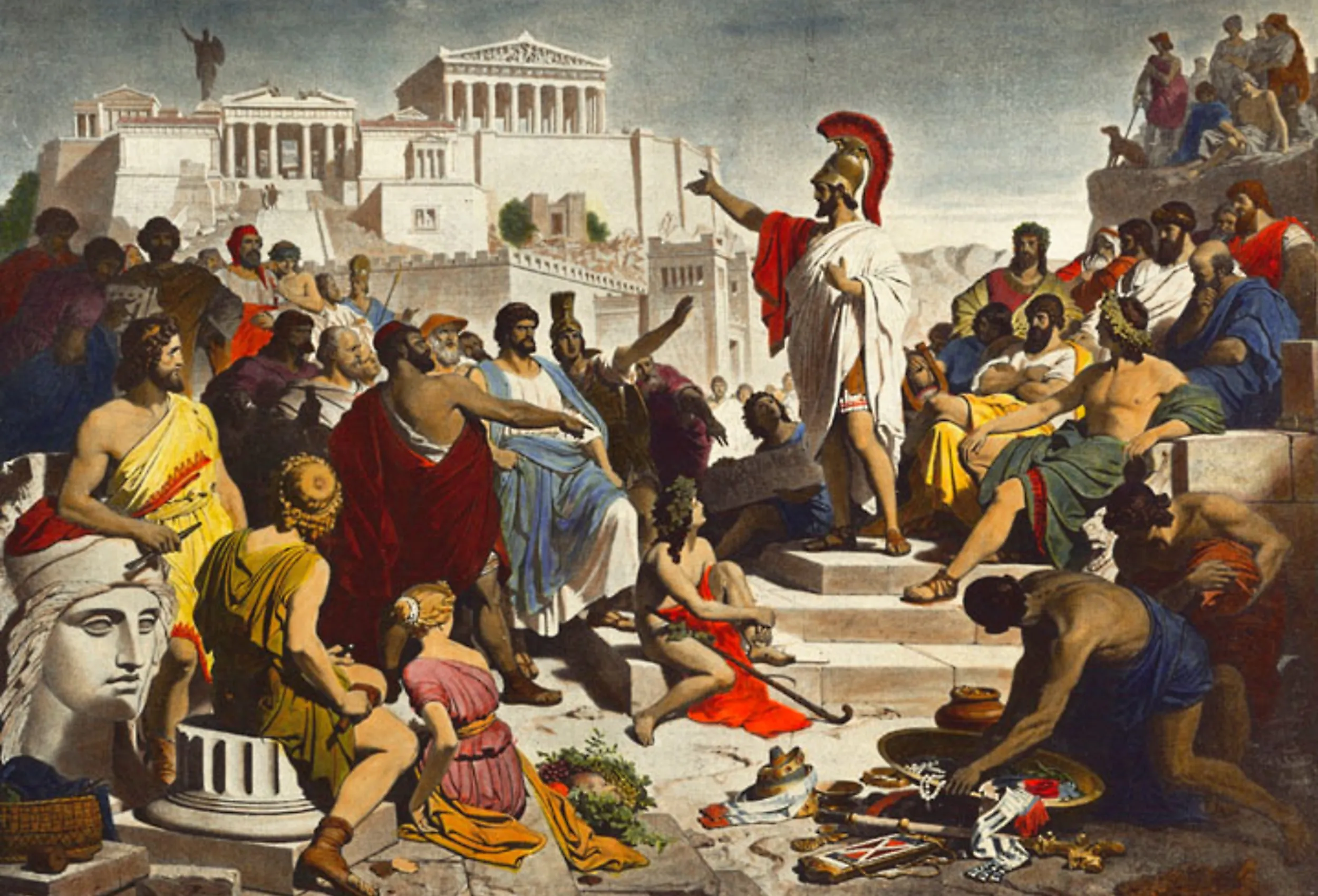
The Assembly (Ecclesia): In Athens, every citizen had the right to speak (isegoria) and vote. This established the principle that public policy should be the result of open, collective deliberation rather than the whim of a monarch.
The Council of 500 (Boule): To prevent any one person from seizing power, members were chosen by sortition (lottery). This reflected the Greek belief that any citizen was capable of governing, a sharp contrast to modern "professional" politics.
2. Aristotle and the "Politeia"
Aristotle’s Politics remains one of the most influential texts in history. He categorized governments by who rules and whether they rule for the common good or self-interest.
The Mixed Constitution: Aristotle argued that the most stable government was a "polity"—a blend of democracy (rule by the many) and aristocracy (rule by the few). This prevented the "tyranny of the majority" while ensuring the elite couldn't exploit the poor.
The Rule of Law: Aristotle famously argued that "the law should govern," asserting that even the most powerful leaders must be subordinate to established legal principles. This is the direct ancestor of the modern concept of the Rule of Law.
3. The Separation of Powers and Checks
While the Greeks didn't have a formal three-branch system, they pioneered the mechanics of balancing power to prevent tyranny.
Ostracism: A unique Athenian process where citizens could vote to exile a politician for ten years if they felt he was becoming too powerful. It was a literal "check" on individual ambition.
The Spartan "Great Rhetra": Sparta’s system included two kings, a council of elders (Gerousia), and elected overseers (Ephors). Polybius, a Greek historian, praised this "mixed" system for its stability, which deeply influenced Enlightenment thinkers like Montesquieu and the American Founding Fathers.
4. Civic Virtue and the Social Contract
For the Greeks, politics was not a spectator sport; it was a moral duty. The word idiotes (idiot) originally referred to a private person who took no interest in the affairs of the state.
The Common Good: Greek thought emphasized that the goal of the state was to foster eudaimonia (flourishing) for its citizens.
The Trial of Socrates: This event forced a permanent debate in political theory: the tension between the will of the majority and the rights of the individual. Modern democracies protect minority rights largely as a response to the "excesses" of Athenian direct democracy.
5. The Enlightenment and the American Experiment
During the 18th century, the "Rediscovery of the Ancients" provided the framework for modern republics.
The Federalist Papers: James Madison and Alexander Hamilton frequently cited Greek history—specifically the failures of the Achaean League and the chaos of Athenian mobs—to argue for a Representative Republic rather than a Direct Democracy.
Natural Law: The Stoic Greek idea of a universal "Natural Law" that transcends local edicts became the foundation for the Declaration of Independence and the concept of "unalienable rights."
The Enduring Legacy
The Greeks gave us the "grammar" of politics. When we debate the merits of a "mixed economy," worry about "demagogues," or argue for "transparency" in government, we are using tools invented 2,500 years ago. Their greatest legacy is the conviction that the state is a human creation, intended for human benefit, and subject to human reason.