The story of how Greek texts returned to Western Europe is one of the most dramatic "relay races" in intellectual history. For centuries, the Latin West had lost direct access to the works of Plato, Aristotle, and the Greek scientists, living instead off thin summaries and fragments. The "rediscovery" wasn't a single event, but a multi-century process that flowed through three primary gateways: Islamic Spain, Norman Sicily, and the Byzantine Empire.
1. The Arabic Gateway: The "Great Translation"
During the 12th-century Renaissance, the most significant influx of Greek knowledge came not from Greece, but from the Islamic world.
The Path of Knowledge: After the fall of Rome, Greek texts were preserved and expanded upon in Baghdad. As the Reconquista pushed south into Toledo, Spain, European scholars discovered massive libraries filled with Arabic translations of Greek masterpieces.
The Translators: Figures like Gerard of Cremona worked tirelessly to translate these works from Arabic into Latin. It was through this "Arabic filter" that Europe first regained the bulk of Aristotle’s logic and science, as well as the astronomical works of Ptolemy.
The Impact: This influx provided the "fuel" for the rise of the first universities in Paris, Bologna, and Oxford.
2. The Sicilian Connection: Direct Bridges to the East
While Spain provided Arabic translations, Norman Sicily offered a rare opportunity for direct translation from the original Greek.
A Multicultural Hub: Sicily was a unique crossroads where Greek-speaking Byzantines, Arabic-speaking Muslims, and Latin-speaking Normans lived side-by-side.
Direct Access: Scholars in Sicily, such as Henricus Aristippus, were able to translate works like Plato’s Meno and Phaedo directly from Greek manuscripts obtained from the Byzantine court. This allowed for a higher degree of accuracy than the multi-step Arabic-to-Latin process.
3. The Scholastic Synthesis: Harmonizing Faith and Reason
The rediscovery of Greek logic—specifically the "New Logic" of Aristotle—initially caused a crisis in the Church. Aristotle’s view of an eternal universe seemed to contradict the Biblical account of creation.
Thomas Aquinas: The most significant intellectual shift occurred when St. Thomas Aquinas used Aristotelian logic to create a systematic defense of Christian doctrine.
The New Method: This "Scholasticism" turned theology into a rigorous, logical science. It taught students how to use syllogisms and dialectics to reconcile apparent contradictions between the "Light of Reason" (Greek philosophy) and the "Light of Faith" (Scripture).
4. The Byzantine Wave and the Council of Florence
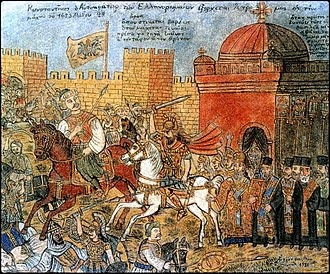
As the Byzantine Empire faced the threat of Ottoman conquest in the 14th and 15th centuries, Greek scholars began moving westward, bringing their libraries with them.
Petrarch and Boccaccio: Early Renaissance figures in Italy were desperate to learn Greek. They hired Byzantine teachers like Barlaam of Calabria to help them decipher the works of Homer and Plato.
The Council of Florence (1439): This attempt to unite the Eastern and Western churches brought a massive delegation of Greek intellectuals to Italy. Their presence, and the manuscripts they brought, effectively ended the medieval "monopoly" on Latin and launched the full-scale Greek revival of the Renaissance.
5. Why the Rediscovery Changed Everything
Before this period, medieval thought was largely focused on authority and tradition. The reintroduction of Greek texts introduced three revolutionary concepts:
The Sovereignty of Reason: The idea that the human mind could understand the laws of nature through observation and logic.
Scientific Inquiry: Access to Euclid (geometry), Galen (medicine), and Archimedes (physics) laid the groundwork for the Scientific Revolution.
Humanism: The Greek focus on the dignity and potential of the individual began to slowly shift the European worldview away from a purely God-centered focus.
The "lost" Greek texts acted like a time capsule. When they were finally opened in the Middle Ages, they provided the intellectual vocabulary that Europe used to build the modern world.
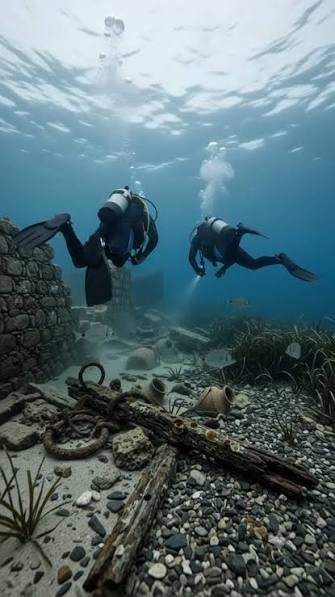
Given your interest in archaeology and artifacts, does the idea of these "lost" manuscripts—some hidden for a thousand years—feel like a kind of intellectual excavation to you?