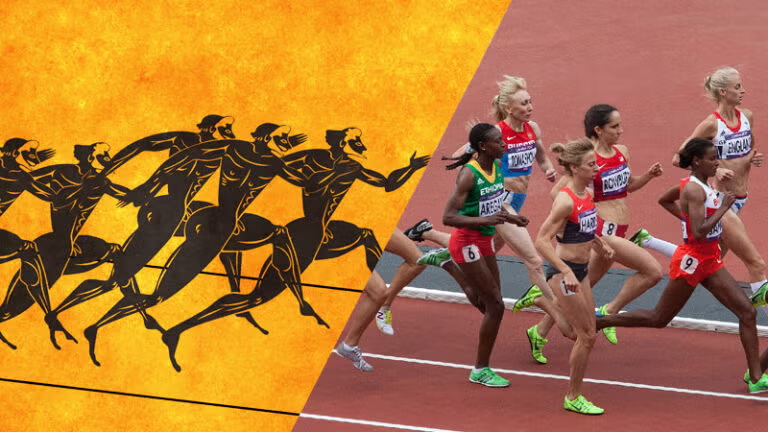
While the modern Olympics are inspired by the ancient games of Olympia, the two events are separated by much more than just 1,500 years of history. The ancient games were a religious festival held in honor of Zeus, whereas the modern games are a global secular celebration of athletic excellence and international cooperation.
1. Purpose: Religion vs. Internationalism
The most fundamental difference lies in the why behind the games.
Ancient: The games were a sacred religious ritual. Athletes sacrificed animals to Zeus, and the competition was a way to display Arete (excellence/virtue) as an offering to the gods. A "sacred truce" (ekecheiria) was declared across Greece, not to end wars, but to ensure safe passage for pilgrims traveling to the sanctuary.
Modern: The games are designed to promote world peace and "Olympism." While they still feature ritual (the torch relay and opening ceremonies), the focus is on the secular unity of nations and the breaking of world records.
2. Participation and Eligibility
The "Who" of the Olympics has expanded significantly over the centuries.
Ancient: Participation was strictly limited to free-born Greek males. Non-Greeks (barbarians), slaves, and women were excluded. In fact, married women were forbidden from even watching the games under penalty of death, though unmarried women had their own separate festival, the Heraia, in honor of Hera.
Modern: The games are arguably the most inclusive event on Earth. Since 1900, women have competed, and today, athletes from over 200 nations—regardless of religion, race, or social status—participate in both the Summer and Winter Games, as well as the Paralympics.
3. The Events: Specialization vs. Combat
The ancient Greeks valued the "all-around" athlete, while the modern era prizes the specialist.
Ancient Combat: The ancient games featured brutal combat sports like Pankration, a mix of wrestling and boxing with almost no rules (only biting and eye-gouging were banned). Matches didn't have rounds or weight classes; they ended when someone surrendered or died.
Modern Diversity: Today, we have over 300 events across dozens of sports, including team sports (like basketball and soccer) which were entirely absent in the ancient world. Modern sports are strictly regulated with safety gear, weight classes, and medical staff.
4. Clothing (or Lack Thereof)
One of the most striking visual differences is what the athletes wore.
Ancient: Athletes competed entirely naked. This was partly to show off their physical form (a tribute to the gods) and partly for freedom of movement. They would coat their bodies in olive oil and scrape it off with a metal tool called a strigil after competing.
Modern: High-tech performance gear is the norm. From aerodynamic swimsuits to carbon-fiber running shoes, modern apparel is designed to shave milliseconds off a performance.
5. The Prize: Glory vs. Medals
The concept of "second place" didn't really exist for the Greeks.
Ancient: There was only one winner. The prize was a simple olive wreath (kotinos) cut from a sacred tree. However, the "real" rewards came back home; winners were treated like modern celebrities, receiving free meals for life, tax exemptions, and even statues in their honor.
Modern: We recognize the top three performers with Gold, Silver, and Bronze medals. While modern winners certainly gain fame and endorsements, the official recognition is tiered to celebrate a broader range of excellence.
6. Location and Frequency
Ancient: The games were always held in Olympia. The site was a permanent sanctuary, and the four-year cycle (an Olympiad) became a way for Greeks to measure time.
Modern: The games rotate to a different host city every four years. This "Traveling Circus" model allows different cultures to showcase their heritage to the world, though it lacks the permanent sacred connection of the ancient site.
The modern Olympics act as a bridge. We have replaced the sacrificial altars with podiums and the naked combat with synchronized swimming, but the core drive—to see just how far the human body can be pushed—remains exactly the same as it was in 776 BCE.
Given your interest in archaeology, have you ever looked into the specific ruins at Olympia, or do you find the cultural "evolution" of the games more fascinating?