Introduction
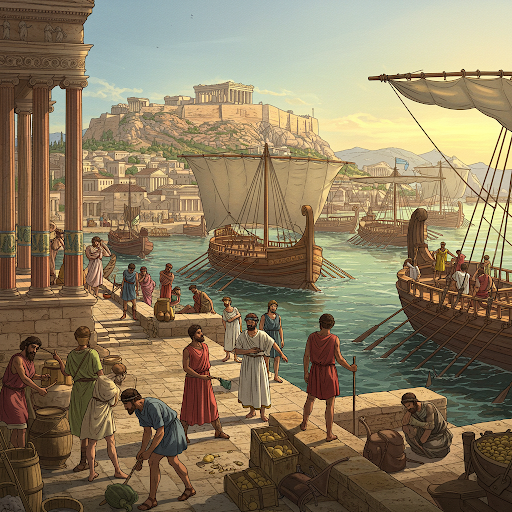
The economic wealth and geopolitical dominance of maritime powers like Athens, Rhodes, and Corinth were entirely dependent on their access to the sea. However, the Mediterranean coastline offered few natural bays capable of safely sheltering massive commercial fleets and state-managed navies from violent winter storms. To overcome this ecological barrier, ancient Greek engineers pioneered advanced maritime infrastructure and hydraulic engineering. By inventing underwater construction techniques and designing specialized, permanent dry-docks, they transformed open coastlines into highly secure, heavily fortified naval hubs that could rapidly project military and commercial power across the ancient world.
Hydraulic Engineering, Moles, and Trireme Shipsheds
The foundational challenge of Greek harbor construction was creating the choma—a massive, artificial breakwater or mole designed to absorb the crushing energy of incoming waves. To lay these foundations underwater, engineers utilized a highly resource-intensive stone-dropping method. They packed large merchant barges with multi-ton blocks of quarried limestone and raw volcanic pozzolana earth, towing them to the designated line and deliberately sinking them.
Over multiple seasons, workers piled thousands of tons of rock atop this submerged foundation, eventually raising a wide, stone-faced barrier above the sea level that created a calm, protected basin inside the harbor area.
The stone ramps were capped with wooden rollers and heavily lubricated with animal fat. When a warship (trireme) returned from patrol, its crew attached ropes to the hull and utilized heavy mechanical winches to pull the vessel completely out of the sea into a dry dock chamber.
Protected beneath expansive timber roofs, the vulnerable wooden hulls were insulated from the blistering summer sun and wet winters, effectively preventing the wood from warping and stopping catastrophic infestations of marine wood-boring shipworms (Teredo navalis). This ensured that the navy remained structurally sound and ready for instant deployment.
Conclusion
The construction of these monumental harbor complexes stands as a brilliant monument to ancient civil engineering, proving that the Greeks possessed a highly advanced command of structural geometry, logistics, and hydraulic dynamics. By systematically mastering underwater foundations and building highly specialized dry-dock networks, they effectively conquered the volatile coastal environment. These heavily fortified ports served as the secure launching pads for the maritime trade and naval dominance that directly financed the Golden Age of classical civilization.
The stone ramps were capped with wooden rollers and heavily lubricated with animal fat. When a warship (trireme) returned from patrol, its crew attached ropes to the hull and utilized heavy mechanical winches to pull the vessel completely out of the sea into a dry dock chamber.
Protected beneath expansive timber roofs, the vulnerable wooden hulls were insulated from the blistering summer sun and wet winters, effectively preventing the wood from warping and stopping catastrophic infestations of marine wood-boring shipworms (Teredo navalis). This ensured that the navy remained structurally sound and ready for instant deployment.
Conclusion
The construction of these monumental harbor complexes stands as a brilliant monument to ancient civil engineering, proving that the Greeks possessed a highly advanced command of structural geometry, logistics, and hydraulic dynamics. By systematically mastering underwater foundations and building highly specialized dry-dock networks, they effectively conquered the volatile coastal environment. These heavily fortified ports served as the secure launching pads for the maritime trade and naval dominance that directly financed the Golden Age of classical civilization.
The stone ramps were capped with wooden rollers and heavily lubricated with animal fat. When a warship (trireme) returned from patrol, its crew attached ropes to the hull and utilized heavy mechanical winches to pull the vessel completely out of the sea into a dry dock chamber.
Protected beneath expansive timber roofs, the vulnerable wooden hulls were insulated from the blistering summer sun and wet winters, effectively preventing the wood from warping and stopping catastrophic infestations of marine wood-boring shipworms (Teredo navalis). This ensured that the navy remained structurally sound and ready for instant deployment.
Conclusion
The construction of these monumental harbor complexes stands as a brilliant monument to ancient civil engineering, proving that the Greeks possessed a highly advanced command of structural geometry, logistics, and hydraulic dynamics. By systematically mastering underwater foundations and building highly specialized dry-dock networks, they effectively conquered the volatile coastal environment. These heavily fortified ports served as the secure launching pads for the maritime trade and naval dominance that directly financed the Golden Age of classical civilization.
The stone ramps were capped with wooden rollers and heavily lubricated with animal fat. When a warship (trireme) returned from patrol, its crew attached ropes to the hull and utilized heavy mechanical winches to pull the vessel completely out of the sea into a dry dock chamber.
Protected beneath expansive timber roofs, the vulnerable wooden hulls were insulated from the blistering summer sun and wet winters, effectively preventing the wood from warping and stopping catastrophic infestations of marine wood-boring shipworms (Teredo navalis). This ensured that the navy remained structurally sound and ready for instant deployment.
Conclusion
The construction of these monumental harbor complexes stands as a brilliant monument to ancient civil engineering, proving that the Greeks possessed a highly advanced command of structural geometry, logistics, and hydraulic dynamics. By systematically mastering underwater foundations and building highly specialized dry-dock networks, they effectively conquered the volatile coastal environment. These heavily fortified ports served as the secure launching pads for the maritime trade and naval dominance that directly financed the Golden Age of classical civilization.
The stone ramps were capped with wooden rollers and heavily lubricated with animal fat. When a warship (trireme) returned from patrol, its crew attached ropes to the hull and utilized heavy mechanical winches to pull the vessel completely out of the sea into a dry dock chamber.
Protected beneath expansive timber roofs, the vulnerable wooden hulls were insulated from the blistering summer sun and wet winters, effectively preventing the wood from warping and stopping catastrophic infestations of marine wood-boring shipworms (Teredo navalis). This ensured that the navy remained structurally sound and ready for instant deployment.
Conclusion
The construction of these monumental harbor complexes stands as a brilliant monument to ancient civil engineering, proving that the Greeks possessed a highly advanced command of structural geometry, logistics, and hydraulic dynamics. By systematically mastering underwater foundations and building highly specialized dry-dock networks, they effectively conquered the volatile coastal environment. These heavily fortified ports served as the secure launching pads for the maritime trade and naval dominance that directly financed the Golden Age of classical civilization.
The stone ramps were capped with wooden rollers and heavily lubricated with animal fat. When a warship (trireme) returned from patrol, its crew attached ropes to the hull and utilized heavy mechanical winches to pull the vessel completely out of the sea into a dry dock chamber.
Protected beneath expansive timber roofs, the vulnerable wooden hulls were insulated from the blistering summer sun and wet winters, effectively preventing the wood from warping and stopping catastrophic infestations of marine wood-boring shipworms (Teredo navalis). This ensured that the navy remained structurally sound and ready for instant deployment.
Conclusion
The construction of these monumental harbor complexes stands as a brilliant monument to ancient civil engineering, proving that the Greeks possessed a highly advanced command of structural geometry, logistics, and hydraulic dynamics. By systematically mastering underwater foundations and building highly specialized dry-dock networks, they effectively conquered the volatile coastal environment. These heavily fortified ports served as the secure launching pads for the maritime trade and naval dominance that directly financed the Golden Age of classical civilization.
The stone ramps were capped with wooden rollers and heavily lubricated with animal fat. When a warship (trireme) returned from patrol, its crew attached ropes to the hull and utilized heavy mechanical winches to pull the vessel completely out of the sea into a dry dock chamber.
Protected beneath expansive timber roofs, the vulnerable wooden hulls were insulated from the blistering summer sun and wet winters, effectively preventing the wood from warping and stopping catastrophic infestations of marine wood-boring shipworms (Teredo navalis). This ensured that the navy remained structurally sound and ready for instant deployment.
Conclusion
The construction of these monumental harbor complexes stands as a brilliant monument to ancient civil engineering, proving that the Greeks possessed a highly advanced command of structural geometry, logistics, and hydraulic dynamics. By systematically mastering underwater foundations and building highly specialized dry-dock networks, they effectively conquered the volatile coastal environment. These heavily fortified ports served as the secure launching pads for the maritime trade and naval dominance that directly financed the Golden Age of classical civilization.