Introduction
The tactical supremacy of the classic Greek hoplite phalanx was entirely dependent on the structural integrity of its defensive equipment. Standing shoulder-to-shoulder in a tightly packed wall of metal and wood, a soldier's survival hinged on the strength of his personal armor. Crafting these defensive masterpieces required an exceptional level of specialized metallurgical knowledge and composite engineering. By masterfully manipulating bronze alloys and combining them with organic shock-absorbing layers, ancient armorers (hoplopoioi) transformed raw metals into iconic shields and helmets that could successfully withstand the crushing impacts of hand-to-hand combat.
Metallurgical Engineering and Structural Composition
The defining symbol of the infantryman was the aspis (or hoplon)—a massive, circular shield stretching roughly three feet in diameter. Far from being a simple chunk of solid metal, the aspis was a masterpiece of composite structural engineering. The core was carved from seasoned wood (typically lightweight, resilient poplar or willow), which was meticulously shaped into a deep, convex dish.The armorer riveted a wide bronze band (the porpax) directly into the center of the shield to slide the forearm through, and placed a leather handle (the antilabe) at the outer edge. This distributed the massive 16-pound weight across the entire arm rather than straining the wrist alone, allowing the soldier to steer the shield with immense leverage.
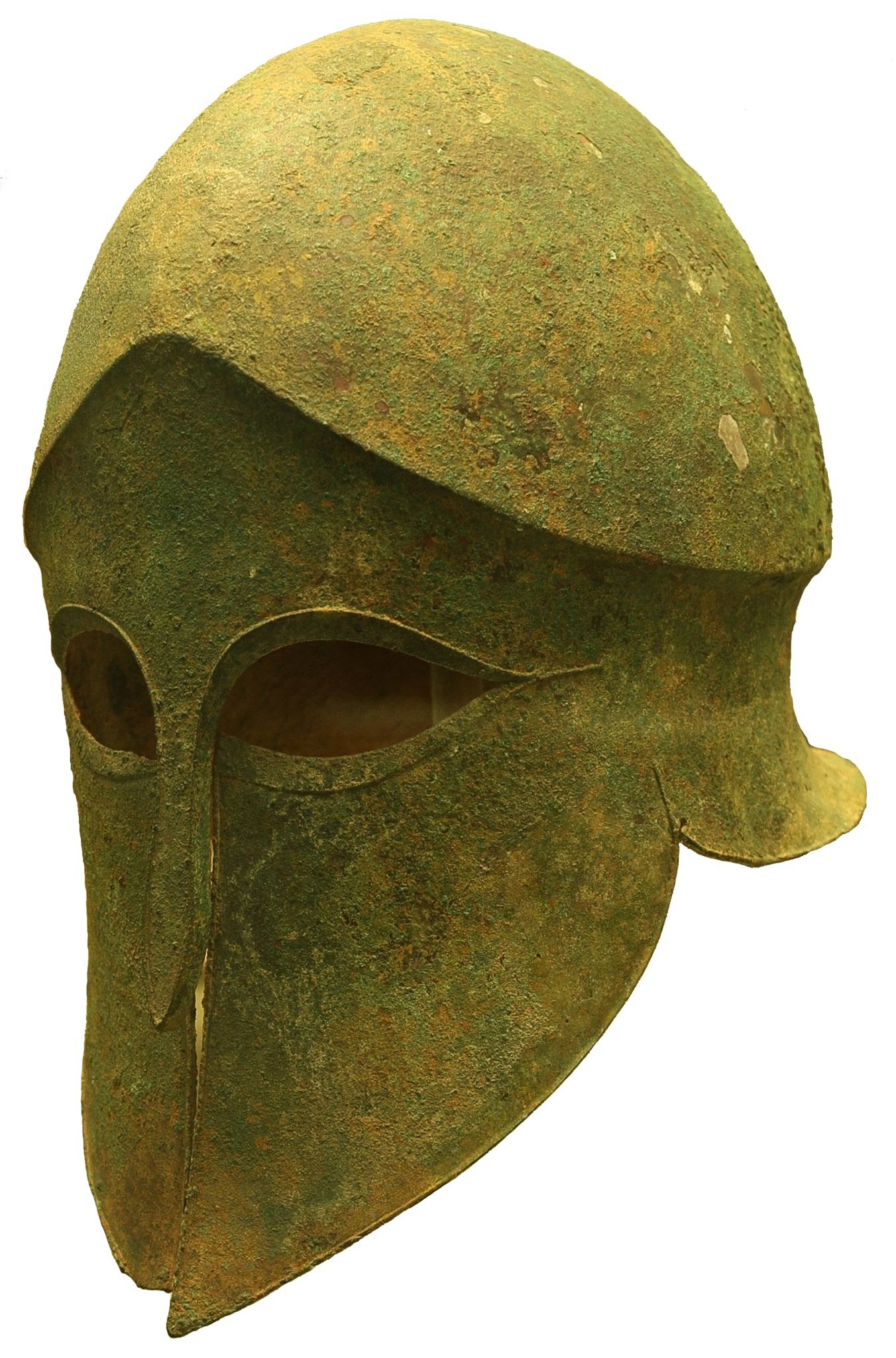
For head protection, the pinnacle of craftsmanship was the Corinthian helmet. Master armorers forged this legendary design from a single, solid ingot of high-tin bronze (approximately 90% copper, 10% tin). Through a grueling process of repeated heating and cold-hammering over custom iron anvils, the smith carefully manipulated the metal's thickness—raising a heavy, reinforced ridge across the forehead to deflect descending sword blows while thinning the cheek guards to reduce weight.
The interior was lined with soft felt or leather caps to cushion the skull against concussive forces, creating a seamless, highly resilient barrier that traded peripheral vision and hearing for absolute structural protection.
Conclusion
The construction methods undergirding ancient Greek arms armor highlight a sophisticated fusion of material science and functional geometry. The aspis and Corinthian helmet were not mere artisanal decorations; they were precisely engineered survival tools designed to absorb and redistribute extreme kinetic energy. The enduring material legacy of these bronze artifacts stands as a powerful testament to the skill of Aegean armorers, proving that the victories of the classical phalanx were built in the intense heat and ringing strikes of the blacksmith's forge.
The armorer riveted a wide bronze band (the porpax) directly into the center of the shield to slide the forearm through, and placed a leather handle (the antilabe) at the outer edge. This distributed the massive 16-pound weight across the entire arm rather than straining the wrist alone, allowing the soldier to steer the shield with immense leverage.
For head protection, the pinnacle of craftsmanship was the Corinthian helmet. Master armorers forged this legendary design from a single, solid ingot of high-tin bronze (approximately 90% copper, 10% tin). Through a grueling process of repeated heating and cold-hammering over custom iron anvils, the smith carefully manipulated the metal's thickness—raising a heavy, reinforced ridge across the forehead to deflect descending sword blows while thinning the cheek guards to reduce weight.
The interior was lined with soft felt or leather caps to cushion the skull against concussive forces, creating a seamless, highly resilient barrier that traded peripheral vision and hearing for absolute structural protection.
Conclusion
The construction methods undergirding ancient Greek arms armor highlight a sophisticated fusion of material science and functional geometry. The aspis and Corinthian helmet were not mere artisanal decorations; they were precisely engineered survival tools designed to absorb and redistribute extreme kinetic energy. The enduring material legacy of these bronze artifacts stands as a powerful testament to the skill of Aegean armorers, proving that the victories of the classical phalanx were built in the intense heat and ringing strikes of the blacksmith's forge.