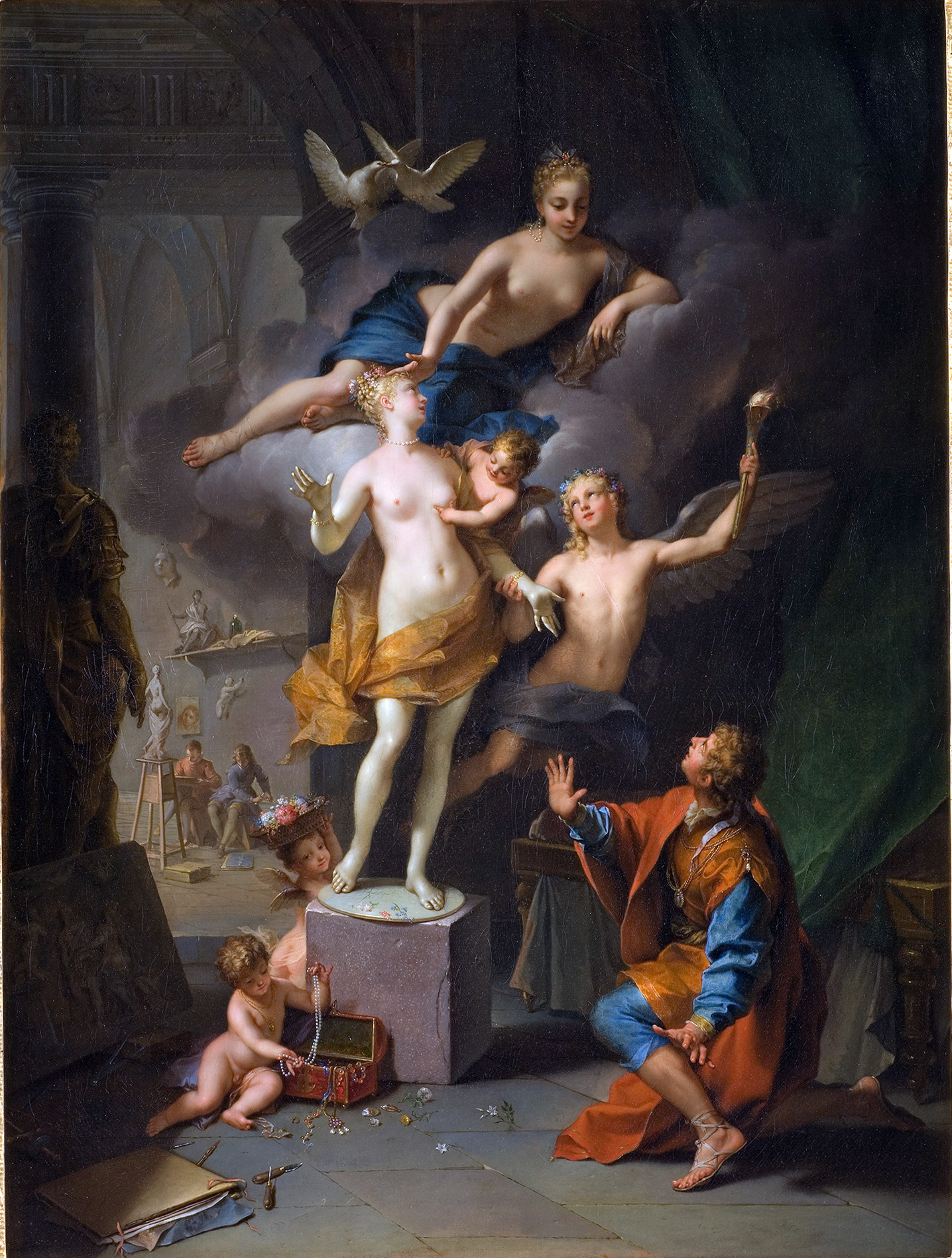
The Myth of Pygmalion and Galatea is one of the most enduring stories of love, artistic creation, desire, and transformation in classical mythology. At its center is Pygmalion, a gifted sculptor who becomes so deeply enamored with a statue he creates that he wishes for it to become a living woman.
The story explores a fascinating relationship between art and reality. Can an artist create something so beautiful that it transcends its material form? Can desire give life to an otherwise lifeless object? And what does the myth reveal about ancient ideas concerning beauty, divine intervention, and human creativity?
Although the name Galatea is commonly associated with Pygmalion's statue today, it is important to note that this name does not appear in the earliest surviving version of the story. The fullest ancient account comes from the Roman poet Ovid, whose Metamorphoses describes the woman as an unnamed ivory statue brought to life by the goddess Venus.
Pygmalion the Sculptor
Pygmalion was traditionally associated with Cyprus, an island strongly connected with the worship of Aphrodite, the Greek goddess of love.
He was described as an exceptionally talented sculptor.
According to Ovid, Pygmalion had become dissatisfied with real women and chose to remain unmarried. He considered the behavior of certain women around him morally objectionable and therefore withdrew from ordinary romantic relationships.
Instead, he devoted himself to his art.
The Creation of the Statue
Pygmalion eventually carved a statue of a woman from ivory.
The sculpture was extraordinarily beautiful.
He carefully shaped every feature:
the face;
the hair;
the hands;
the body;
and the proportions.
The statue appeared so lifelike that Pygmalion began to develop feelings for it.
The boundary between artistic representation and living reality gradually disappeared in his mind.
When Art Becomes an Object of Love
Pygmalion treated the statue as though it were a real woman.
He decorated it with clothing and jewelry.
He touched it affectionately.
He admired its beauty.
He imagined that it could respond to him.
The myth therefore presents an unusual form of love: the creator becomes emotionally attached to his own creation.
The Festival of Aphrodite
Eventually, Pygmalion participated in a festival dedicated to Aphrodite.
He prayed to the goddess for a wife resembling his statue.
He did not explicitly demand that the statue become alive.
Instead, he asked for a woman like the one he had created.
Aphrodite understood the meaning behind his prayer.
The Miracle
When Pygmalion returned home, he approached the statue.
He touched it.
To his astonishment, the ivory seemed to become warm.
The material softened.
The statue's body began to respond like living flesh.
Aphrodite had granted his wish.
The Statue Becomes Human
The transformation represents the climax of the story.
What had been:
stone-like material → sculpture → object of desire → living human being
was transformed through divine intervention.
The artist had created the form, but only the goddess could provide life.
Galatea
In later traditions, the statue became known as Galatea.
The name is particularly associated with later adaptations rather than Ovid's original account.
Over centuries, Galatea became a character in her own right.
Marriage
Pygmalion and the newly living woman were married.
Their relationship became an example of divine blessing upon sincere love.
In some later traditions, they had a child named Paphos, who became associated with the city of Paphos in Cyprus.
Aphrodite's Role
Aphrodite is crucial to the story.
Pygmalion's artistic skill alone cannot produce life.
The goddess represents the force that transforms desire into reality.
This reinforces an important distinction in Greek and Roman thought:
human beings can create forms, but the gods control life and divine transformation.
Art and Reality
The story raises questions that remain relevant today.
Artists create images of people, places, and ideas.
Sometimes those creations become emotionally powerful enough that audiences feel as though they are encountering something alive.
Pygmalion represents the extreme version of this phenomenon.
He becomes so absorbed in his creation that the distinction between representation and reality collapses.
The Pygmalion Effect
The name Pygmalion eventually entered modern psychology through the expression Pygmalion effect, which refers to situations in which expectations can influence performance.
Although the psychological concept is not the same as the ancient myth, the connection is based on the broader idea that belief can influence reality.
Later Literature and Art
The story has inspired:
paintings;
sculptures;
poems;
operas;
plays;
novels;
and films.
One of the most famous modern adaptations is George Bernard Shaw's Pygmalion, which later influenced the musical My Fair Lady.
However, Shaw's story changes the central idea considerably. Instead of a sculptor creating a woman, a linguist attempts to transform a working-class woman through education and social training.
Symbolism of the Ivory Statue
Ivory was an expensive and prestigious material in the ancient world.
Its smoothness and pale appearance made it suitable for representing idealized beauty.
The choice of ivory therefore emphasizes Pygmalion's extraordinary craftsmanship.
The Myth's Deeper Meaning
The myth can be interpreted as a story about:
artistic perfection;
idealized beauty;
desire;
divine grace;
creativity;
and the relationship between imagination and reality.
Conclusion
The Myth of Pygmalion and Galatea is ultimately a story about the extraordinary power human beings attribute to beauty and creation.
Pygmalion creates an idealized figure and falls in love with what he has made. Through Aphrodite's intervention, the boundary between art and life disappears.
The enduring appeal of the story lies in its central fantasy: that something created by human hands could become truly alive.