The Story of Agave and the Death of Pentheus is one of the darkest tragedies in Greek mythology.
It is closely associated with Dionysus, the god of wine, religious ecstasy, theater, and altered states of consciousness. The story describes how Pentheus, king of Thebes, attempts to suppress the worship of Dionysus and ultimately suffers a horrifying death at the hands of his own mother.
The most famous surviving literary version appears in Euripides' Bacchae.
The tragedy explores religious intolerance, human pride, divine vengeance, and the terrifying consequences of denying forces that cannot simply be controlled by political authority.
Dionysus Comes to Thebes
Dionysus was the son of Zeus and Semele, a princess of Thebes.
Semele died before Dionysus was born after Zeus revealed himself to her in his divine form.
Dionysus later returned to Thebes to establish his worship.
But the royal family did not fully accept his divine identity.
Pentheus
Pentheus was the son of Agave and Echion.
He became king of Thebes.
Unlike Dionysus' followers, Pentheus viewed the new religious movement with suspicion.
He considered the rituals associated with Dionysus dangerous and socially disruptive.
The Bacchants
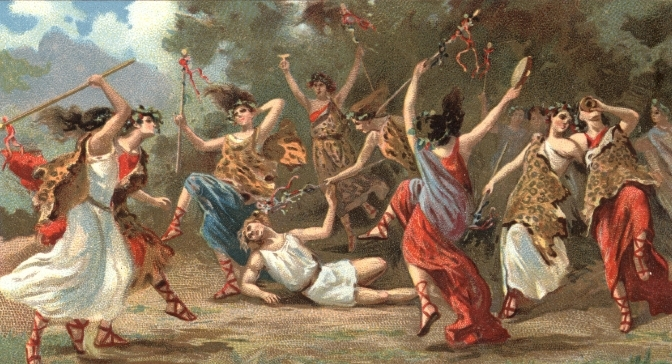
Women who followed Dionysus were known as Bacchants or Maenads.
They participated in ecstatic rituals involving:
dancing;
music;
chanting;
religious procession;
and altered states of consciousness.
Pentheus interpreted their behavior as immoral and threatening to public order.
The Conflict Between Pentheus and Dionysus
Pentheus attempted to arrest Dionysus.
But Dionysus manipulated events through divine power.
Pentheus believed that political authority could suppress the god.
This assumption becomes the central mistake of the tragedy.
Divine Retribution
Dionysus wanted Pentheus to recognize his divinity.
Instead, Pentheus remained hostile.
The conflict therefore became more than political.
It became a confrontation between:
human authority and divine power.
Pentheus Is Persuaded
Dionysus eventually manipulates Pentheus into observing the Bacchants secretly.
Pentheus becomes fascinated by the rituals he previously condemned.
The god convinces him to disguise himself so he can watch the women in the mountains.
The Fatal Journey
Pentheus travels into the wilderness.
There he hides among the trees.
But the Bacchants discover him.
Among them is his own mother, Agave.
The Madness of Agave
Agave is not consciously aware that the person before her is her son.
Under Dionysian frenzy, she perceives Pentheus as a wild animal.
The women attack him.
The Death of Pentheus
The Bacchants tear Pentheus apart.
Agave participates in the killing.
In her altered state, she believes she has successfully hunted a dangerous animal.
She returns to Thebes carrying Pentheus' head.
The Horrifying Recognition
Only after the frenzy ends does Agave realize what she has done.
She discovers that the “animal” she killed was her own son.
The moment is one of the most devastating scenes in Greek tragedy.
The Meaning of Dionysian Madness
The tragedy presents Dionysian ecstasy as something enormously powerful.
Dionysus cannot simply be reduced to the pleasant aspects of wine and celebration.
His domain includes:
liberation;
transformation;
ecstatic experience;
loss of ordinary identity;
and destructive frenzy.
Pentheus' Fatal Error
Pentheus believes that rational political authority can control everything.
His refusal to acknowledge Dionysus becomes a form of hubris.
The Greeks repeatedly warned against humans believing themselves powerful enough to challenge divine order.
Agave's Tragedy
Agave is not simply a villain.
She is simultaneously:
mother;
worshipper;
victim;
and killer.
Her tragedy comes from realizing that divine punishment has transformed her into the instrument of her son's destruction.
Euripides' Bacchae
Euripides' tragedy is especially significant because it does not offer an uncomplicated moral lesson.
Dionysus is both fascinating and terrifying.
Pentheus is both arrogant and understandable.
Agave is both responsible and manipulated.
The complexity makes the tragedy enduringly powerful.
Conclusion
The Story of Agave and the Death of Pentheus demonstrates the danger of treating divine forces as though they were merely political problems.
Pentheus attempts to suppress Dionysian worship through authority.
Instead, his resistance leads to his own destruction.
Agave's tragedy is even more devastating because she becomes the instrument of that destruction without understanding what she is doing.