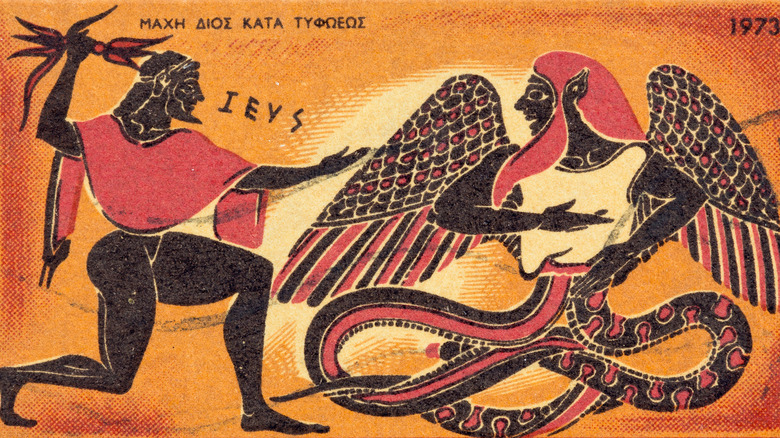
The Myth of Typhon and the Wrath of Zeus describes one of the greatest battles in Greek mythology: the confrontation between Zeus, king of the gods, and Typhon, an enormous primordial monster.
The conflict represents a cosmic struggle between divine order and destructive chaos.
The Birth of Typhon
Typhon was traditionally born to Gaia, the Earth, and Tartarus, the deep region beneath the Underworld.
He was one of the most terrifying beings in Greek mythology.
Description of Typhon
Ancient descriptions portray Typhon as enormous and monstrous.
He possessed:
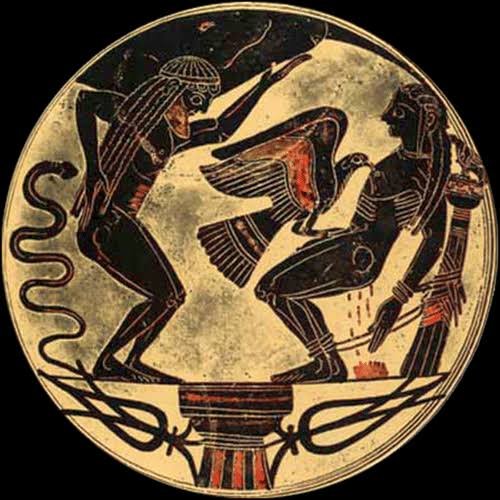
massive wings;
serpentine features;
numerous terrifying heads;
enormous strength;
and fiery or storm-like powers.
Some descriptions give him serpents emerging from his body.
A Threat to the Gods
Typhon challenged Zeus and the Olympian gods.
His goal was to overthrow the divine order established after Zeus' victory over the Titans.
The Battle
The conflict became a cosmic struggle.
Typhon was powerful enough to frighten the gods.
Some traditions say several gods fled temporarily to Egypt.
Greek mythology sometimes explains Egyptian animal-headed deities through this episode, although this interpretation belongs to a Greek mythological framework rather than Egyptian theology itself.
Zeus Fights Back
Zeus confronted Typhon using his thunderbolts.
The thunderbolt represented Zeus' supreme weapon.
The battle involved:
mountains;
fire;
storms;
and enormous supernatural force.
The Sicilian Tradition
One tradition states that Zeus eventually defeated Typhon and buried him beneath Mount Etna in Sicily.
The monster's movements were said to cause volcanic activity.
Volcanoes and Mythology
Ancient people lacked modern geological explanations for volcanic eruptions.
Mount Etna's:
smoke;
fire;
explosions;
and lava
could therefore be interpreted as evidence of supernatural activity beneath the earth.
Typhon provided a mythological explanation for this frightening natural phenomenon.
Zeus and Cosmic Order
The victory establishes Zeus as ruler of the cosmos.
Typhon represents uncontrolled destructive power.
Zeus represents:
law;
order;
authority;
and divine governance.
Typhon's Descendants
Typhon and Echidna were said to be the parents of several famous monsters, including:
Cerberus;
the Hydra;
the Chimera;
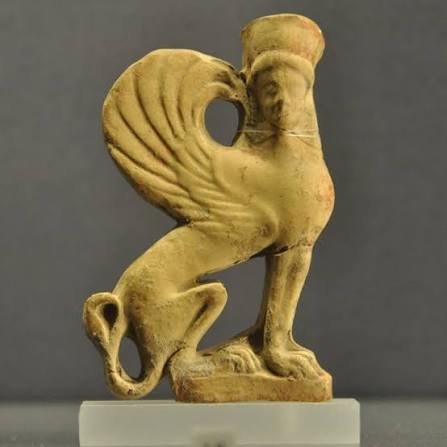
and the Sphinx in some traditions.
This makes Typhon part of a vast mythological genealogy of monsters.
The Meaning of the Conflict
The story can be understood as a myth explaining how cosmic order survived a final challenge.
The Olympian gods did not automatically possess absolute security.
They had to defend their authority.
Conclusion
The Myth of Typhon and the Wrath of Zeus is one of Greek mythology's greatest cosmic battles.
Typhon represents primordial destructive power, while Zeus embodies the establishment and preservation of divine order.
The story also connects mythology with natural phenomena, particularly volcanic activity.
By placing Typhon beneath Mount Etna, Greek mythology transformed a terrifying geological landscape into the prison of a defeated cosmic monster.