The Tale of Ixion and the Burning Wheel is one of the darkest myths of punishment in Greek mythology.
Ixion was a king who violated some of the most important rules of ancient Greek society, including the obligations of hospitality and respect for the gods.
His punishment was extraordinary.
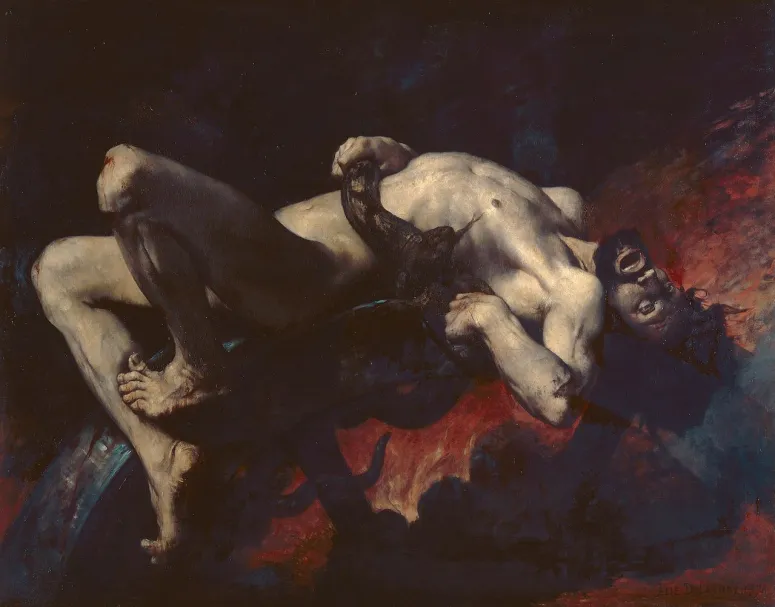
He was bound to a fiery wheel that continually rotated through the heavens.
Ixion the King
Ixion was king of the Lapiths in Thessaly.
He possessed wealth and power, but he became infamous because of his actions.
The Murder of His Father-in-Law
According to the myth, Ixion promised his father-in-law a valuable bride-price.
After the marriage, he refused to fulfill his obligation.
Eventually, Ixion killed his father-in-law.
The act was considered especially horrifying because it violated family obligations and the sacred bonds associated with marriage.
Pollution
In ancient Greek religion, murder created a condition of miasma, or ritual pollution.
A murderer needed purification.
Ixion's crime was so serious that ordinary purification was considered insufficient.
Zeus Shows Mercy
Surprisingly, Zeus took pity on Ixion.
He invited him to Olympus.
This was an extraordinary honor.
The gods were willing to give him an opportunity for redemption.
Ixion's Betrayal
Instead of showing gratitude, Ixion became obsessed with Hera, Zeus' wife.
His desire represented a direct violation of divine boundaries.
The Cloud Nephele
Zeus created a cloud resembling Hera.
The cloud was called Nephele in later tradition.
Ixion approached the cloud, believing it to be Hera.
The deception exposed his intentions.
The Birth of the Centaurs
Some traditions state that the union between Ixion and the cloud produced Centaurus, an ancestor of the Centaurs.
Other traditions provide different genealogies for the Centaurs.
The variation demonstrates the fluid nature of Greek mythological traditions.
The Punishment
Zeus condemned Ixion to an extraordinary punishment.
He was bound to a wheel.
The wheel was set on fire.
It was then made to rotate endlessly.
Ixion's punishment became eternal.
Why the Wheel?
The wheel symbolizes:
endless repetition;
instability;
loss of control;
and perpetual suffering.
Unlike a punishment that ends after a fixed period, Ixion's suffering has no conclusion.
Hospitality and Greek Culture
The story is deeply connected with xenia, the ancient Greek concept of sacred hospitality.
Guests and hosts were expected to respect each other.
Zeus himself was associated with the protection of strangers and guests.
Ixion's behavior violated these sacred expectations.
The Gods and Human Limits
Ixion's story demonstrates an important principle in Greek mythology:
Humans may receive divine favor, but abusing that favor can produce catastrophic consequences.
Zeus gives Ixion an extraordinary opportunity.
Ixion responds by violating divine trust.
Ixion's Place in the Underworld
Later traditions associate Ixion with the punishments of the Underworld.
His wheel became one of the most recognizable images of eternal punishment.
It belongs to the same mythological world as:
Sisyphus;
Tantalus;
and the Danaids.
Ixion and Desire
The story also examines uncontrolled desire.
Ixion's downfall begins with an inability to control his ambitions and appetites.
His desire for Hera becomes the final violation.
Symbolism of Fire
Fire adds another dimension to the punishment.
In Greek mythology, fire can symbolize:
purification;
divine power;
destruction;
and punishment.
The burning wheel transforms Ixion's punishment into an eternal spectacle of suffering.
Ixion as a Warning
The myth teaches several interconnected lessons:
gratitude matters;
hospitality is sacred;
divine generosity should not be abused;
desire must be controlled;
and humans should recognize their limits.
Conclusion
The Tale of Ixion and the Burning Wheel is a powerful story about betrayal, uncontrolled desire, and the consequences of violating sacred boundaries.
Ixion receives extraordinary mercy from Zeus but repays that mercy with further wrongdoing.
His punishment reflects the seriousness of his offenses: endless rotation upon a burning wheel.
Like the punishment of Sisyphus, Ixion's fate became a lasting symbol of eternal suffering.
But while Sisyphus is condemned to endless labor, Ixion is condemned to endless movement—a wheel that turns forever without carrying him anywhere.
Together, these myths reveal one of Greek mythology's recurring themes: those who refuse to respect the limits between human and divine existence may ultimately become trapped by the very desires and ambitions that drove them beyond those limits.