The Myth of Sisyphus is one of the most famous stories about punishment in Greek mythology.
Sisyphus was a clever king who repeatedly attempted to outwit the gods and even death itself.
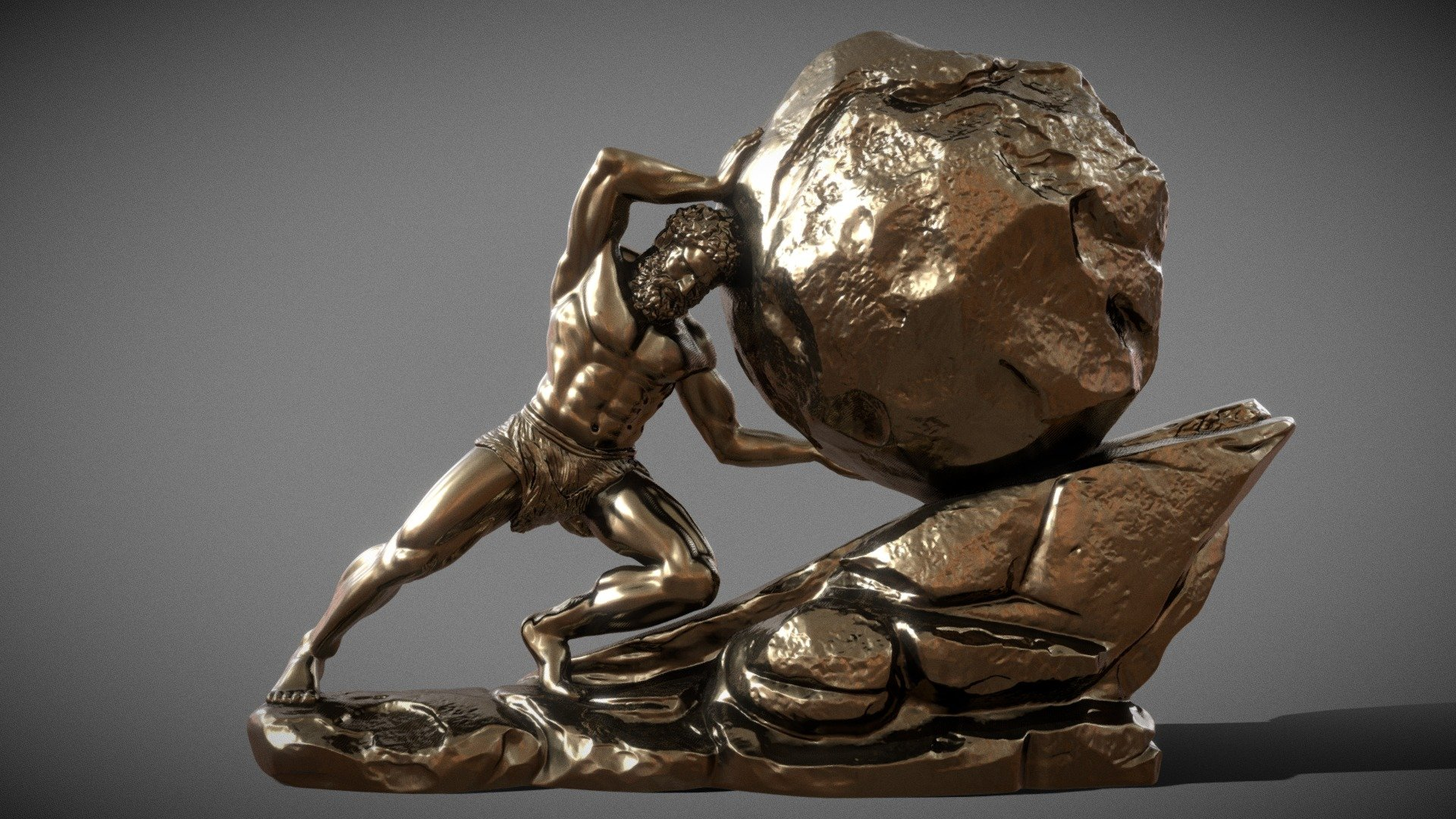
His punishment was extraordinary: he was condemned to push an enormous boulder up a hill, only to watch it roll back down every time he approached the summit.
He was then forced to repeat the task forever.
Sisyphus the King
Sisyphus was traditionally the founder and king of Corinth.
He was famous for his intelligence and cunning.
But Greek mythology often treats excessive cleverness as dangerous when it is used to challenge divine authority.
His Deceptions
Sisyphus was accused of violating divine boundaries by revealing secrets and attempting to manipulate supernatural forces.
He was particularly notorious for deceiving death.
Death Comes for Sisyphus
Eventually, the gods sent Thanatos, the personification of death, to take Sisyphus to the Underworld.
Sisyphus managed to trick Thanatos.
In one tradition, he chained Death itself.
The Consequences
With Thanatos restrained, humans could no longer die normally.
This created a cosmic problem.
The gods eventually intervened.
Sisyphus' deception could not continue indefinitely.
The Second Trick
Sisyphus also attempted to escape the consequences of death by arranging for his wife not to perform proper funeral rites.
He then claimed that he should be allowed to return temporarily to the world of the living so he could correct the situation.
Once back, he refused to return.
Eventually, the gods retrieved him.
The Punishment
Sisyphus was condemned to push a massive stone uphill.
Every time he approached the top, the stone rolled back down.
He had to begin again.
The task had no completion.
Why This Punishment?
The punishment was perfectly suited to Sisyphus.
His defining characteristic was his refusal to accept limits.
He continuously attempted to outsmart forces greater than himself.
The gods therefore gave him a task that represented endless effort without achievement.
The Meaning of Futility
Sisyphus became a symbol of pointless labor.
His task has:
effort;
repetition;
frustration;
and no final reward.
The punishment represents a condition in which work never produces lasting completion.
Sisyphus and Modern Philosophy
The myth became especially influential through the French philosopher Albert Camus.
In his 1942 philosophical essay The Myth of Sisyphus, Camus used the story to explore the concept of the absurd.
For Camus, the important question was not simply why Sisyphus suffers.
It was how a human being should respond to a world in which existence may appear meaningless.
“One Must Imagine Sisyphus Happy”
Camus famously concluded that Sisyphus could be imagined as happy.
The argument transforms the myth.
Instead of seeing Sisyphus only as a victim, Camus presents him as someone who becomes conscious of his situation and therefore possesses a form of freedom within it.
The Ancient and Modern Sisyphus
The ancient myth emphasizes:
punishment;
divine justice;
arrogance;
and the limits of human cunning.
The modern philosophical interpretation emphasizes:
existence;
meaning;
consciousness;
and human resilience.
Sisyphus as a Universal Symbol
Today, “a Sisyphean task” describes work that appears endlessly repetitive and impossible to complete.
The phrase is used in discussions of:
bureaucracy;
repetitive labor;
personal struggles;
and seemingly endless problems.
Conclusion
The Myth of Sisyphus has survived because its central image is immediately understandable.
A person pushes a stone uphill.
The stone falls.
He begins again.
Yet beneath this simple image lies a profound question about human existence.
The ancient Greeks used Sisyphus to demonstrate the consequences of defying divine limits, while modern thinkers have transformed him into a symbol of the human struggle to find meaning in repetition and hardship.