The transition from explaining the cosmos through myth to explaining it through reason (logos) is one of the most profound shifts in human history. Following the foundational frameworks of Socrates, Plato, and Aristotle, Greek philosophy and science fractured into highly specialized, brilliant disciplines during the Hellenistic and Roman eras.
1. The Hellenistic Schools of Thought: Philosophy as a Way of Life
After the conquests of Alexander the Great, the traditional Greek city-state (polis) collapsed into massive empires. Philosophy shifted from asking "How do we build a perfect city?" to "How do I, as an individual, find peace in a chaotic world?"
Stoicism (Founded by Zeno of Citium, c. 300 BCE)
Stoicism argued that the universe is governed by a rational, divine order called the Logos.
The Core Belief: True happiness (eudaimonia) is achieved by aligning one's will with nature and developing cardinal virtues: wisdom, courage, justice, and temperance.
The Dichotomy of Control: Stoics divided life into things they could control (their thoughts, desires, and actions) and things they could not (wealth, reputation, death). By focusing exclusively on the former, one achieves ataraxia (unshakable tranquility).
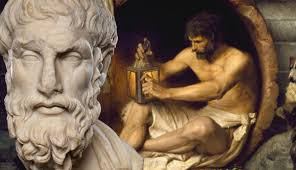
Epicureanism (Founded by Epicurus, c. 307 BCE)
Often misunderstood as a philosophy of hedonistic indulgence, Epicureanism was actually a philosophy of radical simplicity.
The Material World: Epicurus adopted the scientific view that the universe is entirely physical, composed of indivisible particles called atoms moving through an infinite void. There was no afterlife and no divine judgment.
The Absence of Pain: The highest good was pleasure, which Epicurus defined negatively as aponia (the absence of physical pain) and ataraxia (the absence of mental anxiety). To achieve this, one should withdraw from stressful public life, eat simple foods, and cultivate deep friendships.
2. The Revolution in Mathematics and Geometry
While philosophers debated the soul, Greek mathematicians began mapping the immutable laws of space and numbers.
Euclid (c. 300 BCE) and the Elements
Working in the great library city of Alexandria, Euclid revolutionized mathematics by compiling and systematizing all known geometric knowledge into a single 13-volume work, the Elements.
Euclid’s genius lay in his methodology. He began with just five basic, self-evident assumptions (axioms)—such as "a straight line segment can be drawn joining any two points"—and used strict, deductive logic to prove hundreds of complex geometric theorems. His deductive system remains the bedrock of mathematical rigor today.
Archimedes of Syracuse (c. 287–212 BCE)
Archimedes is widely regarded as one of the greatest mathematicians of antiquity. He anticipated modern calculus by using the method of exhaustion to calculate the area under a parabolic curve and approximate the value of Pi ($\pi$) with astonishing precision.
3. The Birth of Advanced Physics and Mechanics
Greek science was not purely theoretical; it resulted in mind-boggling feats of mechanical engineering.
Archimedes' Principle
Commissioned by the King of Syracuse to determine if a golden crown had been adulterated with silver, Archimedes realized while stepping into a bath that the volume of water displaced was equal to the volume of his body submerged.
$$\text{Buoyant Force} = \text{Weight of Displaced Fluid}$$
This allowed him to calculate the density of the crown, proving the fraud and establishing the foundational law of hydrostatics.
The Antikythera Mechanism (c. 150–100 BCE)
For centuries, historians believed complex gear-driven technology didn't exist until the European Middle Ages. That narrative shattered with the discovery of the Antikythera Mechanism, a corroded bronze artifact recovered from an ancient Roman shipwreck.
X-ray imaging revealed that this device was an extraordinarily complex, hand-cranked analog computer. Using a differential gear train of over 30 interlocking bronze wheels, it could calculate the exact positions of the sun, moon, and five known planets, predict solar and lunar eclipses, and even track the four-year cycle of the Olympic Games.
4. Mapping the Cosmos: Hellenistic Astronomy
Greek astronomers moved past the flat-earth mythologies of old, using basic geometry to measure the true scale of the universe.
Eratosthenes (c. 276–194 BCE): Measuring the Earth
Eratosthenes, a head librarian at Alexandria, calculated the circumference of the Earth using nothing more than a walking stick, shadows, and simple geometry.
He noticed that at noon on the summer solstice, the sun shone directly down a deep well in Syene (modern Aswan), meaning it was directly overhead ($0^\circ$). At the exact same time in Alexandria, further north, a vertical stick cast a shadow, showing the sun was at an angle of roughly $7.2^\circ$ (or $1/50\text{th}$ of a full $360^\circ$ circle).
By hiring professional pacing steps to measure the physical distance between the two cities ($\approx 5,000$ stadia) and multiplying it by 50, he concluded the Earth was roughly 250,000 stadia in circumference—strikingly close to the true modern value of 40,075 kilometers.
Aristarchus of Samos (c. 310–230 BCE): The Heliocentric Model
Eighteen centuries before Copernicus, Aristarchus proposed the first known heliocentric model of the universe. By measuring the angle between the sun and the moon during a half-moon phase, he deduced that the sun was vastly larger than the Earth. He argued that it was mathematically absurd for a massive body like the sun to orbit a smaller body like the Earth, concluding that the Earth must revolve around the sun.
His theory was largely rejected by his contemporaries, who favored Aristotle’s geocentric view because they could not feel the Earth moving beneath their feet.
5. Summary of Intellectual Evolution
The Presocratics (6th–5th C. BCE): Asked what the universe was made of (Matter/Cosmology).
The Classical Era (5th–4th C. BCE): Asked how we should think and behave (Ethics, Logic, Politics via Plato/Aristotle).
The Hellenistic Era (3rd–1st C. BCE): Applied empirical observation and mathematics to isolate specific sciences (Mechanics, Geometry, Astronomy).
The fusion of Greek philosophical inquiry with rigorous mathematical proof created a legacy that outlived the empires that birthed it. It laid the literal templates for the Islamic Golden Age and the European Scientific Revolution.