The rise of classical Greece was fueled by its mastery of the sea. Because Greece is a mountainous peninsula fractured by rugged terrain and surrounded by thousands of islands, the Aegean Sea became its primary highway.
To dominate this maritime world, Greek shipwrights evolved from building basic wooden transport boats to engineering the trireme, the sleek, devastating "stealth fighter" of the ancient Mediterranean. This leap was made possible by revolutionary woodworking techniques, geometry, and a unique method of hull construction.
1. Mortise-and-Tenon: Building Hull-First
Modern wooden ships are typically built "frame-first," meaning a skeletal framework of ribs is constructed, and then wooden planks are nailed onto the outside. The ancient Greeks did the exact opposite: they built "hull-first."
The Joinery: Shipwrights carved out thousands of individual peg-and-socket joints called mortise-and-tenon. Planks were laid edge-to-edge, and a wooden tongue (tenon) was inserted into a slot (mortise) carved into the adjoining plank.
Locking the Joints: A wooden dowel or peg was then driven vertically through each tenon to lock it into place.
The Result: This created an incredibly strong, watertight, and flexible shell. Once the outer hull was complete, internal ribs were added later to reinforce the structure. This technique allowed Greek ships to be remarkably lightweight and flexible enough to ride over waves rather than crashing rigidly through them.
2. Evolution of Design: From Penteconter to Trireme
As naval warfare escalated from piracy and coastal raiding to massive state-level engagements, ship designs rapidly adapted to maximize speed and ramming power.
The Penteconter (50 oars): The standard warship of the early archaic period. It featured 25 rowers on each side on a single level. To make it faster, shipwrights had to make it longer, but a longer wooden boat risked snapping in half on rough seas.
The Breakthrough: To get more power without making the ship dangerously long, Greek builders looked upward. They stacked rowers on top of each other.
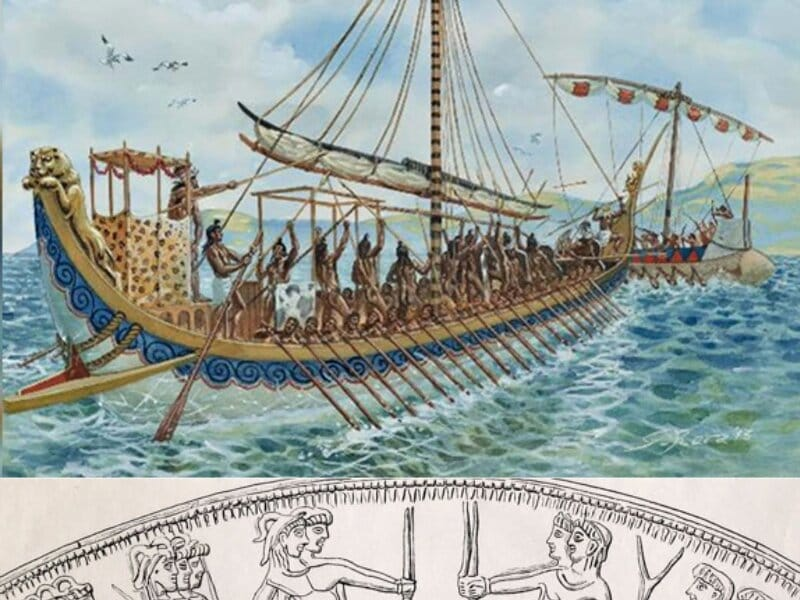
The Trireme (170 oars): Perfected in the late 600s BCE (and championed by Athens), the trireme arranged 170 rowers across three staggered vertical tiers on each side. This tripled the horsepower of the ship while keeping the hull short, narrow, and incredibly agile.
3. The Anatomy of a Speed Machine
A trireme was not built to spend weeks at sea; it was a highly specialized, lightweight weapon designed for speed.
Green Wood and Seasoning: Shipwrights favored silver fir or pine for the hull because it was light and flexible, while the internal keel was made of tough oak to withstand the tension of beaching.
The Outrigger (Parexeiresia): To fit the third, topmost tier of rowers (the thranites) without making the ship top-heavy or excessively wide, builders extended a wooden outrigger framework over the sides of the hull. This gave the top rowers leverage to pull their long oars cleanly through the water.
The Hypozoma (The Tension Cable): Because these ships were so light and long, they suffered from "hogging"—the tendency of the bow and stern to sag, snapping the ship's spine. To prevent this, the Greeks stretched massive hemp ropes (hypozomata) internally from bow to stern, cranked tight with a windlass. This acted like a structural spine, keeping the wooden hull under constant compression.
4. The Ram: Engineering the Ultimate Weapon
The defining feature of a Greek warship was the bronze ram (embolos) mounted at the waterline of the bow.
Not a Spike: The ram was not designed to pierce an enemy ship and get stuck; it was shaped like a blunt, three-pronged trident meant to shatter the timber seams of an enemy hull, causing immediate flooding.
Distributing the Shock: If the ram were simply bolted to the front of the boat, the impact of hitting an enemy vessel at 9 knots would rip the ram clean off or shatter the attacker’s own bow.
Integration: Shipwrights intricately integrated the ram into the heavy timber beams of the keel and the waterline wales. When a trireme hit an enemy ship, the massive kinetic energy of the impact was absorbed and distributed safely along the entire length of the attacker's hull.
5. Standardized Production and Assembly Lines
During the Persian Wars, Athens built a fleet of 200 triremes in just a few short years. Achieving this scale required the world’s first version of mass production and standardization.
The Ship Sheds (Neosoikoi): Warships were highly vulnerable to shipworms (teredo navalis) and rotting if left in the water. Cities built vast complexes of covered stone ramps where triremes were dragged out of the water after every use to dry.
Interchangeable Parts: Oars, sails, rigging, and even the dimensions of the hull planks were standardized based on geometric modules. A standard trireme oar was exactly 9.5 cubits long, meaning any oar on any ship could be replaced mid-battle with parts kept in central naval storehouses, like the famous Arsenal of Philon in Piraeus.
Through this combination of micro-precision carpentry, mathematical scaling, and a deep understanding of structural tension, the Greeks transformed shipbuilding from a traditional craft into a highly advanced military science. It was this technological edge that allowed their outnumbered fleets to hold the line at Salamis and Mycale, changing the course of history.