Before the 6th century BCE, the western world explained the mechanics of nature through the lens of mythology. If an earthquake shook the ground, it was the wrath of Poseidon; if lightning struck, it was the judgment of Zeus.
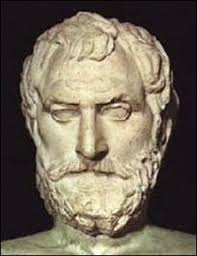
This framework shifted radically in the prosperous Ionian port city of Miletus (modern-day Turkey). A thinker named Thales of Miletus (c. 624–545 BCE) bypassed mythological consensus to ask a brand-new question: What is the underlying, physical substance of the universe, and how can we explain it using reason? By shifting the human gaze from the heavens down to the material earth, Thales became recognized by Aristotle and modern historians alike as the first philosopher and the father of Western science.
1. The Arche: The Search for the Primary Substance
Thales’s most famous philosophical contribution is his material monism—the belief that the entire cosmos is fundamentally composed of a single, primordial substance, which the Greeks called the Arche.
Thales declared that the Arche was water.
While the conclusion sounds primitive today, his reasoning was deeply empirical and observational:
He noticed that water is essential for the generation and nourishment of all living things (seeds are moist, blood is fluid).
He observed that water is uniquely versatile, capable of transforming across three distinct physical states: solid (ice), liquid (water), and gas (steam/mist).
He deduced that the Earth itself was a flat disc floating upon a vast, infinite cosmic ocean, which explained why earthquakes occurred (the earth was simply being rocked by cosmic waves beneath it).
The revolutionary aspect of this theory was not the choice of water itself, but the reduction of the dizzying complexity of the universe to a single, observable, natural element.
2. Naturalism: Banishing the Supernatural
By proposing that natural phenomena had natural causes, Thales established the foundational methodology of Naturalism.
He did not necessarily deny the existence of the divine—he famously stated that "all things are full of gods"—but he redefined what the divine was. To Thales, the "divine" was not a collection of capricious, human-like deities sitting on a mountain, but rather the intrinsic, self-moving, and eternal life-force embedded directly within nature itself.
When he observed a lodestone (a natural magnet) attracting iron, he argued it possessed a "soul" (psyche). To him, this meant the force was an inherent property of the rock's material nature, operating under regular, discoverable laws rather than an external magical spell.
3. The Eclipse of 585 BCE: Science Over Superstition
The moment that cemented Thales’s reputation across the ancient world was his prediction of a total solar eclipse.
According to the historian Herodotus, a brutal, six-year war was raging between the Medes and the Lydians. During a battle, the sky suddenly turned to night. Horrified by what they perceived as an ominous sign of divine anger, both armies immediately dropped their weapons and signed a peace treaty.
Thales, however, had allegedly predicted the exact year of this event by studying Babylonian and Egyptian astronomical records and tracking celestial cycles. By demonstrating that a terrifying celestial event was actually a predictable, mechanical alignment of cosmic bodies, Thales proved that reason (logos) could master the mysteries of the universe.
4. Bounding Geometry and Practical Mathematics
Thales traveled extensively in Egypt, where he absorbed practical mathematical rules used for land surveying and tax calculation. However, true to his philosophical nature, he transformed these functional rules into abstract, deductive proofs.
He introduced several foundational geometric theorems to Greece, including what is now known as Thales's Theorem: if three points (A, B, and C) lie on a circle where the line AC is the diameter, then the angle ABC is a perfect right angle ($90^\circ$).
Using his geometric insights, he performed legendary feats of measurement:
Measuring the Pyramids: He calculated the exact height of the Great Pyramid of Giza by measuring the length of its shadow at the exact moment of the day when his own shadow was perfectly equal to his physical height.
Distance at Sea: He utilized similar triangles to calculate the distance of enemy ships from the shoreline, demonstrating the immediate, practical value of abstract geometry.
5. The Birth of the Milesian School and Its Legacy
Thales’s greatest legacy was not his specific answers, but the school of thought he founded in Miletus. He didn't demand blind obedience to his ideas; instead, he encouraged his students to critique, refine, and improve upon his theories. This marked the birth of scientific debate.
Anaximander (His Student): Critiqued Thales's water theory, arguing that water could not create its opposite (fire). He proposed instead that the Arche was the Apeiron—an infinite, boundless, and formless cosmic substance.
Anaximenes (His Grand-student): Refined the system further, arguing that the primary substance was aer (air/vapor), which created all other matter through the physical processes of rarefaction and condensation.
6. Summary of Thales's Intellectual Pivot
Before Thales (Mythos): The universe is chaotic, personal, and governed by the shifting emotions of anthropomorphic gods. Truth is revealed via poets and seers.
After Thales (Logos): The universe is an ordered, impersonal cosmos (kosmos) governed by immutable natural laws. Truth is discovered via empirical observation and logical deduction.
By daring to suggest that the human mind was capable of understanding the internal mechanics of the world without divine mediation, Thales set off a chain reaction of intellectual inquiry. This path led directly through Pythagoras, Socrates, and Aristotle, ultimately shaping the framework of Western philosophy and science.