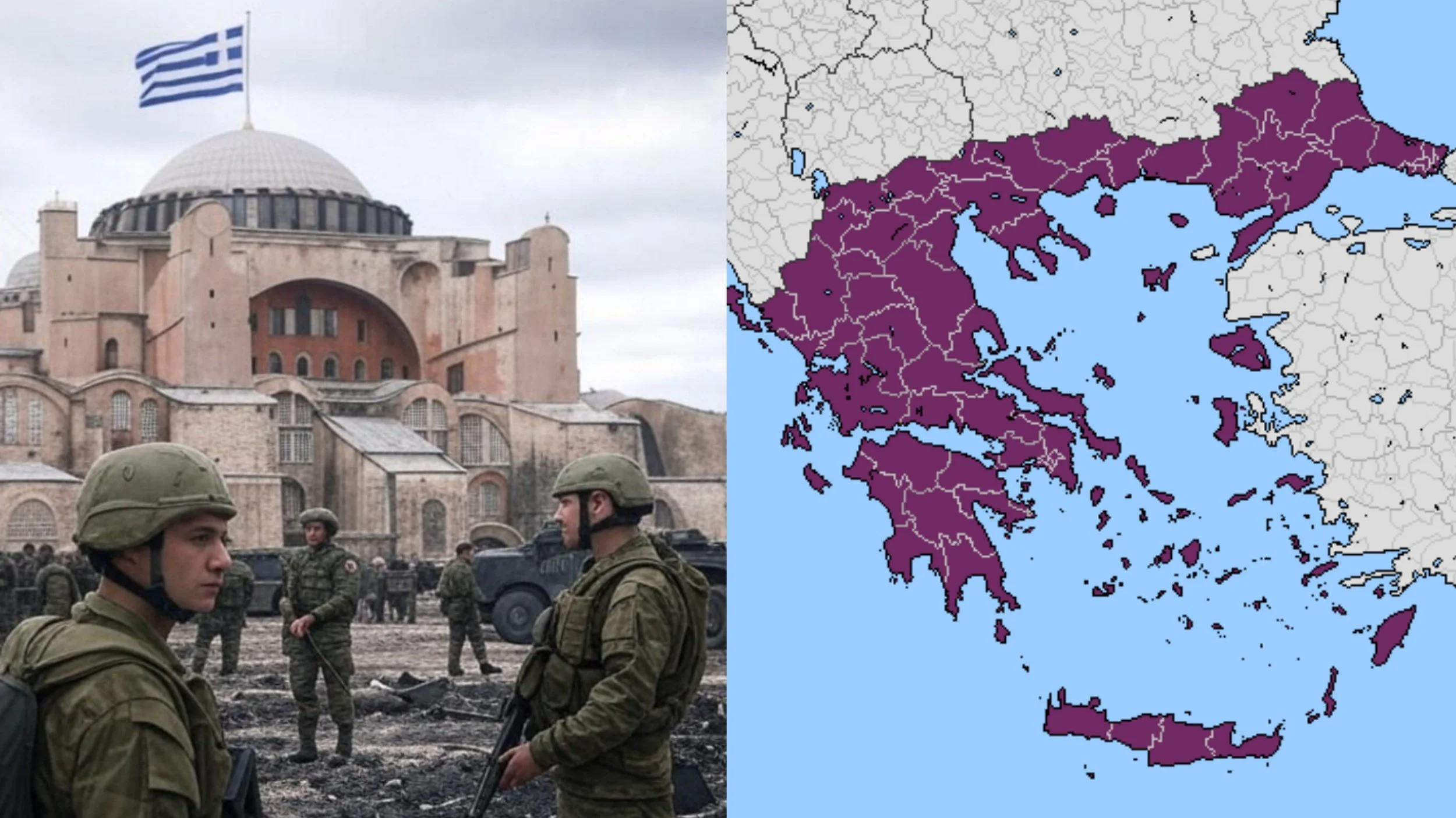
What if Constantinople had remained Greek and served as the capital of modern Greece? This alternative historical scenario would have dramatically reshaped the country's geopolitical standing, economy, and culture. Let’s explore how Greece might have evolved under these circumstances.
A Larger and More Influential Greek State
If Constantinople had been the capital, Greece’s borders would likely have extended far beyond their current limits. The country might have included Thrace, parts of Asia Minor, and even Cappadocia, maintaining a significant presence in the Eastern Mediterranean. The catastrophic events of 1922, which led to the expulsion of Greeks from Asia Minor, may never have occurred.
With control over the Bosporus and the Dardanelles—key maritime routes connecting the Mediterranean to the Black Sea—Greece would have had a dominant strategic position, influencing its relations with Russia, the Ottoman Empire, and Western nations. Turkey, in this scenario, might have been a smaller state with a different political trajectory.
Economic and Trade Powerhouse
Constantinople has long been one of the world's most prosperous cities. As Greece’s capital, it would have positioned the country as a major commercial and maritime hub. Greek shipping and trade might have dominated the Mediterranean and the Black Sea, similar to how the city once thrived under Byzantine rule.
Controlling the Bosporus Strait would have brought immense economic advantages, with Greece profiting from trade tariffs and maritime commerce. The city could have developed into a financial center, akin to modern-day Switzerland or Dubai, attracting global investments and fostering economic growth.
A Multicultural Empire
A Greek Constantinople could have led to a more diverse and multiethnic state, incorporating Greek, Armenian, Jewish, and other communities that once flourished under the Ottoman Empire. The country might have evolved into a cultural and economic superpower, blending Eastern and Western influences.
Additionally, with Asia Minor under Greek rule, the country would have had vast agricultural and industrial resources, making it more self-sufficient and economically robust.
The Intellectual and Spiritual Heart of Hellenism
As the historical center of the Byzantine Empire, Constantinople would have remained a beacon of Greek culture, education, and religion. The city’s universities, libraries, and religious institutions could have continued the intellectual traditions of the past, solidifying Greece's role as a leader in Orthodox Christianity and Mediterranean scholarship.
Challenges of a Greek Constantinople
While the idea of a Greek Constantinople is fascinating, it would have presented challenges as well. The city’s diverse population—including Greeks, Turks, Armenians, and Jews—would have required careful governance to ensure peaceful coexistence. The tensions over territorial control might have still led to conflicts, although potentially of a different nature than those seen in Greek-Turkish history.
Conclusion
Had Constantinople remained Greek, Greece today would likely be a much larger, more influential, and economically powerful nation. The country could have played a central role in global trade and diplomacy while preserving a rich multicultural identity. However, such a scenario would have also required balancing ethnic diversity and navigating complex geopolitical challenges.