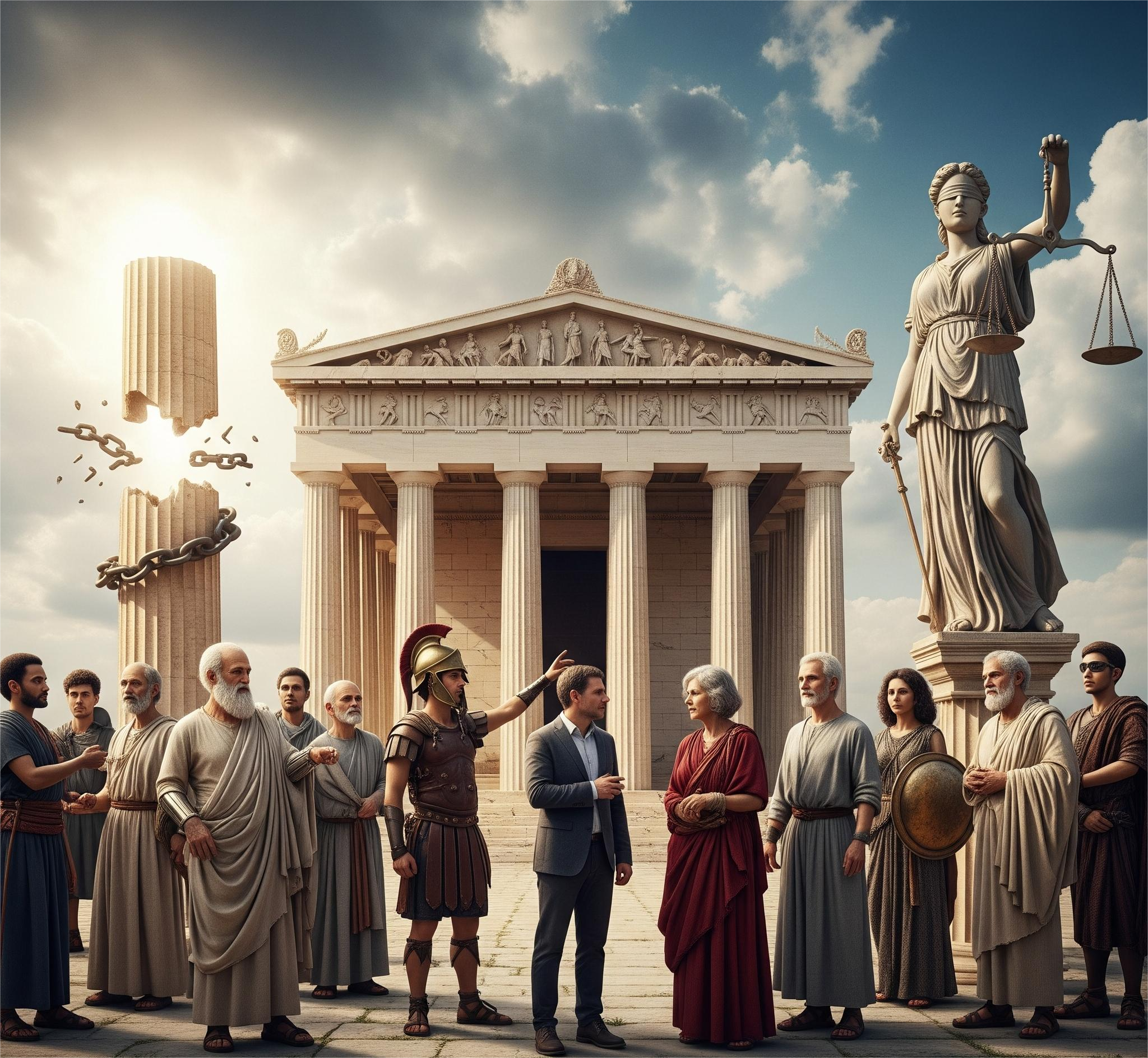
When we think of democracy, human rights, and justice, our minds often turn to modern nations and global institutions. But these cornerstones of contemporary political life trace their roots all the way back to ancient Greece—specifically, to Athens during its golden age.
Long before the drafting of the U.S. Constitution or the formation of the United Nations, Greek thinkers and city-states were experimenting with ideas that remain central to how we understand freedom, citizenship, and governance today.
Birthplace of Democracy: Athens Leads the Way
In the 5th century BCE, Athens developed what many historians consider the first form of direct democracy. Unlike modern representative systems, Athenian democracy involved ordinary male citizens voting directly on laws and policies.
Key features of Athenian democracy:
Citizens could propose and vote on legislation.
Political offices were often filled by lottery, promoting equality.
Public officials were held accountable through regular evaluations.
Isegoria: the equal right to speak in the assembly.
Freedom of speech was celebrated as essential for civic participation.
These ideas laid the foundation for modern democratic principles, including equal representation, transparency, and freedom of expression.
Justice and the Rule of Law
The Greeks believed in nomos (law) as a guiding force for order and fairness in society. Philosophers like Plato and Aristotle explored what it meant to live under just laws—and who should have the power to make and enforce them.
Solon’s reforms (6th century BCE) introduced:
Rights of appeal for common citizens.
Legal protections against debt slavery.
A written legal code accessible to the public.
Legacy:
The idea that law should apply equally to all citizens.
The belief that justice is foundational to a healthy state.
Influence on Western legal traditions, including civil liberties and checks on authority.
Philosophical Groundwork: Freedom, Virtue, and Civic Duty
Socrates, Plato, and Aristotle debated the balance between individual liberty and the needs of the community.
Socrates:
Championed the importance of moral autonomy—thinking for oneself even against public opinion.
Became a martyr for freedom of thought.
Plato:
Explored the concept of justice in his work The Republic.
Though skeptical of democracy, he emphasized the need for wise governance and ethical rulers.
Aristotle:
Described humans as “political animals” who achieve fulfillment through participation in civic life.
Advocated for constitutional government and the rule of law.
Their writings became essential reading during the Enlightenment, profoundly influencing thinkers like John Locke, Montesquieu, and Rousseau, who in turn helped shape modern constitutions and democratic governments.
From Ancient Agora to Modern Parliament
The agora of Athens wasn't just a market—it was a civic hub where ideas, debates, and public decisions flourished. This ancient culture of open discussion gave rise to the concept of the public sphere—a place where citizens gather to deliberate matters of common concern.
Today, we see this legacy in:
Town hall meetings
Parliamentary debates
Freedom of the press
Civic engagement movements