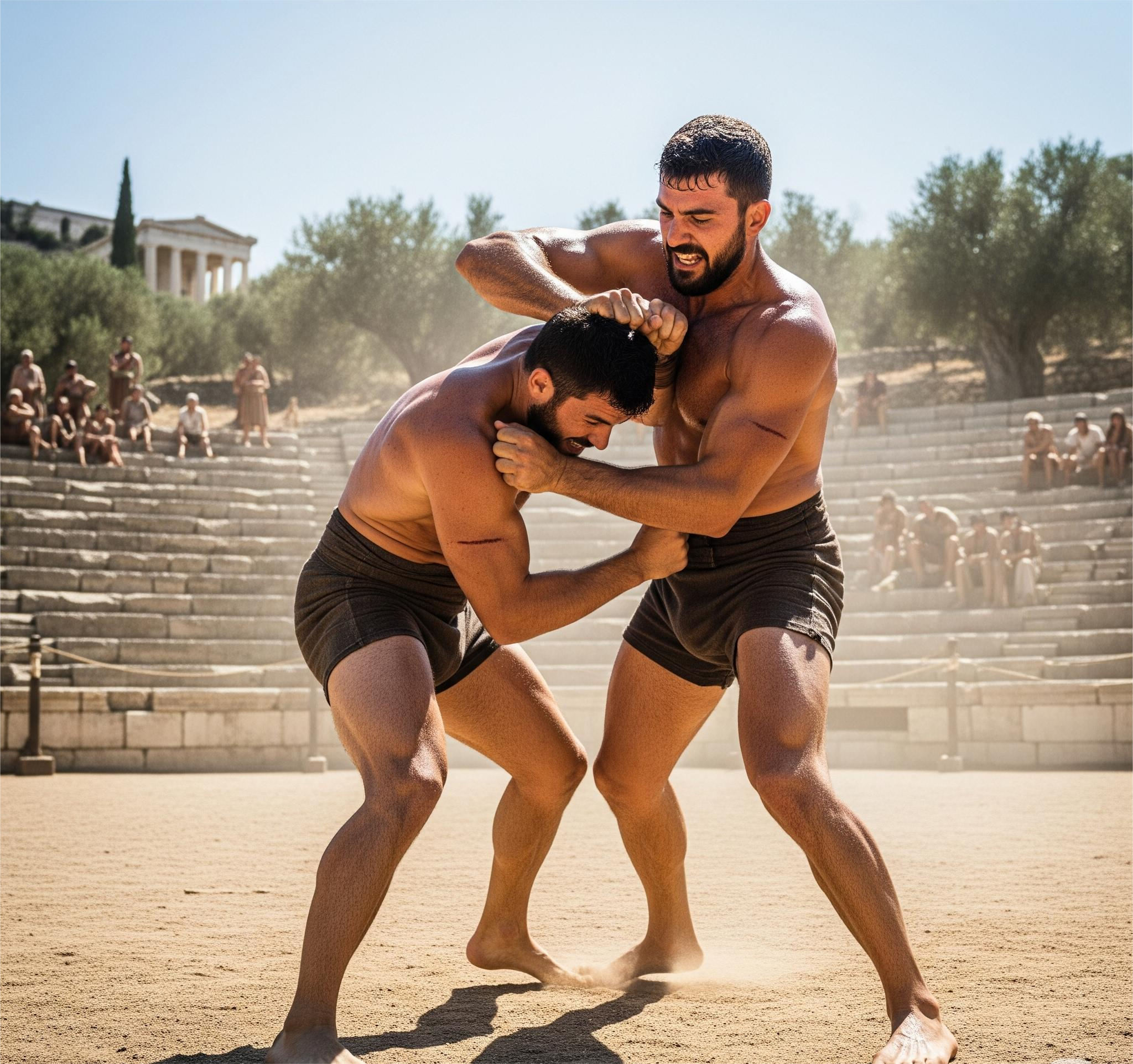
Among the most intense and celebrated events of the ancient Greek games was pankration, a no-holds-barred combat sport that fused the techniques of boxing (pygmachia) and wrestling (pale). The name itself means "all powers" or "all force," reflecting its reputation as the ultimate test of physical dominance and combat skill. Introduced in the Olympic Games in 648 BCE, pankration showcased the Greek ideal of arete (excellence) by demanding strength, technique, endurance, and courage.
In pankration, athletes used punches, kicks, joint locks, chokes, and throws to subdue their opponents. Unlike boxing, pankration fighters did not use gloves, and unlike wrestling, they were not restricted to grappling alone. The only illegal moves were biting and gouging the eyes or soft parts of the body—though even these rules were not always strictly enforced. Matches could end in knockout, submission, or, in rare cases, death.
Famous pankratiasts such as Arrhichion of Phigalia gained legendary status. Arrhichion died while applying a winning chokehold—earning posthumous victory. Such stories underscored the valor associated with pankration and its role as a martial art rooted in heroism and sacrifice.
Training for pankration was grueling. Fighters practiced in palaestrae under the guidance of skilled paidotribes (trainers), perfecting their techniques while cultivating resilience. The sport, though brutal, was also strategic—requiring an understanding of timing, leverage, and body mechanics.
Today, pankration is seen as a precursor to modern mixed martial arts (MMA), a testament to the ancient Greeks' sophisticated understanding of combat sports.