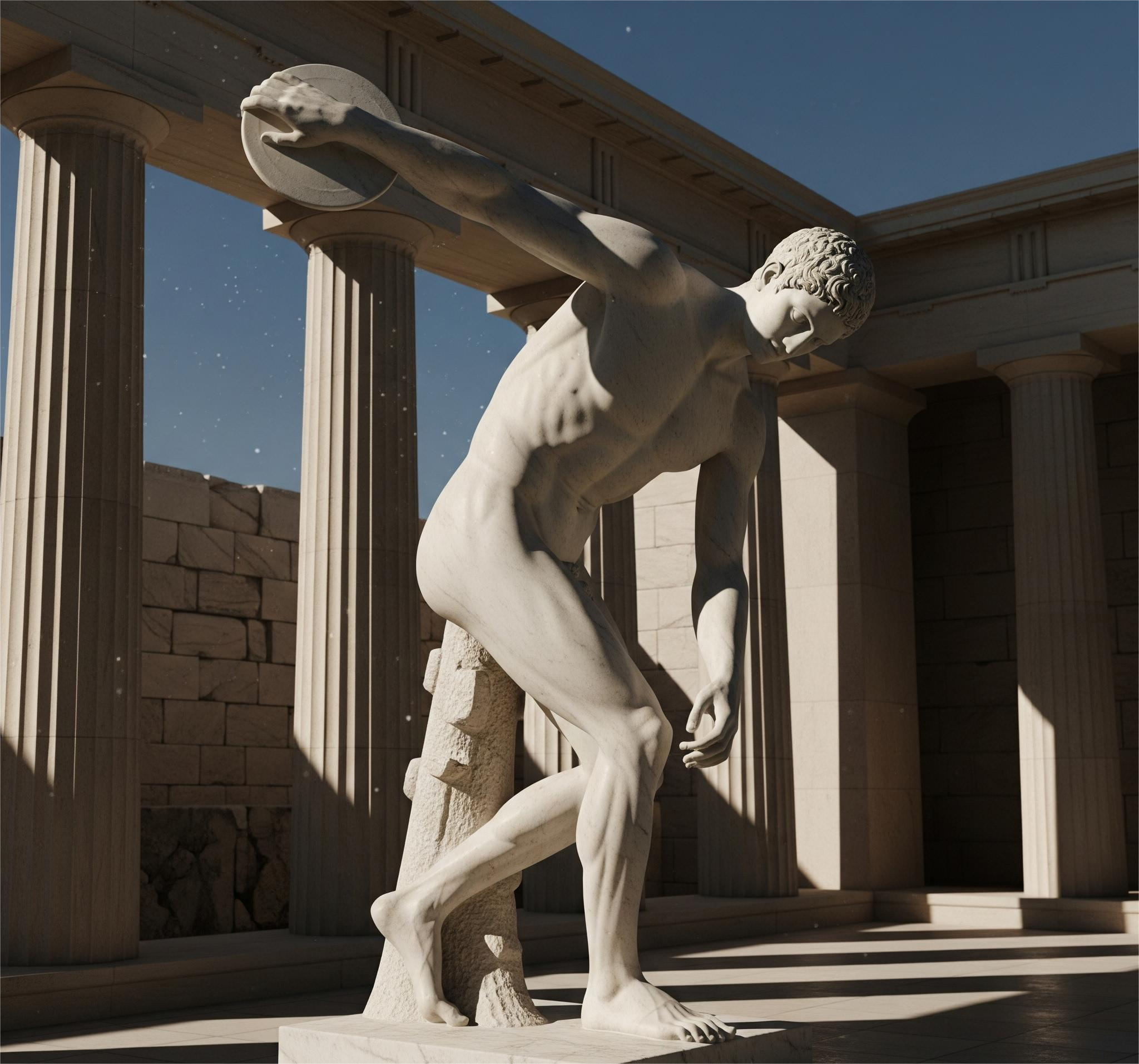
Few artworks capture the essence of Greek athleticism like the Discobolus, or “Discus Thrower.” This iconic statue, attributed to the 5th-century BCE sculptor Myron, is one of the most recognizable representations of physical perfection, balance, and movement in ancient art. Beyond its aesthetic appeal, the Discobolus offers insight into how the Greeks viewed the human body, sport, and the ideal form.
Who Was the Discobolus?
The Discobolus depicts a nude male athlete in the midst of throwing a discus—a key event in the ancient Olympic Games. While the statue captures a moment of intense action, it is also marked by a serene, almost detached facial expression, revealing a core principle of Greek art: emotional control (sophrosyne) in the face of physical effort.
Myron’s Vision: Freezing Motion in Marble
Myron of Eleutherae, the artist behind the Discobolus, was renowned for his ability to capture movement. Though the original bronze sculpture is lost, Roman marble copies—such as the famous one housed in the Museo Nazionale Romano—allow us to study Myron’s dynamic composition.
The figure’s torso is twisted dramatically, one arm reaching back with the discus while the other stabilizes the motion.
The legs form a spiral, with one foot grounded and the other poised, showing tension and readiness.
The statue displays an incredible understanding of anatomy, yet stylized for aesthetic perfection rather than naturalism.
It’s not a true snapshot of a discus throw—no real athlete could hold this position—but rather an idealized moment, designed to communicate grace, strength, and harmony.
The Athlete as Ideal Citizen
To the ancient Greeks, the athlete wasn’t just a competitor—he was a symbol of moral and civic excellence. The Discobolus expresses the belief that a physically perfect body was a reflection of inner discipline and noble character.
The nudity in Greek sculpture wasn’t erotic—it emphasized heroic nudity, linking athletes to gods and demigods.
Athletic training was part of a young man’s education (paideia), alongside music, philosophy, and civic responsibility.
The statue embodies kalokagathia, the unity of physical beauty (kalos) and moral virtue (agathos).
Cultural Context: The Discus and the Games
The discus throw was one of the five events in the pentathlon, a prestigious athletic competition in ancient Greece. Alongside running, jumping, wrestling, and javelin, it tested an athlete’s overall fitness and versatility.
The discus was made of stone, iron, or bronze and weighed around 2–4 kilograms.
Technique, rather than brute strength, was key—aligning with the Greek emphasis on form, rhythm, and control.
Victors were celebrated as civic heroes and often honored with statues in sanctuaries like Olympia and Delphi.
The Legacy of the Discobolus
Though sculpted over 2,400 years ago, the Discobolus has endured as a universal symbol of athletic achievement. It inspired Renaissance artists in their pursuit of anatomical accuracy and later became an emblem of neoclassical ideals. Unfortunately, the statue was also appropriated for propaganda in the 20th century due to its visual alignment with certain ideological aesthetics.
Yet at its core, the Discobolus remains a testament to the Greek belief in harmony—between mind and body, action and poise, power and elegance.