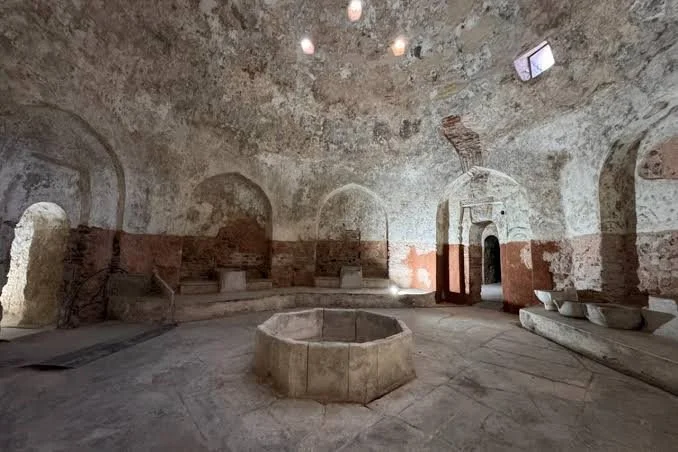
Ottoman bathhouse architecture, supernatural traditions, and the spiritual imagination of a multicultural city.
A City of Bathhouses and Hidden Spaces
Thessaloniki has occupied an important position in the history of the eastern Mediterranean. Its location connected the city with maritime commerce, inland trade routes, and the political and cultural networks of the Byzantine and Ottoman worlds. Over centuries, its population included communities with different religious traditions, languages, and cultural practices.
Among the buildings that shaped Ottoman urban life were public bathhouses, commonly known as hammams. These establishments served practical purposes, providing spaces for washing and personal care, but they also played social and cultural roles. Their architecture created distinctive environments of heat, steam, water, stone, and filtered light.
The atmosphere of a historic bathhouse can readily inspire stories about unseen presences. Heated rooms, dim passages, echoing chambers, and sudden changes in temperature create sensory experiences that differ from those of ordinary streets and houses. In societies where supernatural beliefs were part of everyday culture, such places could become settings for stories about spirits and encounters beyond the visible world.
The title's reference to forgotten djinn pacts in Thessaloniki hammams is an evocative premise, but a specific historical tradition of such pacts would need documentary support. The broader relationship between Ottoman bathhouses and supernatural storytelling offers a more reliable starting point for research.
Djinn in Islamic and Ottoman Traditions
Djinn occupy an important place in Islamic religious tradition and in the wider folklore of Muslim societies. They are described in Islamic sources as beings distinct from humans and angels, possessing their own characteristics and capacities. Interpretations of djinn vary across theological scholarship and local traditions.
Stories about djinn developed in many cultural settings, incorporating religious ideas, regional customs, and literary motifs. Some narratives describe encounters in isolated places, abandoned buildings, wells, or other environments that seem separated from ordinary social life. Other stories focus on bargains, warnings, possession, protection, or the consequences of crossing an invisible boundary.
These traditions should not be treated as identical everywhere. Ottoman society encompassed a wide range of communities, and beliefs about supernatural beings could differ according to language, religious background, local custom, and literary influence.
Thessaloniki's Ottoman history makes it a useful setting for investigating how religious and cultural traditions circulated through urban life. However, the existence of djinn beliefs in the wider Islamic world does not establish that particular pacts occurred in the city's hammams.
A historical investigation would examine Ottoman documents, local narratives, religious writings, and regional folklore collections to establish whether a specific connection can be demonstrated.
The Social World of the Ottoman Hammam
Public bathhouses were important institutions in Ottoman cities. Their functions extended beyond hygiene, creating places where people could gather, follow established routines, and participate in social life. Bathhouses could be associated with preparation for weddings, family celebrations, and other significant events, although practices differed across communities and periods.
Architecturally, many hammams were designed around sequences of rooms with different temperatures. Heated spaces, domed ceilings, stone surfaces, and controlled openings shaped the movement of heat and moisture through the building. Light entering through small openings could create changing patterns on walls and floors, while the sound of running water and conversation moved through enclosed chambers.
These features provide a practical explanation for some of the unusual sensory qualities associated with historic bathhouses. They also help explain why such places could become compelling settings for stories about mysterious presences.
The social function of the hammam matters as much as its architecture. A building used by many people could become a repository of stories, rumors, personal memories, and shared beliefs. Accounts associated with such a place might reflect anxieties about privacy, illness, social interaction, or the unseen consequences of human behavior.
A study of Thessaloniki's historic bathhouses could combine architectural documentation with social history, investigating how the buildings were used and how their meanings changed as the city developed.
Agreements, Bargains, and Supernatural Boundaries
Stories about pacts with supernatural beings often revolve around the exchange of something valuable. A person may seek protection, knowledge, healing, wealth, or influence, but the agreement introduces uncertainty about what must be given in return.
Such narratives appear in many cultural traditions, although their characters and moral implications differ. A pact may serve as a warning against arrogance, a story about desperation, or a means of explaining an unexpected event. The supernatural bargain can also express concerns about power: someone who receives extraordinary assistance may become dependent on a force they cannot control.
When investigating the idea of djinn pacts in Ottoman Thessaloniki, researchers should distinguish religious texts discussing djinn from stories describing specific encounters and from modern retellings inspired by the general motif. These sources offer different kinds of evidence and should not be combined into a single historical claim.
The language of the original account is especially important. A reference to a spirit, a magical practice, or an unusual event may have a meaning that changes when translated into English. Careful interpretation requires attention to terminology, historical context, and the beliefs of the community in which the account circulated.
Preserving the History of a Changing City
Thessaloniki's built environment has changed significantly over time. Some Ottoman structures survive, while others have been altered, repurposed, damaged, or lost. Historical photographs, maps, architectural surveys, and archival documents can help reconstruct how the city looked during different periods.
Researchers studying hammams can use building surveys and digital models to document surviving architectural features. Archival research may reveal information about construction, ownership, maintenance, and use. Folklore research can then investigate whether specific stories became associated with particular buildings or neighborhoods.
A careful investigation would not need to prove that a supernatural pact occurred. Instead, it could examine how djinn traditions developed in the Ottoman cultural world, why bathhouses provided evocative settings for supernatural narratives, and whether local sources preserve identifiable Thessaloniki stories.
This approach would create an article grounded in the real history of the city while exploring the imaginative worlds that existed alongside its markets, mosques, homes, and public buildings.