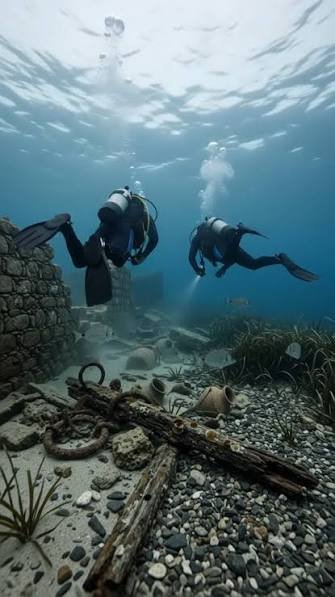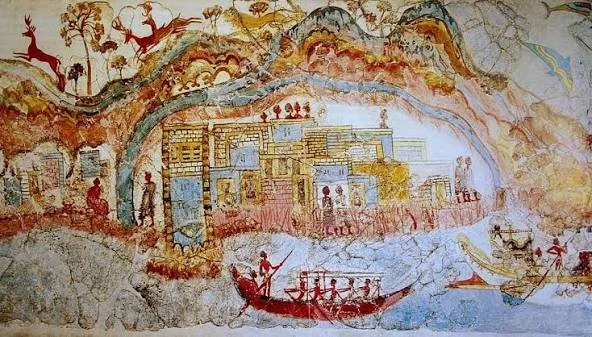
Island solitude, philosophical communities, and the search for a life guided by reflection.
The Hellenistic Age and the Search for Wisdom
The Hellenistic period began after the death of Alexander the Great in 323 BCE. His conquests had transformed the political geography of the eastern Mediterranean and created new connections among communities that had previously been separated by distance, language, or political boundaries.
This period also saw the development and expansion of influential philosophical traditions. Thinkers explored questions about happiness, knowledge, virtue, nature, friendship, and the relationship between individuals and society. Their ideas were debated in schools, public spaces, private homes, and communities of students.
Epicurus and his followers emphasized the pursuit of tranquility, friendship, and freedom from unnecessary fear. Stoic philosophers stressed virtue, reason, and living in accordance with nature. Other traditions continued to develop approaches to ethics, logic, and the study of the natural world.
The idea of philosophers withdrawing to the Sporades evokes the possibility of secluded places for contemplation. However, specific Hellenistic retreats on these islands require historical or archaeological evidence identifying the people and locations involved.
Why an Island Might Attract a Philosopher
An island could provide distance from the noise, obligations, and political competition of a large city. Its coastline, open horizon, and changing weather might offer an environment suited to reading, writing, conversation, or personal reflection.
Yet ancient philosophical life was not necessarily solitary. Many schools depended on teachers, students, friendships, shared meals, and continuing discussion. A retreat might therefore have been a quiet place for concentrated study rather than a permanent escape from human society.
The practical needs of a philosophical community also mattered. People required food, fresh water, shelter, and access to transport. A remote island without reliable supplies might be unsuitable for an extended stay, regardless of its appeal as a place of solitude.
A philosopher might also have chosen an island for reasons unrelated to the landscape, such as family connections, political circumstances, or an invitation from a local patron.
The Sporades and the Ancient Aegean
The Sporades comprise islands in the Aegean whose histories varied by location and period. Their communities participated in maritime life through fishing, agriculture, local exchange, and contact with neighboring settlements.
The sea connected these islands to the mainland and to other parts of the Mediterranean. Boats carried people, supplies, and ideas, allowing intellectual traditions to circulate alongside commercial goods.
A remote island should not automatically be interpreted as isolated from the ancient world. Even a small settlement might maintain connections with larger ports through seasonal travel, trade, or religious activity.
Archaeological evidence from island settlements can reveal patterns of occupation, economic life, and contact with other communities. However, the presence of a secluded building or cave does not prove that a philosopher lived there.
Philosophical Schools and Their Different Approaches
Ancient philosophy was not a single movement with one understanding of the ideal life. Different schools disagreed about pleasure, virtue, knowledge, nature, and the responsibilities of the individual.
Epicurean philosophy placed great importance on friendship and the pursuit of a tranquil life. Although popular portrayals sometimes reduce Epicureanism to indulgence, its ethical teachings emphasized freedom from unnecessary desires and fears.
Stoicism developed a different framework, emphasizing the cultivation of virtue and the use of reason to respond to circumstances beyond one's control. Other philosophical traditions placed particular emphasis on logic, natural science, or the relationship between knowledge and political life.
These differences matter when interpreting the idea of a retreat. A location used for communal philosophical study might have had a very different purpose from a temporary place where an individual withdrew to write or reflect.
Solitude and the Ancient Ideal of Reflection
The idea of stepping away from public life has a long history in philosophical writing. Distance from ordinary obligations could be presented as a way to concentrate on what mattered most, examine one's assumptions, or cultivate self-discipline.
However, the ideal of solitude should not be confused with the historical reality of every philosopher's life. Ancient thinkers frequently depended on patrons, students, social relationships, and access to books or other resources.
A retreat might be temporary rather than permanent. It could offer a change of setting while allowing the philosopher to maintain correspondence or continue teaching.
How a Historical Retreat Could Be Identified
A reliable identification would ideally connect a named philosopher with a particular island through an ancient text, inscription, or securely interpreted archaeological site. Researchers would also need to establish the chronology and consider whether later writers embellished the story.
A building's remote location cannot establish its function. The same structure might have served as a farmhouse, storage facility, religious space, or residence unrelated to philosophy.
Local traditions can provide useful starting points for research, but they must be compared with independent evidence before they are treated as historical fact.
The Appeal of the Philosopher's Island
The proposed Hellenistic philosopher retreats in the Sporades remain unverified as a specific historical claim. Nevertheless, the subject offers a meaningful way to explore the relationship between philosophy, travel, and the ancient island world.
If a named thinker can be connected to a documented location, the evidence could reveal how intellectual life intersected with the geography and social networks of the Aegean. Until then, the retreat remains an intriguing research possibility rather than a confirmed discovery.