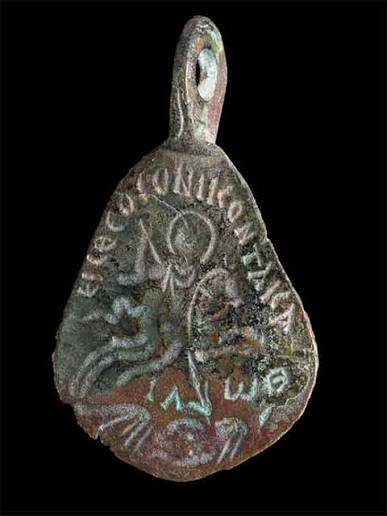
Protective prayers, mysterious symbols, and the medieval struggle against invisible forces.
The Fear of an Unseen Gaze
In the Byzantine world, misfortune could carry meanings that extended beyond the physical circumstances of an event. An unexpected illness, a child's unexplained weakness, the sudden death of livestock, or a period of persistent bad luck might prompt questions about envy, divine favor, and supernatural harm. Among the beliefs that circulated throughout the eastern Mediterranean was the evil eye, the idea that a person's gaze, often associated with envy or excessive admiration, could cause injury or misfortune.
The belief had roots in earlier Greek and Roman traditions and continued to develop during the Byzantine period. Although Christianity profoundly influenced the empire's religious life, older cultural ideas did not disappear overnight. Instead, they interacted with Christian teachings, local customs, household practices, and inherited understandings of the supernatural.
The evil eye was particularly interesting because it involved an invisible threat. Unlike an invading army, a dangerous animal, or a visible injury, its supposed effects could not easily be identified or prevented through ordinary means. Protective prayers, religious symbols, and amulets offered ways to respond to a danger that believers might perceive but could not directly observe.
Monasteries and the Preservation of Protective Traditions
Byzantine monasteries were important centers of manuscript production, religious scholarship, and cultural preservation. Monks copied biblical texts, theological works, medical writings, historical accounts, and collections of prayers. Some manuscripts also preserved material concerning healing, ritual protection, divination, and practices that religious authorities sometimes condemned as superstition.
These sources provide valuable evidence for investigating how medieval people understood supernatural danger. However, a manuscript mentioning a protective ritual does not necessarily demonstrate that the practice was widespread or officially accepted. Some writers recorded customs to criticize them, while others copied older texts without necessarily endorsing every idea they contained.
This distinction matters when investigating claims about hidden evil eye amulets. A monastic manuscript might contain a prayer against envy or harmful influences without describing a physical amulet. Another text might mention an object used for protection but offer little information about its appearance or the circumstances in which it was carried.
Historians must therefore examine the actual wording, date, provenance, and purpose of each manuscript. The surviving evidence may reveal how Byzantine writers understood harmful gazes and protective practices, but claims about specific secret collections of amulets require independent documentation.
The Symbols of Protection
Protective objects in the ancient and medieval Mediterranean took many forms. They could include pendants, engraved stones, metal objects, inscriptions, and religious images. Their purposes varied, and an object's appearance alone rarely establishes exactly how its owner understood it.
The Gorgon's face, for example, appeared in ancient Greek art as a potentially protective image. Its frightening appearance could symbolically confront or repel danger. Other protective traditions involved inscriptions, gestures, and objects believed to turn harmful influences away from their intended victims.
During the Byzantine period, Christian symbols became central to many forms of personal devotion. Crosses, images of saints, biblical passages, and prayers invoking divine protection could provide reassurance against illness and misfortune. Yet the relationship between religious devotion and protective objects was not always straightforward. Some practices were accepted as expressions of faith, while others were criticized when they appeared to attribute supernatural power to forbidden rituals or objects.
An archaeological pendant bearing a cross might have been worn as a devotional object, a personal reminder of faith, or a means of seeking protection. Its function cannot automatically be reduced to one explanation. The same caution applies to eye-shaped motifs, which could have decorative, symbolic, or apotropaic meanings depending on their context.
Reading the Manuscripts Against the Archaeological Record
The most promising way to investigate Byzantine protective traditions is to compare written evidence with surviving objects. A manuscript may preserve a prayer or describe a particular custom, while archaeological finds can reveal the materials and symbols people used in daily life.
Researchers can examine inscriptions, manufacturing techniques, find locations, burial contexts, and similarities between objects discovered at different sites. If a written source describes a particular protective formula, scholars can search for comparable wording on surviving artifacts. A close match may support a connection, although the date and provenance of both sources must still be considered.
Digital manuscript catalogues and high-resolution imaging have made this work increasingly accessible. Multispectral imaging can sometimes reveal faded writing, while computational tools can help identify repeated phrases across large collections. These methods may uncover passages that were previously overlooked or make it easier to compare manuscripts held by different institutions.
Such technologies cannot establish historical meaning on their own. An ambiguous word may have several interpretations, and a repeated formula may reflect copying rather than widespread practice. Linguistic expertise and historical context remain essential.
The history of the evil eye therefore offers more than a search for mysterious objects. It reveals how people attempted to understand invisible dangers, how religious institutions responded to popular beliefs, and how protective traditions changed as ancient Mediterranean societies developed into the medieval world.