
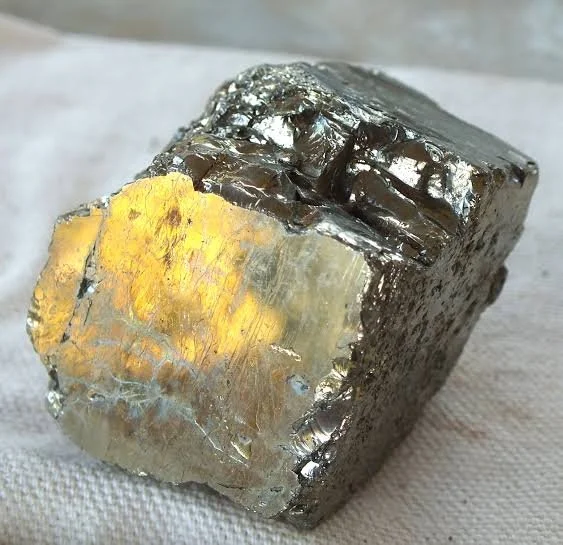
Fool's gold, ancient mining landscapes, and the mineral evidence behind the search for precious metals.
The Golden Appearance of Pyrite
Pyrite is one of the most familiar minerals to collectors because of its metallic luster and brassy yellow color. Its resemblance to gold has earned it the nickname “fool's gold,” although its geological significance extends far beyond its appearance.
The possibility of pyrite crystals hidden among mining relics near Philippi raises questions about mineral formation, ancient extraction, and the relationship between visible minerals and economically valuable deposits. However, the presence, abundance, and precise location of any proposed crystal occurrence must be established through reliable geological evidence.
How Pyrite Forms
Pyrite is iron disulfide, a mineral that can develop in a wide range of geological environments. It occurs in sedimentary rocks, hydrothermal veins, metamorphic rocks, and other settings where the necessary iron and sulfur are available.
Its crystals can form cubes, pyritohedra, and other geometric shapes. Some specimens develop sharp, reflective faces, while others appear as fine grains or massive aggregates within rock.
Pyrite may occur alongside minerals containing gold, but the two are not interchangeable. A rock rich in pyrite does not necessarily contain economically recoverable gold, and the presence of gold does not mean every pyrite crystal contains it.
Philippi and the History of Mining
Philippi, in northern Greece, is an important archaeological site with a long history extending from antiquity through later periods. The wider region has also been associated with mineral resources and historical mining activity.
A careful investigation must distinguish the archaeological site of Philippi from any specific mining locality in the surrounding region. The presence of ancient remains, metalworking evidence, or regional mineralization does not establish that a particular collection of mine relics contains pyrite crystals.
Historical mining research relies on excavation reports, archival documents, geological mapping, and the examination of mining infrastructure. These sources can help establish which materials were extracted, when particular operations occurred, and how ore was processed.
What Mining Relics Can Reveal
Old mine workings may preserve clues about extraction methods, ore-bearing formations, ventilation, drainage, and the movement of materials. Rock fragments left behind can also provide evidence of the minerals encountered during mining.
To verify a pyrite occurrence, researchers would collect or examine documented samples and identify them using mineralogical methods. They would then determine whether the specimens came from the site itself or were introduced later.
The distinction is important because historic mining areas often attract collectors, tourists, and later commercial activity. A specimen found near an old mine is not automatically evidence of what miners originally extracted there.
Preserving Industrial and Archaeological Heritage
Mining landscapes can hold both geological and cultural value. Shafts, tunnels, spoil heaps, and abandoned equipment may help explain the relationship between local communities and mineral resources.
Exploring such sites without permission can damage heritage and expose visitors to unstable structures, contaminated materials, or falling rock. Old mine workings should never be entered without appropriate authorization and safety assessment.
Pyrite is also capable of oxidizing under certain conditions, sometimes contributing to acidic drainage when sulfide minerals react with oxygen and water.
The prospect of pyrite crystals among Philippi's mining relics is best approached through documented samples and historical research. The mineral's true story lies in its chemistry, its relationship to ore formation, and the evidence it may preserve about the region's mining past.







