
Volcanic glass, ancient technology, and the geological legacy of Milos.
A Volcanic Island with a Long Human History
Milos, also known by the Greek name Melos, belongs to the volcanic landscape of the southern Aegean. Its geological history has produced distinctive rocks and mineral resources, while its position in the Mediterranean made the island part of wider networks of settlement and exchange.
Obsidian adds a particularly interesting human dimension to volcanic geology. This naturally occurring volcanic glass can fracture into extremely sharp edges, making it valuable to prehistoric communities that used it for cutting tools and other implements.
The phrase “secret obsidian flows” suggests concealed formations in the depths of a caldera. Although Milos has a genuine volcanic history, a specific submerged field of obsidian flows in a caldera should not be presented as confirmed without geological mapping and direct evidence.
How Obsidian Forms
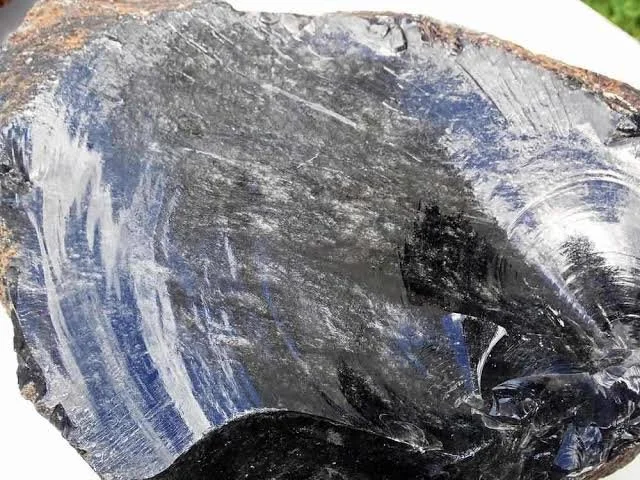
Obsidian forms when silica-rich lava cools rapidly enough that crystals do not have sufficient time to develop extensively. The resulting material is volcanic glass rather than a rock composed of clearly visible mineral grains.
Its appearance can range from glossy black to brown, gray, or other shades, depending on its composition and microscopic inclusions. Obsidian commonly breaks with a curved, shell-like fracture known as conchoidal fracture.
Not every volcanic eruption produces obsidian. Its formation depends on magma chemistry, viscosity, water content, and cooling conditions. The presence of volcanic rocks on an island therefore does not automatically indicate an obsidian deposit.
Milos and the Archaeology of Obsidian
Milos is famous for its historical association with obsidian, which circulated through Aegean exchange networks during prehistoric periods. Archaeological studies of obsidian artifacts have helped researchers investigate trade, mobility, and connections between communities.
By analyzing the chemical characteristics of an artifact and comparing them with known geological sources, scientists can sometimes identify where the raw material originated. This approach helps reconstruct the movement of materials across islands and coastlines.
The archaeological significance of Milos's obsidian is well established in broad terms. That does not mean every proposed deposit, underwater formation, or volcanic feature associated with the island has been documented.
What a Caldera Can Reveal
A caldera is a large volcanic depression that may form when a magma chamber is partly emptied and the ground above it collapses. Later eruptions, erosion, sedimentation, and changes in sea level can alter the original landscape.
Marine geologists studying a suspected underwater volcanic formation would use bathymetric mapping, seismic surveys, rock sampling, and remotely operated vehicles. Laboratory analysis could establish whether a specimen is obsidian, another volcanic glass, or a different type of rock.
The location and geometry of any glassy volcanic material would then need to be interpreted in relation to the island's documented volcanic history.
From Geological Source to Ancient Tool
Obsidian connects geological processes with human innovation. Its sharp edges made it useful for tools, while its recognizable chemical signature allows modern researchers to trace the movement of raw material across ancient networks.
If an additional underwater obsidian occurrence were confirmed near Milos, it could offer new questions about volcanic activity and the island's geological development. Archaeologists would still need separate evidence before connecting that occurrence with prehistoric extraction or trade.
The strongest account of Milos's obsidian is therefore not a story of an assumed secret deposit. It is the documented relationship between volcanic processes, natural glass, and the communities that learned to use it.







