
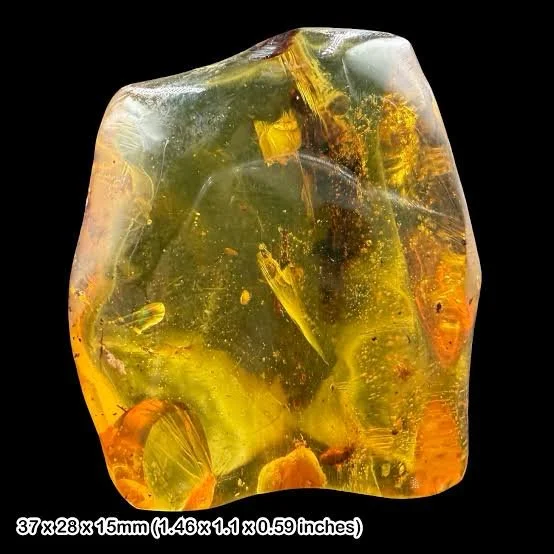
Ancient resin, trapped organisms, and the reconstruction of vanished ecosystems.
A Forest Preserved in Resin
Amber is fossilized tree resin that can preserve a record of ancient biological environments. Small insects, plant fragments, and other materials sometimes become trapped in resin before it hardens and undergoes chemical changes over geological time. When the material survives, it can preserve details that are rarely available from ordinary fossils.
An inclusion in amber may retain the shape of an insect's body, delicate wings, or other structures that would be difficult to preserve in many sedimentary environments. Some specimens provide evidence of ancient species, while others reveal interactions between organisms and the plants that produced the resin.
The title refers to amber inclusions from Miocene forests around the Prespa region, which spans parts of Greece, Albania, and North Macedonia. The Miocene epoch lasted from approximately 23 million to 5.3 million years ago, a period during which climates, vegetation, and animal communities changed significantly.
The specific claim that amber deposits containing inclusions occur in Miocene forests near Prespa requires geological verification. The presence of ancient forest environments in a region does not automatically mean that amber formed there or survived to the present. A credible investigation must establish the existence, age, and provenance of the material.
How Amber Forms
Trees and other plants can produce resin in response to injury or other biological processes. Resin may flow over bark, branches, or nearby surfaces, sometimes trapping insects, pollen, plant fragments, and other material. If the resin is rapidly buried and protected from destructive environmental conditions, it may undergo chemical changes over long periods.
Not all resin becomes amber. Much of it decomposes, weathers away, or remains in a form that has not undergone the changes associated with fossilization. Preservation depends on the original material, burial conditions, temperature, pressure, and the geological history of the deposit.
Amber can occur in sedimentary deposits that contain evidence of ancient forests and the environments in which resin-producing plants grew. Its color and clarity vary, and inclusions may be distributed unevenly within a specimen.
Geologists investigate amber through its physical properties, chemical composition, and relationship to the surrounding sediment. Dating the material often depends on establishing the age of the geological deposit rather than simply examining the amber's appearance.
What Inclusions Reveal About Ancient Life
Amber inclusions can provide an unusually detailed view of organisms that lived millions of years ago. Insects may be preserved in three dimensions, allowing researchers to study body structures and compare them with those of living and extinct species.
Some inclusions can also reveal ecological relationships. A specimen might preserve evidence of an insect interacting with plant material, while multiple inclusions from the same deposit can help reconstruct the diversity of an ancient environment.
However, amber is not a complete record of an ecosystem. Resin traps only certain organisms under particular circumstances, and the material may be transported from its original environment before burial. The organisms preserved within it therefore represent a selective sample rather than a comprehensive inventory of ancient life.
Researchers must also establish whether an inclusion is genuinely fossilized and whether the specimen's provenance is reliable. Commercially circulated amber can sometimes be misidentified or lack sufficient documentation to support detailed geological claims.
Modern imaging techniques can help researchers examine inclusions without damaging the specimen. Microscopy, computed tomography, and other analytical approaches may reveal structures hidden within opaque or irregular pieces of amber.
Reconstructing the Miocene Environment
The Miocene was a period of significant environmental change. Forests, grasslands, wetlands, and other habitats shifted as climate and geography evolved. Fossil plants, pollen, animal remains, and sedimentary deposits help scientists reconstruct these changing environments.
The Prespa region's modern landscape includes lakes, mountains, wetlands, and diverse habitats. Its present-day ecology, however, should not be projected directly onto the Miocene. The geological history of the area must be established through stratigraphy, fossil evidence, and other scientific data.
If a verified amber deposit were found in the region, researchers could investigate the resin-producing plants, the organisms preserved within it, and the conditions under which the material accumulated. These findings could then be compared with other fossil sites to understand regional ecological patterns.
Pollen analysis and plant fossils may provide information about ancient vegetation, while sedimentary geology can clarify the environments in which deposits formed. The combination of these methods allows scientists to reconstruct landscapes that no longer exist.
Ancient DNA and the Limits of Amber
Amber has often been portrayed in popular culture as a source of perfectly preserved ancient DNA. In reality, recovering authentic genetic material from very old inclusions is extremely difficult, and claims of successful recovery require rigorous testing for contamination and other sources of error.
DNA degrades over time, and the conditions required for long-term preservation are complex. Even when an organism is visibly preserved in amber, its genetic material may no longer survive in a usable form.
Other types of evidence can be much more reliable. Physical anatomy, chemical signatures, and microscopic structures can reveal substantial information about extinct organisms without requiring DNA recovery. Researchers can also compare amber inclusions with fossils preserved in other environments.
An article about the unseen amber inclusions of Prespa can therefore explore the scientific value of fossil resin, the reconstruction of Miocene ecosystems, and the limits of ancient biomolecular research. The crucial first step is to verify whether the specific amber deposit described in the title has actually been documented in the region.







