
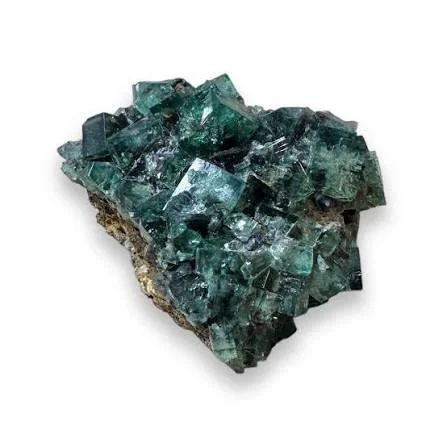
Fluorescent minerals, ultraviolet light, and the geology of Greece's quarry landscapes.
When Ordinary Rocks Begin to Glow
Some minerals display unexpected colors when exposed to ultraviolet light. A specimen that appears ordinary under daylight may produce bright blue, green, violet, or other colors under suitable lighting conditions. This phenomenon, known as fluorescence, has fascinated mineral collectors and researchers because it reveals properties that cannot always be recognized through ordinary visual inspection.
Fluorite is one of the minerals commonly associated with fluorescence, although not every specimen glows and the intensity and color vary according to its composition and internal structure. The mineral itself can occur in a range of colors, including purple, green, blue, yellow, and colorless varieties.
Euboea, also known as Evia, is a large Greek island with varied geology and a history of quarrying and mineral extraction in different areas. Its rock formations provide a setting for investigating how minerals form and how unusual optical properties can help researchers identify them.
The title's reference to hidden fluorite glow stones from Euboea quarries requires confirmation from mineralogical records. The existence of quarries on the island does not establish that a particular fluorite occurrence has been documented there. A reliable article should investigate the geological evidence before presenting such stones as a confirmed discovery.
The Chemistry Behind Fluorescence
Fluorescence occurs when a material absorbs energy and then releases part of that energy as light. In fluorescent minerals, ultraviolet radiation can excite electrons associated with particular chemical components or structural features. As the electrons return to lower-energy states, the mineral emits visible light.
Fluorite is calcium fluoride, but natural specimens can contain small amounts of other elements or structural imperfections that influence their optical behavior. These variations help explain why two specimens of the same mineral may fluoresce differently.
Not all fluorite is fluorescent, and not every glowing mineral is fluorite. Other minerals can also produce fluorescence under ultraviolet illumination, while some specimens may display phosphorescence, in which light emission continues for a period after the excitation source is removed.
Correct identification requires a combination of physical properties and, where necessary, laboratory analysis. Fluorescence is a useful clue, but color under ultraviolet light alone is not enough to establish a mineral's identity.
How Fluorite Forms in Rock
Fluorite commonly forms when mineral-rich fluids move through fractures and cavities in rock. As the chemistry, temperature, or pressure of the fluid changes, calcium and fluoride can combine to produce fluorite crystals. The exact conditions depend on the geological environment.
Fluorite can occur in veins, cavities, and other mineralized settings. It may be associated with different kinds of host rocks and with other minerals deposited from the same fluids. The shape and quality of the crystals depend on the space available for growth and the conditions under which crystallization occurred.
Geologists investigate fluorite deposits by mapping their location, examining surrounding rocks, and identifying associated minerals. Laboratory techniques can establish the composition of specimens and help distinguish fluorite from other materials with similar appearances.
For Euboea, researchers would need to identify a documented occurrence before discussing its geological origin. If no reliable source confirms fluorite at a particular quarry, the article should focus on the mineral's science and the broader geological history of the island rather than inventing a deposit.
Quarry Landscapes and Mineral Discoveries
Quarries expose rock surfaces that may otherwise remain hidden beneath soil and vegetation. They can reveal geological layers, fractures, veins, and mineral relationships that are difficult to observe elsewhere. At the same time, quarrying changes the landscape and can remove or disturb features that were previously intact.
A mineral discovery at a quarry requires careful recording of its location and geological context. Researchers need to establish whether the specimen formed naturally within the rock, whether it belongs to a later fracture or vein, and whether it can be linked to the surrounding mineral assemblage.
Historical records can help establish when quarrying began, which materials were extracted, and whether unusual minerals were ever reported. Museum collections and published mineralogical surveys may also contain specimens from the region, although collection labels and provenance must be evaluated carefully.
An isolated fluorescent crystal is not necessarily evidence of a large or economically important deposit. Mineral occurrences vary in size and continuity, and some are scientifically interesting despite having little commercial value.
Using Ultraviolet Light in Mineral Research
Ultraviolet illumination can help mineralogists examine specimens and distinguish materials with different optical responses. Researchers may record the wavelength of the excitation source, the emitted color, and whether the light persists after the source is switched off.
The response depends on the mineral's composition and structure, so observations should be made under controlled conditions when scientific comparisons are intended. Photographs can be useful, but camera settings and lighting can influence the appearance of the resulting image.
Fluorescence can also help identify particular mineral associations within a specimen. However, it does not replace more definitive methods such as diffraction or chemical analysis when accurate mineral identification is required.
An article about glowing stones from Euboea can use this science to explain why minerals sometimes seem to possess hidden colors. The strongest investigation would combine the optical properties of fluorite with verified geological information about the island's quarries, making clear whether the specific occurrence in the title has been documented.







