Investigating the mysterious Dragon Houses of Euboea and the legends surrounding their enormous stone walls.
The Stone Buildings of Southern Euboea
In the mountains of southern Euboea, Greece, stand unusual stone structures known as Drakospita, commonly translated as Dragon Houses. Their name immediately invites supernatural interpretations, but the buildings themselves are real architectural features that have attracted archaeological and historical interest.
The structures are generally associated with large blocks of locally available stone arranged into substantial walls and roofs. Their construction can appear strikingly different from that of ordinary domestic buildings, particularly where massive slabs form corbelled roofs. The buildings' locations and architectural characteristics have encouraged questions about their original purposes and the communities that constructed them.
The word drakos is associated with dragons or powerful monstrous beings in Greek tradition, but a building's traditional name does not necessarily reveal its original function. Place names and folk names can emerge long after a structure was built, reflecting the impressions it made on later generations rather than the intentions of its builders.
This distinction creates a compelling starting point for an archaeological investigation. What can be established about the Dragon Houses through their architecture, location, dating, and archaeological context? Which interpretations remain uncertain, and how might folklore have influenced the way people understood them?
Architecture That Encourages Questions
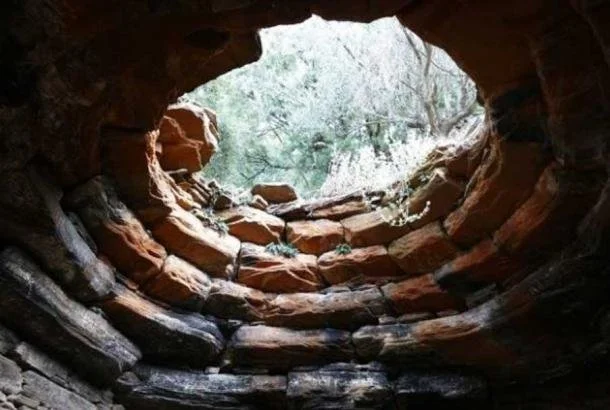
The Dragon Houses are notable for their substantial dry-stone construction, in which stones are fitted together without the conventional use of mortar in the manner associated with many later buildings. Some structures feature carefully arranged slabs that project inward from successive courses, producing a corbelled roof.
Corbelling is an established architectural technique found in different parts of the world. It allows builders to create roofed spaces by gradually bringing courses of stone closer together until the opening can be covered. Although the method may appear mysterious to modern observers, it reflects practical knowledge of stone weight, balance, and structural stability.
The size of the stones also raises questions about transportation and labor. Builders needed to identify suitable materials, extract or gather them, move them to the construction site, and position them accurately. The work required knowledge of the local geology and a coordinated understanding of the intended structure.
Archaeologists can investigate these buildings by measuring their dimensions, recording construction techniques, studying tool marks where present, and comparing their features with other regional structures. The surrounding landscape can provide additional clues, including paths, water sources, agricultural areas, and evidence of other human activity.
Such observations help establish the buildings' place within the wider history of the region. They do not, by themselves, establish that the structures concealed underground chambers or served as dragon lairs.
Why Were They Called Dragon Houses?
The traditional name of the Drakospita is one of their most intriguing characteristics. In Greek folklore, dragons and dragon-like beings have not always corresponded to the winged creatures familiar from modern fantasy. The word drakos can refer to formidable supernatural beings whose characteristics vary across stories and historical periods.
A place associated with such a being may acquire a name reflecting its unusual appearance, imposing size, or mysterious purpose. In the absence of a surviving explanation from the builders, later communities may interpret an unfamiliar structure through the language of folklore.
This process is common in the history of monuments. Ancient ruins have often been attributed to giants, legendary kings, supernatural beings, or civilizations imagined to possess extraordinary abilities. Such explanations can preserve cultural memories of places whose original functions have been forgotten.
The Dragon Houses should therefore be examined through both archaeological evidence and the history of their names. Researchers can ask when the term first appears in written sources, how local communities used it, and whether historical accounts provide clues about the development of the associated legends.
The name itself is evidence of cultural interpretation, but it is not proof of a supernatural origin.
Searching for Evidence Beneath the Stones
The idea of underground dragon lairs provides an atmospheric premise, but any claim about hidden chambers must be supported by evidence. A large stone building may contain cavities, foundation spaces, or natural geological features without having been deliberately constructed as an underground complex.
Modern archaeological methods can help investigate subsurface structures without immediately disturbing the site. Ground-penetrating radar may identify certain buried features, while electrical resistivity and other geophysical methods can reveal differences in the materials below the surface. The suitability of each technique depends on local geology, soil conditions, and the nature of the suspected feature.
Remote sensing and detailed topographic mapping can also help researchers understand how a structure relates to surrounding terrain. In some cases, a building's position may reflect access to resources, visibility, defensibility, or practical requirements associated with its use.
Any possible underground feature would require interpretation in context. A cavity might be a natural fissure, a later disturbance, or a deliberate architectural element. Archaeological excavation, where justified and permitted, can help establish its age and function.
Without such evidence, it would be misleading to describe a subterranean dragon lair as an established discovery. The more productive investigation is to ask why the buildings inspired extraordinary stories and what their actual construction reveals about the people who made them.
The Builders and Their World
The precise interpretation of individual Dragon Houses has been debated, and the buildings should not be assigned a single purpose without examining the evidence for each site. Their possible functions have been discussed in relation to habitation, storage, religious activity, and other uses, but interpretations depend on architectural details, dating, and associated archaeological finds.
Dating stone buildings can be difficult when they contain limited diagnostic material. Archaeologists may need to compare construction techniques, examine associated ceramics or other objects, and investigate the wider settlement landscape. A structure's appearance alone rarely provides a sufficiently precise date.
The surrounding region also matters. Southern Euboea has a long history of settlement and resource use, and the relationship between mountain buildings and nearby landscapes can offer clues about their role in local life. Researchers can examine routes connecting the sites to settlements, agricultural land, quarries, and other places of activity.
Architectural study can reveal practical knowledge that is easy to overlook when attention focuses entirely on the name. The buildings demonstrate the ability to work with large stones and adapt construction methods to local materials. Their preservation also provides opportunities to investigate how traditional masonry responds to weather, erosion, and changing environmental conditions.
Archaeology, Folklore, and Modern Technology
The Dragon Houses illustrate why archaeological sites benefit from several complementary approaches. Architectural analysis can explain how the buildings were constructed, geological research can identify their materials, and historical study can trace the development of their names. Folklore research can then investigate how communities interpreted the structures and incorporated them into local storytelling.
Three-dimensional recording can preserve detailed models of the buildings, allowing researchers to examine roof construction, wall geometry, and structural relationships. Photogrammetry, laser scanning, and digital mapping can support conservation work and help document features that may deteriorate over time.
These technologies may also improve comparisons between structures. Researchers can measure similarities and differences without relying entirely on photographs or written descriptions. Digital models can support hypotheses about construction sequences, although a model cannot establish an original function without independent archaeological evidence.
The folklore surrounding the Drakospita remains important even when supernatural explanations cannot be verified. It shows how architecture can influence cultural imagination and how an unfamiliar building may acquire a powerful identity through its appearance and location.
An article centered on the Dragon Houses can therefore investigate a genuine archaeological puzzle while exploring the origins of the dragon association. The underground lair can serve as the question that draws readers in, while the actual evidence about architecture, landscape, and historical memory provides the substance of the story.