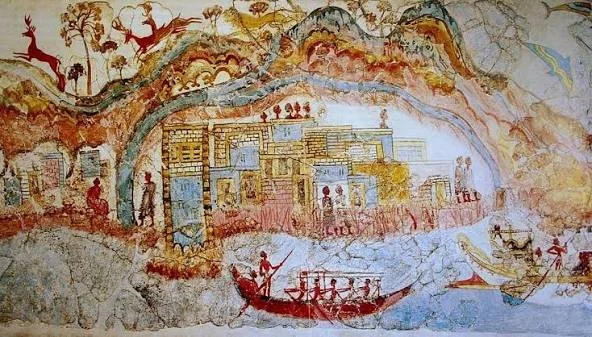
The impact of Ancient Greek mathematics on modern science is not merely historical—it is foundational. The Greeks were the first to move mathematics away from purely practical "counting" (used by the Babylonians and Egyptians for trade and land surveying) and toward a system of abstract reasoning and logical proof.
This shift created the very language that modern physics, engineering, and computer science speak today.
1. The Birth of the Axiomatic Method
Before the Greeks, math was a collection of "recipes" that worked. Euclid changed this by introducing the Axiomatic Method in his work, The Elements.
Logical Deductions: Euclid started with a few "self-evident truths" (axioms) and used them to derive complex theorems. This established the standard for scientific rigor: a theory is only as strong as the logic used to prove it.
The Foundation of Physics: Isaac Newton’s Principia Mathematica was modeled directly after Euclid’s structure. Newton knew that to explain the universe, he had to build his laws of motion on an unbreakable logical scaffold.
2. Pythagoreanism: The Mathematical Universe
Pythagoras and his followers were the first to propose the radical idea that "all is number." They believed that the physical world was governed by mathematical laws.
Harmony and Frequency: By discovering that musical intervals could be expressed as ratios of whole numbers, the Pythagoreans proved that something as subjective as "beauty" had a mathematical basis.
Modern Application: This is the direct ancestor of String Theory and Quantum Mechanics, which posit that the fundamental building blocks of reality are mathematical vibrations and frequencies.
3. Archimedes and the Seeds of Calculus
While Archimedes is famous for his "Eureka" moment in the bathtub, his greatest contribution to science was the Method of Exhaustion.
Approximating the Infinite: To calculate the area of a circle or the volume of a sphere, Archimedes inscribed polygons with an increasing number of sides to "exhaust" the area. This was the first time a mathematician used a precursor to the limit, which is the core concept of Calculus.
Engineering and Fluid Dynamics: His work on buoyancy and levers allowed modern engineers to calculate how ships float and how much weight a bridge can support.
4. Conic Sections: From Apollonius to NASA
Apollonius of Perga spent his life studying Conic Sections—the curves formed by intersecting a cone with a plane (the ellipse, the parabola, and the hyperbola). At the time, this was seen as "pure" math with no practical use.
The Planetary Key: 1,800 years later, Johannes Kepler used Apollonius’s geometry to prove that planets move in elliptical orbits, not perfect circles.
Space Travel: Today, NASA uses these same Greek geometric principles to calculate the "slingshot" trajectories of satellites and the parabolic curves needed for telescopes and satellite dishes.
5. Eratosthenes and Geodesy
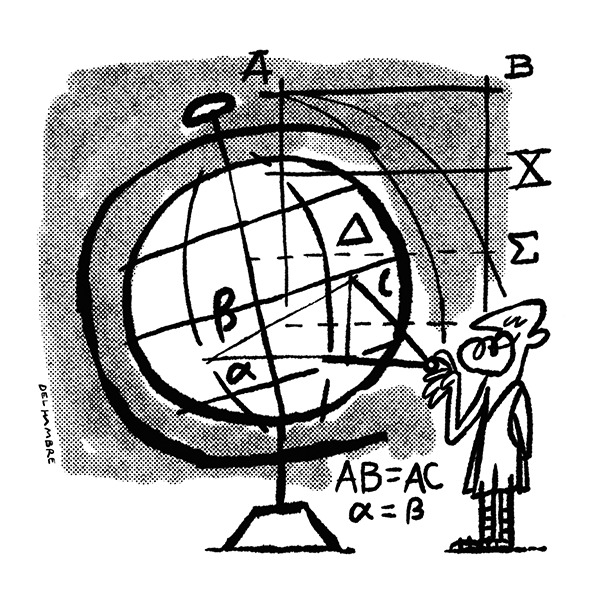
The Greeks used simple geometry to perform the first "big science" experiments. Eratosthenes calculated the circumference of the Earth with incredible accuracy using nothing but a stick, the sun, and the alternate interior angle theorem.
The Power of Geometry: By measuring the shadows cast in two different cities at the same time, he proved that the Earth was a sphere and determined its size within a few percentage points of the modern value.
Modern Cartography: This established the field of Geodesy, which is essential today for GPS technology and satellite mapping.
6. Aristotelian Logic and Computing
While we think of Aristotle as a philosopher, his development of Formal Logic (syllogisms) is the direct ancestor of the Boolean Logic that runs every computer on Earth.
The Binary Connection: Aristotle’s law of the "Excluded Middle" (something is either A or not A) is the philosophical basis for the binary system (1s and 0s). Without the Greek obsession with categorizing and defining logical "if/then" statements, modern computer programming would not exist.
The Legacy of Reason
Greek mathematics didn't just give us formulas; it gave us the conviction that the universe is intelligible. It taught us that if we apply logic to observation, we can uncover the hidden laws of nature. From the curve of a baseball to the orbit of a black hole, we are still using the tools forged in the 3rd century BCE.