An Exception to Centaur Nature
In Greek mythology, centaurs were generally portrayed as untamed, impulsive, and hedonistic creatures that embodied humanity's uncontrolled instincts. Possessing the upper body of a human and the lower body of a horse, they were often associated with drunkenness, violence, and reckless behavior. Most centaurs were believed to be descendants of Ixion, the first mortal guilty of murdering a family member, and Nephele, a cloud created by Zeus in the likeness of Hera. Because of this lineage, they were commonly depicted as savage beings who frequently clashed with both humans and gods. Among this race, however, Chiron stood apart as a remarkable exception. Unlike the other centaurs, Chiron was the son of the Titan Cronus and the sea nymph Philyra, giving him a noble and divine heritage. His immortal Titan lineage distinguished him from his wild relatives and endowed him with exceptional wisdom, compassion, and self-control.
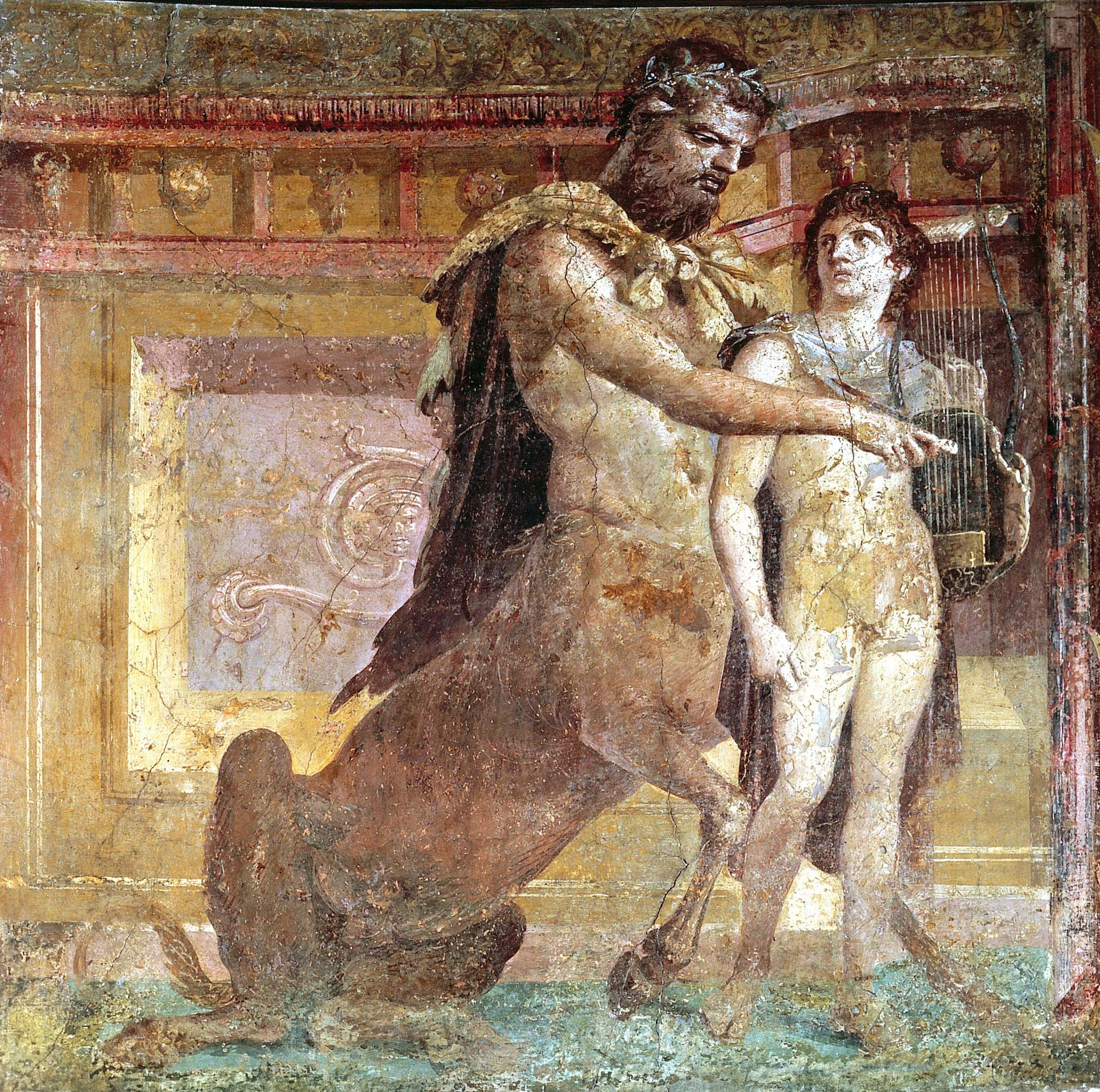
Rather than living according to instinct and violence, Chiron devoted his life to the pursuit of knowledge. He resided peacefully in a cave on Mount Pelion, where he became renowned as a scholar, physician, musician, hunter, and strategist. His cave functioned as both a sanctuary and a school, attracting many of Greece's greatest heroes, who were entrusted to him for education and guidance. Chiron mastered numerous disciplines, including medicine, botany, astronomy, music, ethics, hunting, and military strategy. His reputation for wisdom and fairness earned him the respect of gods and mortals alike, making him one of the most admired figures in Greek mythology.
Because of his extraordinary knowledge, Chiron became known as the universal mentor, serving as the foster father and teacher of many legendary heroes. Among his most famous students was Achilles, whom Chiron instructed in martial arts, survival skills, music, medicine, and moral discipline, helping shape him into one of the greatest warriors of the Trojan War. Chiron also educated Asclepius, teaching him the secrets of herbs, botany, surgery, and the healing arts. Under Chiron's guidance, Asclepius became such a skilled physician that he was eventually worshipped as the Greek god of medicine. Other notable pupils included Jason, leader of the Argonauts, and Heracles, whom Chiron trained in hunting, diplomacy, philosophy, and practical survival. Through these teachings, Chiron influenced an entire generation of Greek heroes, demonstrating that wisdom and education were just as valuable as physical strength.
Despite his peaceful nature, Chiron's life ended in tragedy. During one of Heracles' encounters with a group of wild centaurs, a violent battle erupted. Heracles fought using arrows coated with the deadly venom of the Lernaean Hydra, one of the most poisonous substances in Greek mythology. Amid the confusion, one of these arrows accidentally struck Chiron in the knee. Although the wound would have been instantly fatal to any ordinary being, Chiron's divine ancestry made him immortal. As a result, he could not die, yet the Hydra's poison caused him unbearable and unending agony. Unable to heal the wound or escape the pain through death, Chiron endured continuous suffering despite all of his unmatched medical knowledge.
Eventually, Chiron sought a way to end his torment. According to the myth, he reached an agreement with Zeus, willingly surrendering his immortality so that he could finally find peace. His divine life force was transferred to Prometheus, the Titan who had been eternally punished for giving fire to humanity. By sacrificing his own immortality, Chiron not only freed himself from endless suffering but also secured Prometheus' release, making his final act one of extraordinary compassion and selflessness. In recognition of Chiron's wisdom, generosity, and lifelong service to heroes and humanity, Zeus honored him by placing him among the stars as the constellation Centaurus—and in some traditions, Sagittarius.
The story of Chiron stands in sharp contrast to the typical portrayal of centaurs in Greek mythology. While most centaurs symbolized uncontrolled passion and violence, Chiron represented the ideals of wisdom, education, healing, and noble sacrifice. His life—from his divine birth as the son of Cronus and Philyra, through his role as master of medicine, music, hunting, and philosophy, his mentorship of legendary heroes such as Achilles, Heracles, Jason, and Asclepius, his accidental poisoning by a Hydra-tipped arrow, and finally his selfless decision to exchange his immortality to free Prometheus—made him one of the most respected and inspiring figures in the entire Greek mythological tradition.