The Fated Firebrand
The myth of Meleager, prince of Calydon, is one of the most tragic stories in Greek mythology, illustrating the themes of fate, family loyalty, divine punishment, and the inescapability of destiny. According to the legend, shortly after Meleager's birth, the Three Fates (Moirai)—Clotho, Lachesis, and Atropos—appeared before his mother, Althaea. As they observed the newborn child, they pointed to a piece of wood burning in the household hearth and declared that Meleager's life would endure only as long as that firebrand remained unburned. Once the log was completely consumed by fire, the young prince's life would come to an end. Horrified by this prophecy, Althaea immediately snatched the burning log from the flames, extinguished it before it could burn away, and carefully hid it inside a secure chest. Believing that the preserved firebrand protected her son's life, she guarded it in secret for many years, hoping to prevent the prophecy from ever being fulfilled.
As Meleager grew into adulthood, he became one of the greatest warriors and heroes of his generation. His courage and leadership were soon tested when his father, King Oeneus of Calydon, accidentally offended the goddess Artemis. During the annual harvest festival, Oeneus offered sacrifices to all the Olympian gods but neglected to honor Artemis. Furious at this insult, the goddess punished the kingdom by sending a gigantic and savage Calydonian Boar to devastate the countryside. The monstrous beast destroyed crops, uprooted vineyards, trampled fields, killed livestock, and attacked anyone who attempted to stop it, plunging Calydon into fear and chaos.
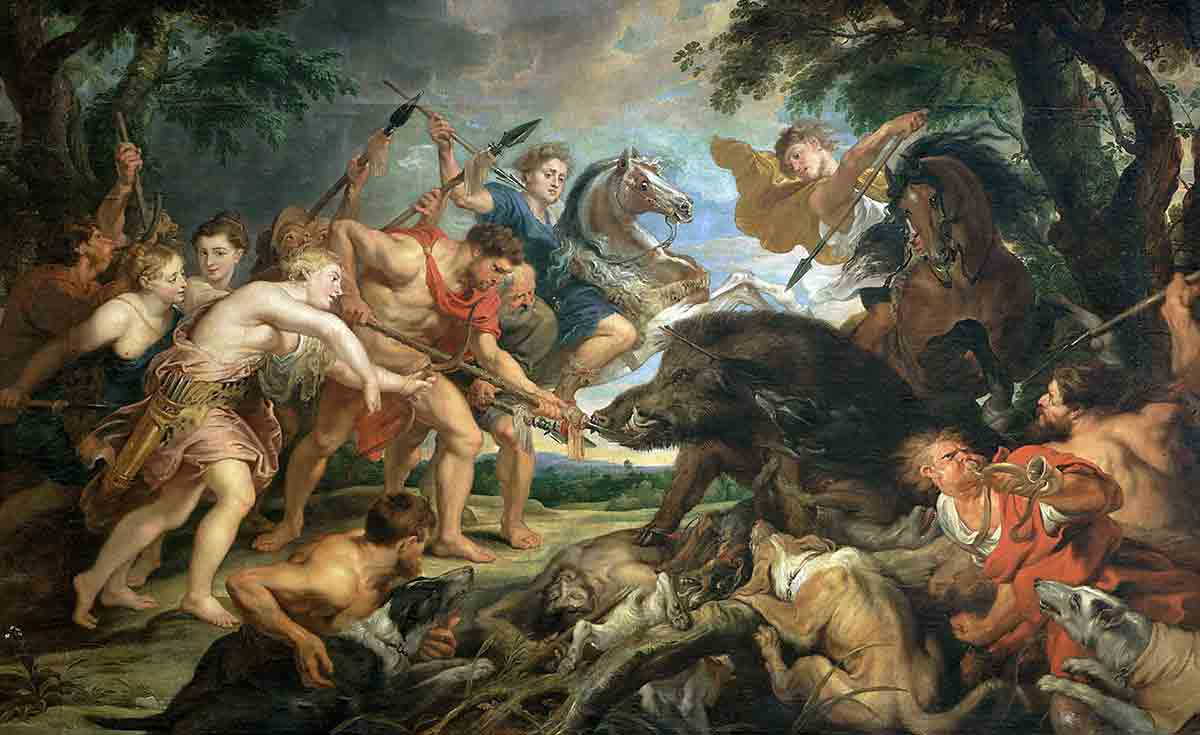
To defeat the terrifying creature, Meleager organized one of the greatest hunting expeditions in Greek mythology, known as the Calydonian Boar Hunt. He gathered many of the most celebrated heroes of Greece, including Theseus, Jason, Telamon, and numerous other legendary warriors. Among them was the renowned huntress Atalanta, whose exceptional skill with the bow made her one of the few women recognized as an equal among Greece's greatest heroes. Although some hunters objected to her participation because she was a woman, Meleager welcomed her, admiring both her courage and extraordinary abilities.
During the hunt, Atalanta achieved the first significant success by striking the monstrous boar with an arrow, becoming the first person to wound the beast. Inspired by her bravery, Meleager confronted the wounded animal and ultimately delivered the fatal spear thrust that killed it. According to Greek custom, the hunter who first wounded the animal deserved recognition, and because Meleager deeply respected—and in many versions of the myth, loved—Atalanta, he awarded her the boar's magnificent hide and tusks as the prize of victory. His decision honored both her skill and her courage, recognizing that she had played a crucial role in the successful hunt.
However, Meleager's choice enraged his maternal uncles, who believed that such an honorable reward should never be given to a woman. Viewing the prize as an insult to their status and masculinity, they attempted to seize the hide from Atalanta by force. A fierce argument erupted, and in a burst of anger, Meleager drew his sword to defend Atalanta's honor. The confrontation escalated into violence, ending with Meleager killing his own uncles. Although he had acted out of loyalty and a sense of justice, his actions shattered his family and brought terrible consequences.
When news reached Althaea that Meleager had killed her brothers, she was overwhelmed by unbearable grief and torn between her love as a mother and her loyalty as a sister. Consumed by sorrow, anger, and a desire for vengeance, she remembered the hidden firebrand upon which her son's life depended. Retrieving the preserved log from the chest where it had remained hidden since Meleager's birth, she threw it back into the flames. As the fire gradually consumed the wood, the prophecy of the Fates unfolded exactly as foretold. At the very moment the firebrand turned to ashes, Meleager was struck by intense internal agony, as though consumed by fire from within. Unable to resist the power of fate, he collapsed and died, fulfilling the prophecy spoken on the day he was born.
The story of Meleager demonstrates one of the central beliefs of Greek mythology: no mortal can escape fate, even when every effort is made to avoid it. Despite Althaea's attempt to preserve her son's life by hiding the firebrand, destiny ultimately prevailed. The myth also explores the devastating consequences of anger, revenge, and divided loyalties, showing how personal emotions can destroy even the strongest family bonds. Through the sequence of the Fates' prophecy, Althaea's preservation of the firebrand, Meleager's heroism in the Calydonian Boar Hunt, his killing of his uncles in defense of Atalanta, and the burning of the log that ended his life, the legend remains one of the most poignant examples of the tragic power of fate in ancient Greek mythology.