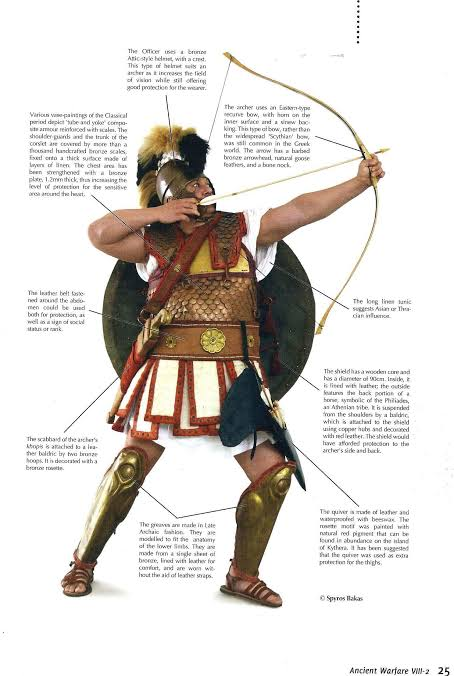
Social Stigma vs. Tactical Reality
In the Archaic and early Classical periods, archers (toxotai) were often viewed with aristocratic disdain compared to heavy armored hoplites. Homeric epic frequently framed archery as an unmanly form of combat that avoided face-to-face clash. However, pragmatic tactical military developments quickly forced Greek poleis to integrate missile troops into their armies.
Specialized Archery Corps
Scythian Archers at Athens: In 5th-century BCE Athens, state-owned Scythian public slaves acted as a standing police force and city guards, equipped with powerful composite recurve bows.
Cretan Archers: Renowned throughout the Mediterranean, Cretan mercenaries were elite marksmen who wielded heavy wooden longbows capable of firing bronze-headed arrows with lethal force and long range.
Combined Arms Operations: During the Peloponnesian War (notably at the Battle of Sphacteria in 425 BCE), light-armed archers and peltasts demonstrated that they could harass, slow, and dismantle unsupported hoplite phalanxes from afar.