The Heritage of Heracles
Philoctetes was one of the greatest archers in Greek mythology and is best remembered as the heir to the legendary bow and poisoned arrows of Heracles, weapons that ultimately played a decisive role in the fall of Troy. According to the myth, Philoctetes earned these priceless weapons through an extraordinary act of courage and loyalty. When Heracles was suffering unbearable pain from the poisoned robe given to him by Deianira, he ordered a funeral pyre to be built on Mount Oeta so that he could end his mortal life. Although many heroes were present, none were willing to ignite the pyre because they feared offending the mighty son of Zeus. Only Philoctetes had the courage to perform the difficult task. In gratitude for this act of compassion, Heracles presented him with his unmatched bow and a supply of arrows tipped with the deadly venom of the Lernaean Hydra before ascending to Olympus as an immortal god. These divine weapons possessed extraordinary power, making Philoctetes one of the most formidable archers in Greece.
When the Greek forces gathered to sail against Troy, Philoctetes joined the expedition carrying the sacred weapons of Heracles. During the voyage, however, the fleet stopped at the island of Chryse to perform religious rites. While entering a sacred sanctuary, Philoctetes was bitten on the foot by a venomous viper. The snakebite became severely infected, producing unbearable pain, a foul-smelling wound, and constant cries of agony. His suffering was so intense that he could scarcely walk, while the unpleasant odor from the infected wound disturbed the soldiers and disrupted their sacrifices to the gods. Seeing him as a burden to the expedition, Odysseus persuaded the Greek commanders that the mission could not continue with Philoctetes aboard.
As a result, the Greeks made a cruel decision. While Philoctetes slept, they abandoned him alone on the deserted island of Lemnos, leaving him with only his bow, arrows, and a few supplies. Betrayed by the very comrades he had joined in battle, Philoctetes awoke to discover that the fleet had departed without him. For the next ten years, he survived in complete isolation, living inside a cave and relying on the bow of Heracles to hunt birds and wild animals for food. Despite his remarkable resilience, he endured constant physical suffering from his unhealed wound while becoming consumed by loneliness, bitterness, and anger toward the Greek leaders—especially Odysseus, whom he blamed for his abandonment.
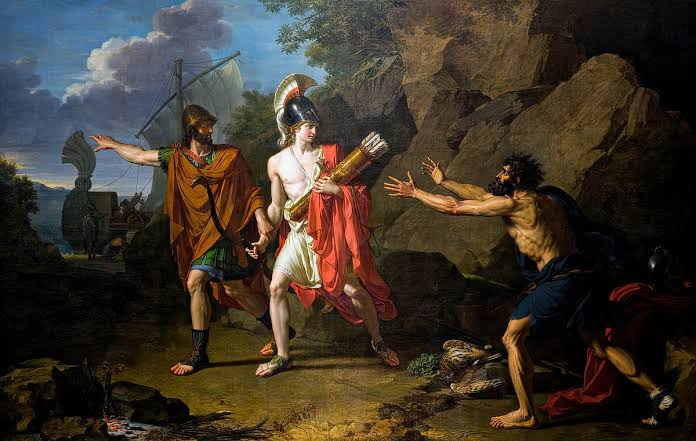
Meanwhile, the Trojan War continued without decisive victory. In the tenth year of the conflict, the Greeks captured a Trojan seer who revealed a crucial prophecy: the city of Troy could never be conquered unless the bow and arrows of Heracles were brought to the battlefield. Realizing that they had abandoned the very man whose weapons were essential to their success, the Greek leaders had no choice but to seek Philoctetes once again. Odysseus, accompanied by Neoptolemus, the son of Achilles, sailed to Lemnos to persuade him to return.
When they arrived, Philoctetes was filled with rage and resentment. After a decade of suffering and betrayal, he initially refused to help the Greeks and, in some versions of the myth, even attempted to kill Odysseus in revenge for abandoning him. However, before violence could erupt, the deified spirit of Heracles appeared in a vision. Heracles reminded Philoctetes that his destiny was greater than his personal grievances and instructed him to journey to Troy, where he would achieve everlasting glory and fulfill the prophecy ordained by the gods. Respecting the command of his former benefactor, Philoctetes finally agreed to return to the Greek army.
Upon arriving at Troy, the renowned physician Machaon, son of Asclepius, successfully treated Philoctetes' infected foot, finally relieving him of the agony he had endured for ten years. Restored to health, Philoctetes entered the battlefield carrying Heracles' divine bow. During the fighting, he fulfilled the prophecy by shooting Paris, the Trojan prince whose abduction of Helen had sparked the war, with one of Heracles' poisoned arrows. Mortally wounded by the Hydra venom, Paris died soon afterward, removing one of Troy's greatest defenders and paving the way for the city's eventual destruction. The death of Paris marked a decisive turning point in the conflict and ultimately contributed to the Greeks' victory through the later stratagem of the Trojan Horse.
The story of Philoctetes is one of endurance, betrayal, forgiveness, and destiny. His journey—from inheriting the bow of Heracles, suffering a snakebite that led to his abandonment on Lemnos for ten years, being rediscovered after a prophecy declared that Troy could not fall without Heracles' bow, and finally returning with Odysseus and Neoptolemus to fulfill his fate by killing Paris—illustrates the Greek belief that even those who endure great suffering may ultimately achieve honor and fulfill a destiny that cannot be avoided.